If you have ever tried to “do SEO” for your business, you have probably realized one thing fast: it’s not just one thing.
Most business owners think SEO (Search Engine Optimization) is just sprinkling a few keywords into a blog post. But if that were true, everyone would be ranking #1. The truth is, SEO is a complex ecosystem. It’s like building a house you need a solid foundation (Technical), a beautiful interior (On-Page), a good reputation in the neighborhood (Off-Page), and a clear address so people can find you (Local).
At Kharb Media, our senior strategists with over 15+ years of combined experience have seen the landscape shift dramatically. What worked in 2015 doesn’t work today. In 2026, Google’s AI-driven algorithms (like the recent core updates) don’t just look for keywords; they look for Intent, Authority, and User Experience.
In this comprehensive guide, we are going to demystify the 4 Types of SEO that actually matter. We will also cover the different “techniques” (White Hat vs. Black Hat) and keyword types you need to know to dominate your market.
Pro Tip: Don’t have time to read 3,000 words? Get Your Free SEO Audit Here and let our team identify your biggest growth opportunities for you.
Table of Contents
Part 1: The 4 Core Pillars of SEO
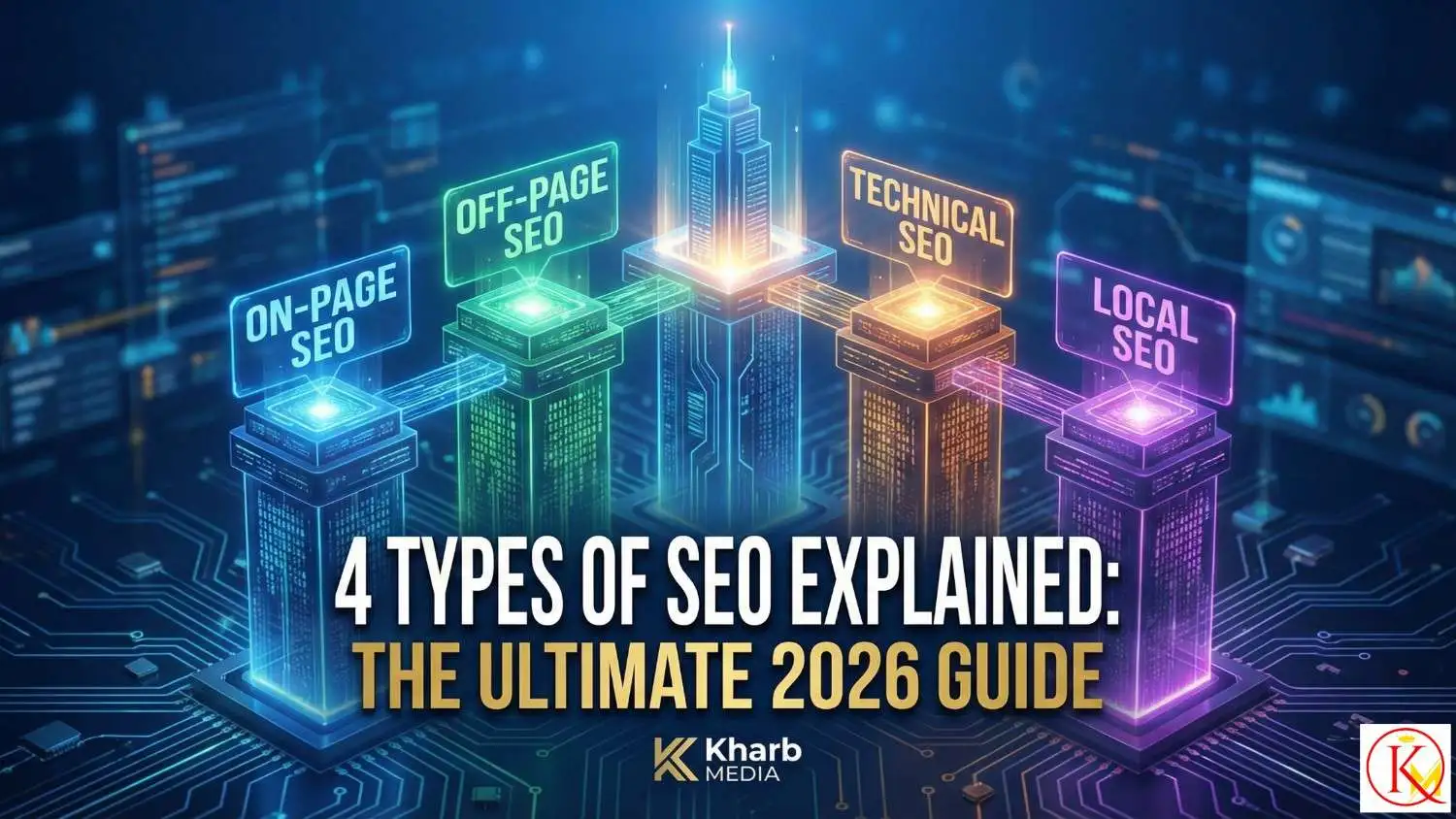
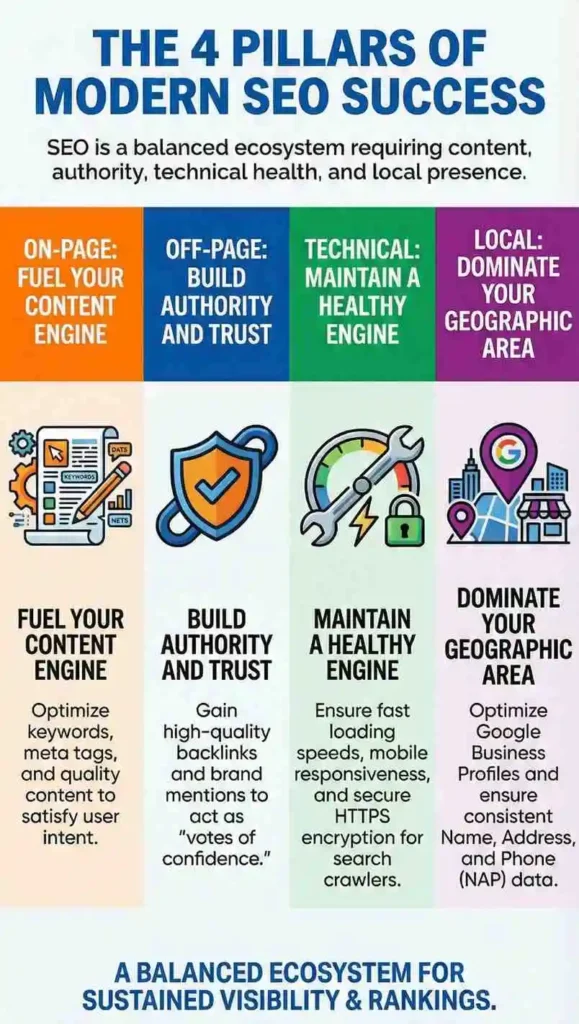
When experts talk about the “types of SEO,” they are usually referring to these four main pillars. You cannot ignore one and expect to succeed with the others.
1. On-Page SEO (The “Content” Pillar)
On-Page SEO refers to everything you do on your own website to help search engines understand your content. It is the pillar you have 100% control over.
Think of On-Page SEO as the “fuel” for your website’s engine. Without high-quality fuel, the car won’t run, no matter how good the engine is.
Key Elements of On-Page SEO:
- Keyword Optimization: Placing the right keywords (like “4 types of seo”) naturally in your H1 tags, opening paragraphs, and headers.
- Content Quality: Creating “Skyscraper” content (like this guide!) that solves user problems better than anyone else.
- Meta Tags: Writing compelling Title Tags and Meta Descriptions to improve Click-Through Rates (CTR).
- Internal Linking: Linking your pages together so Google can crawl them easily.
- Image Optimization: Using descriptive file names and Alt Text so Google understands your visuals.
Kharb Media Insight: In 2026, User Intent is king. It’s not enough to just use a keyword. You must answer the question behind the keyword. If someone searches “coffee calories,” they want a number, not a history of coffee beans.
2. Off-Page SEO (The “Authority” Pillar)
Off-Page SEO involves actions taken outside of your website to impact your rankings. It basically tells Google, “Hey, other people trust this website, so you should too.”
The biggest factor here is Backlinks (links from other sites to yours).
Key Elements of Off-Page SEO:
- Link Building: Getting high-authority sites to link to your content. This acts as a “vote of confidence”.
- Social Media Marketing: While social shares aren’t a direct ranking factor, they drive traffic and visibility, which leads to more links.
- Brand Mentions: Even unlinked mentions of your brand on news sites or forums help build authority.
- Guest Blogging: Writing for other industry blogs to gain exposure and backlinks.
3. Technical SEO (The “Engine” Pillar)
If your website is a car, Technical SEO is the engine under the hood. It ensures your site is healthy, fast, and easy for Google’s robots to “crawl” (read).
You can have the best content in the world, but if your site takes 10 seconds to load, you will not rank.
Key Elements of Technical SEO:
- Site Speed: Google explicitly uses page speed as a ranking factor. Use tools like Google PageSpeed Insights to check yours.
- Mobile-Friendliness: In 2026, most searches happen on mobile. Your site must be responsive.
- Sitemaps & Robots.txt: These files give Google a map of your website so it doesn’t get lost.
- Secure HTTPS: Ensuring your site uses SSL (the little lock icon) is non-negotiable for security and trust.
4. Local SEO (The “Location” Pillar)
Local SEO is designed for businesses that want to be found by people in a specific geographic area (e.g., “Digital Marketing Agency in Haryana”).
Key Elements of Local SEO:
- Google Business Profile (GBP): optimizing your profile with photos, hours, and accurate info.
- NAP Consistency: Ensuring your Name, Address, and Phone number are identical across the web.
- Reviews: Encouraging happy customers to leave 5-star reviews.
- Local Keywords: Targeting terms like “near me” or “in [City Name]”.
Part 2: The 4 SEO Techniques (The “Hat” Strategies)
Beyond the pillars, there are different philosophies or techniques used to execute SEO. These are often categorized by “hat colors,” referencing old cowboy movies where the good guys wore white and the bad guys wore black.
1. White Hat SEO (The Safe Way)
This is the “good guy” approach. White Hat SEO strictly follows Google’s guidelines. It focuses on human audiences first and search engines second.
- Tactics: Creating high-quality content, fast site speed, honest keyword use.
- Risk: Zero. This is the only sustainable long-term strategy.
- Result: Slower growth, but lasting results.
2. Black Hat SEO (The Dangerous Way)
Black Hat SEO tries to “trick” or exploit Google’s algorithms for quick wins.
- Tactics: Keyword stuffing, buying spammy links, cloaking (showing different content to Google than to users), and hidden text.
- Risk: Extremely High. Google will catch you and can ban your site entirely.
- Result: Fast initial spikes, followed by a permanent crash. Avoid this at all costs.
3. Gray Hat SEO (The Middle Ground)
As the name suggests, this falls in the gray area. These tactics aren’t explicitly banned, but they are ethically questionable and risky.
- Tactics: Clickbait articles, spun content (using AI to rewrite articles slightly), and link exchanges.
- Risk: Moderate. Google changes its rules often; what is “Gray” today might become “Black” tomorrow.
4. Negative SEO (The Attack)
This is a malicious practice where competitors try to sabotage your rankings. They don’t optimize their site; they attack yours.
- Tactics: Building millions of spammy links to your site, hacking your content, or posting fake negative reviews.
- Defense: You must constantly monitor your backlink profile (using tools like SEMrush or Ahrefs) and disavow toxic links immediately.
Part 3: The 4 Types of Keywords (Understanding Intent)
To master Content SEO, you must understand why a user is searching. This is called “Search Intent.” There are four main types of keywords:
| Keyword Type | Intent | Example | Best Content Format |
| 1. Informational | User wants to learn something. | “How many calories in coffee?” | Blog posts, Guides, FAQs |
| 2. Navigational | User wants to find a specific site. | “Kharb Media login” or “YouTube” | Homepage, Login Page |
| 3. Commercial | User is researching before buying. | “Best SEO agency in India” or “iPhone vs Samsung” | Comparison Guides, Reviews, Listicles |
| 4. Transactional | User is ready to buy NOW. | “Buy SEO audit services” or “Nike shoes sale” | Product Pages, Landing Pages |
Strategy Note: Most businesses make the mistake of only targeting Transactional keywords. But at Kharb Media, we build “Full Funnel” strategies that capture users at the Informational stage and nurture them until they are ready to buy.
Bonus: SEO Trends You Can’t Ignore in 2026
To truly outperform your competitors, you need to look beyond the basics. Our team is currently implementing these advanced strategies for our B2B and B2C clients:
1. Voice Search SEO
With the rise of Siri, Alexa, and Google Assistant, voice search is exploding. People don’t speak the way they type.
- Typed: “SEO trends 2026”
- Spoken: “Hey Google, what are the most important SEO trends for small businesses this year?”
- Optimization: You must optimize for conversational keywords and questions (Who, What, Where, When, How).
2. E-Commerce SEO
For online stores, standard SEO isn’t enough. You need E-Commerce SEO, which focuses on optimizing product pages, category structures, and Schema Markup (code that shows price/stars in search results).
3. Mobile-First Indexing
Google now predominantly uses the mobile version of the content for indexing and ranking. If your desktop site is perfect but your mobile site is messy, your rankings will tank. Mobile SEO is no longer optional; it is mandatory.
How Kharb Media Integrates All 4 Types for Maximum ROI
You can’t just pick one type of SEO. They are all interconnected.
- Technical SEO builds the engine.
- On-Page SEO drives the car.
- Off-Page SEO gives you the reputation to win the race.
- Local SEO ensures you’re racing on the right track.
At Kharb Media, we don’t offer cookie-cutter packages. We analyze your specific business needs. If you are a local clinic, we double down on Local SEO. If you are a national SaaS company, we focus on Technical and On-Page Content clusters.
Ready to stop guessing and start growing?
Our team is ready to help you build a custom strategy that dominates 2026.
Claim Your Free Digital Growth Strategy Strategy WhatsApp: Chat with an Expert Now
Contact Us Today:
- Phone: +91 97287 85818
- Email: kharbmedia@gmail.com
Frequently Asked Questions (People Also Ask)
What are the 4 types of SEO?
The four main pillars are On-Page SEO, Off-Page SEO, Technical SEO, and Local SEO.
Which type of SEO is most important?
It depends on your business, but Technical SEO is the prerequisite. If your site doesn’t work, nothing else matters. However, On-Page SEO (Content) is usually the biggest driver of long-term growth.
Is “Gray Hat” SEO illegal?
It is not “illegal” in the court of law, but it violates Google’s policies. If caught, your site can be penalized or de-indexed, destroying your traffic overnight. We always recommend sticking to White Hat strategies.
How long does SEO take to show results?
White Hat SEO typically takes 3-6 months to show significant traction, but the results are compounding and long-lasting.