
In the early days of the internet, you could trick search engines. You could stuff the phrase “best pizza” onto a page 50 times, and Google would likely rank you #1.
Those days are gone.
Today, search engines are incredibly smart. They don’t just read words; they understand intent. At Kharb Media, our leadership team has over 15+ years of combined experience watching these algorithms evolve. We have seen firsthand that modern SEO isn’t about tricking a robot it’s about creating the perfect experience for a human.
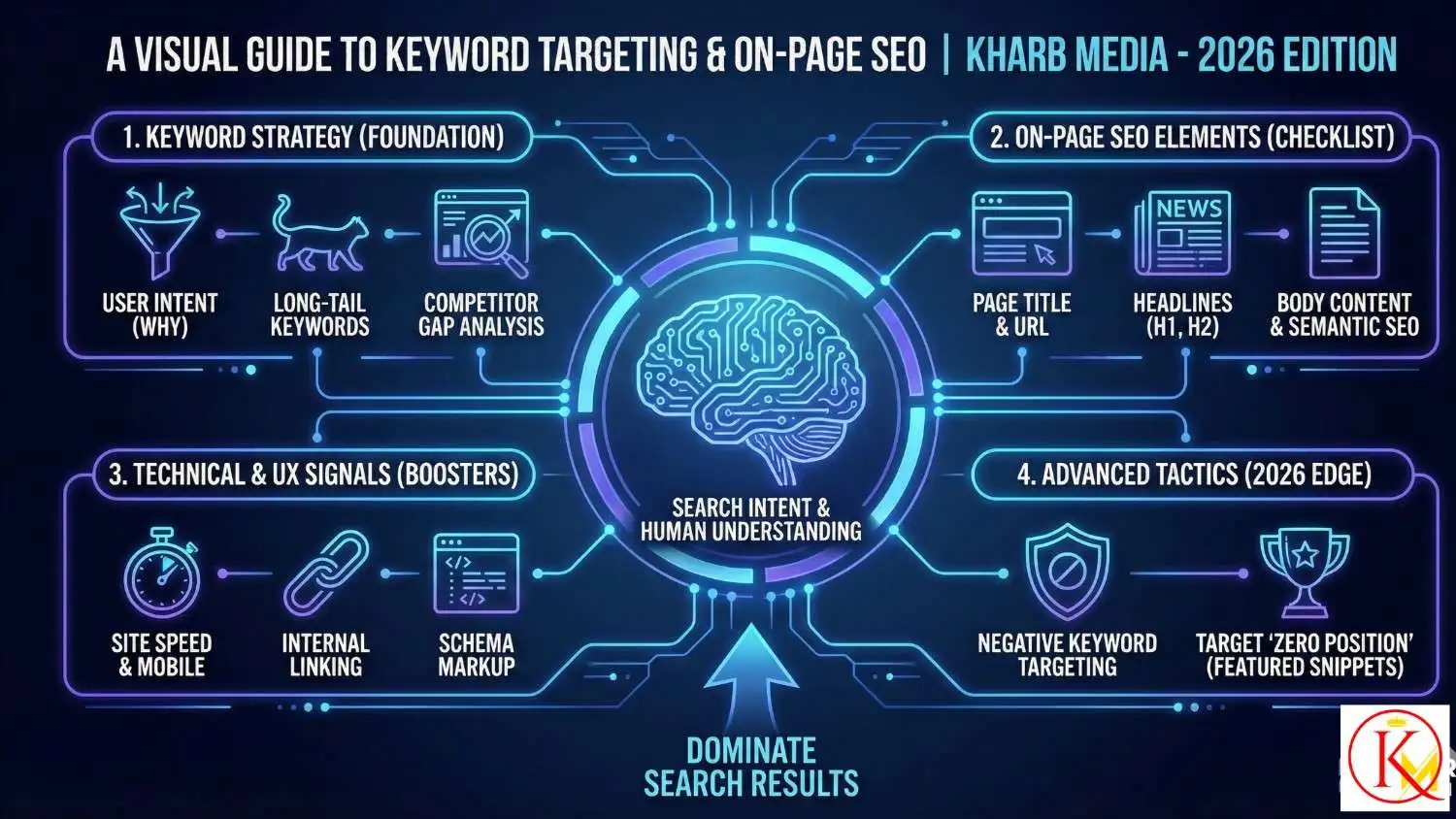
If you are a business owner or marketing manager, this is your ultimate resource. We have analyzed the best strategies from top industry leaders (like Moz and BrandLume) and combined them with our own agency insights to bring you this comprehensive, visual guide to keyword targeting and on page seo.
Let’s build a page that dominates the search results.
Table of Contents
What is Keyword Targeting? (It’s Not Just “Keywords”)
Many people think keyword targeting is just finding a high-volume word and pasting it into your text. That is a mistake.
Keyword targeting is the strategic process of aligning your content with what your customers are actually looking for. It is the engine behind the match between a user’s question and your answer.
The Shift: From “Strings” to “Things”
In the past, on-page optimization was purely about keyword placement putting words in specific HTML spots. Today, Google uses complex algorithms to understand the “why” behind the search.
Our senior strategists at Kharb Media always tell clients: Do not optimize for a search engine. Optimize for the searcher. If you satisfy the user, the rankings will follow.
- Old Way: Stuffing the exact keyword “cheap shoes” 20 times.
- New Way (2026): Writing a helpful guide on “affordable footwear” that covers price comparisons, durability, and style, signaling to Google that you are an authority.
The “Perfectly Optimized” Page: A Visual Breakdown
When we talk about a visual guide to keyword targeting and on page seo, we often refer to the architecture of a page. You cannot just throw text on a screen. You need to build a structure.
According to industry data, a perfectly optimized page balances two things: Keyword Targeting and User Experience (UX).
Here is what the “Perfect Layout” looks like in practice:
Pro Tip from Kharb Media: Don’t sacrifice user experience for keywords. If placing a keyword makes a sentence sound robotic, delete the keyword. A better user experience often leads to better rankings because people stay on your site longer.
- uniquely Valuable Content: Your page must offer value that cannot be found anywhere else. It isn’t enough to be “good.” You must be different.
- Bot Accessible: Can Google’s crawlers actually read your page? If they can’t see it, they can’t rank it.
- Phenomenal UX: Is it easy to read? Does it load fast? Is it beautiful?.
- Keyword Targeted: Are the primary and secondary keywords used in the right places (Headlines, Title, URL)?.
- Built to be Shared: Is it easy for a visitor to tweet, like, or email this URL? Social signals matter.
Step 1: Building Your Keyword Strategy (The Foundation)
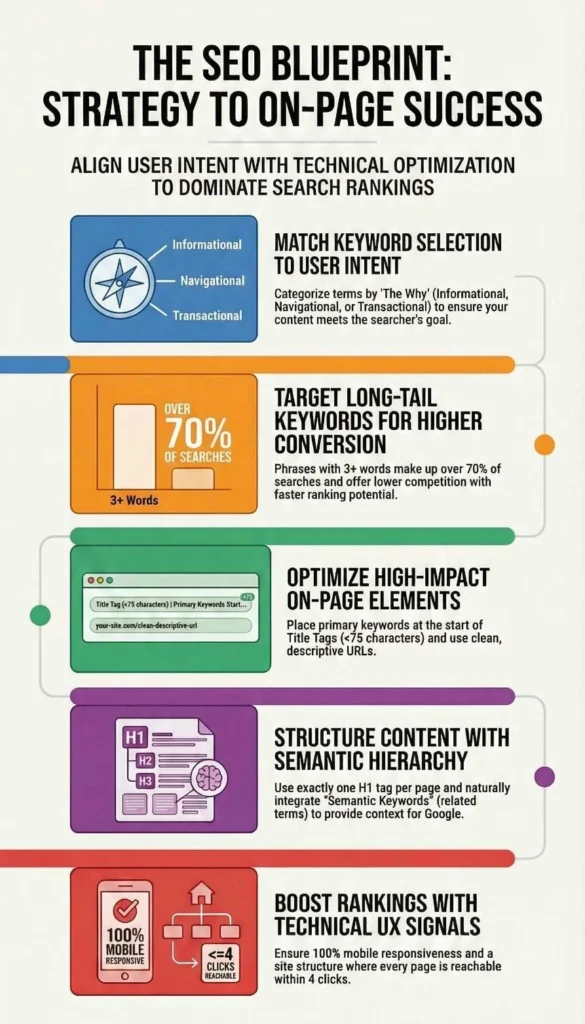
Before you write a single word, you need a plan. Effective keyword targeting starts with a framework.
1. Identify User Intent (The “Why”)
This is the most critical step. You must categorize your keywords by what the user wants:
- Informational: They want to learn (e.g., “how to clean sneakers”).
- Navigational: They want a specific site (e.g., “Nike login”).
- Transactional/Commercial: They are ready to buy (e.g., “buy running shoes size 10”).
If you try to sell a product on a keyword where people just want information, you will fail.
2. The Power of Long-Tail Keywords
Don’t just chase the big, popular words. Long-tail keywords (phrases with 3+ words) make up over 70% of all searches.
- Generic: “Headphones” (High competition, low conversion).
- Long-Tail: “Best noise-cancelling headphones for sleeping” (Lower traffic, but very high conversion).
Our team has found that long-tail keywords are the “low-hanging fruit” of SEO. You rank faster and get customers who are actually ready to spend money.
3. Competitor Gap Analysis
Why guess when you can cheat (legally)? Look at what your competitors are ranking for, but you aren’t.
- Use tools to find “Keyword Gaps”.
- Look for terms they are targeting and create content that is 10x better.
- Visual Matrix: Create a spreadsheet mapping out your keywords against your competitors to spot the holes in their strategy.
Step 2: On-Page SEO Elements (The Checklist)
This is the core of a visual guide to keyword targeting and on page seo. Once you have your keywords, where do you put them?
1. Page Title (The Most Important Tag)
Your page title is the first thing a user sees in Google. It must be compelling.
- Rule: Place your Primary Keyword as close to the start of the title as possible.
- Length: Keep it under 60-75 characters so it doesn’t get cut off.
- Psychology: Make it clickable. “Best Lip Balms” is okay. “The Best Lip Balms (With SPF) to Wear in the Sun” is much better.
2. URL Structure
Keep it clean. Avoid messy codes like www.site.com/?p=123.
- Best Practice: www.site.com/visual-guide-keyword-targeting
- Your URL should describe the page content and include the primary keyword.
3. Headlines (H1, H2, H3)
Think of your content like a newspaper.
- H1: This is your main headline. You should only have one H1 per page, and it must include your main keyword.
- H2 & H3: Use these to break up text. This is a great place to use “Semantic Keywords” (related terms) naturally.
4. Body Content & Semantic SEO
Don’t just repeat your keyword. Use Semantic SEO. This means using related terms and synonyms so Google understands the context.
- If you are writing about “Coffee,” naturally use words like “beans,” “roast,” “mug,” “caffeine,” and “brewing.”
- Density: Aim for a natural flow. If you read it aloud and it sounds weird, change it.
5. Image Optimization
Images are powerful, but Google can’t “see” them like we do. You must help the bot.
- File Name: Rename IMG_001.jpg to keyword-targeting-chart.jpg.
- Alt Text: Write a short description of the image. This helps blind users (accessibility) and tells Google what the image is about.
Step 3: Technical & UX Signals (The Invisible Boosters)
You can have the best keywords in the world, but if your site is broken, you won’t rank.
1. Site Speed & Mobile Responsiveness
In 2026, everyone is on their phone.
- Speed: Your page should load in seconds. Compressing images and minifying code are easy wins.
- Mobile: Your site must look perfect on a phone. Google prioritizes mobile-friendly sites.
2. Internal Linking
Imagine your website is a spiderweb. You need to connect the threads.
- Link from your new post to other relevant pages on your site.
- Anchor Text: Use descriptive words for the link (e.g., click here to read our [SEO Audit Guide]), not just “click here”.
- The Rule: A good page should be reachable in no more than 4 clicks from the homepage.
3. Schema Markup
This is advanced code that helps Google understand your content types (Recipes, Reviews, Events).
- Using Schema can help you get “Rich Snippets” those fancy boxes at the top of Google search results with stars or images.
Advanced Tactics for 2026
At Kharb Media, we push beyond the basics. Here are two advanced strategies our senior team uses to get an edge.
Negative Keyword Targeting
Sometimes, it is about what you don’t want.
- Concept: Exclude terms that bring bad traffic.
- Example: If you sell premium “Enterprise Software,” you might want to ensure you don’t rank for “free software” or “cheap software.” This ensures your traffic is high-quality and ready to buy.
Target “Zero Position” (Featured Snippets)
You know that answer box at the very top of Google? That is Position Zero.
- How to get it: Answer questions directly and concisely (40-60 words). Use bullet points and tables.
- Why: It steals clicks from the #1 result and establishes you as the ultimate expert.
Measuring Success: Are You Winning?
You can’t improve what you don’t measure. As part of a visual guide to keyword targeting and on page seo, you must look at the data.
Key Metrics to Watch:
- Keyword Rankings: Are you moving up?.
- CTR (Click-Through Rate): Are people clicking your title? If not, rewrite your Title and Meta Description.
- Bounce Rate / Dwell Time: Are people leaving instantly? If so, your content might not match their intent.
Tools We Recommend:
- Google Search Console: Essential and free.
- Google Analytics: For user behavior.
- Ahrefs / Semrush: For deep keyword research and competitor spying.
Conclusion
Mastering a visual guide to keyword targeting and on page seo is not about memorizing a checklist of robotic rules. It is about understanding your customer.
It is about knowing that when they search for “best running shoes,” they want a comparison, not a sales pitch. It is about building a page that loads fast, looks great, and answers their question better than anyone else.
At Kharb Media, we have spent years refining these strategies. We know that SEO is a marathon, not a sprint. But with the right map like the one we have laid out here you can cross the finish line first.
Ready to dominate your market?
If you are serious about growing your traffic in 2026, you don’t have to do it alone.
Get Your Free SEO Audit & Strategy Session
WhatsApp: Chat with an Expert
- Phone: +91 97287 85818
- Email: kharbmedia@gmail.com
People Also Ask (FAQs)
What is the most important on-page SEO element?
While all are important, the Title Tag and Content Relevance (Intent) are critical. If your title doesn’t get the click, and your content doesn’t answer the question, nothing else matters.
How often should I use my primary keyword?
There is no “magic number,” but we recommend a density of around 1-2%. Place it naturally in the H1, first paragraph, and conclusion. Never force it.
Can I do SEO myself?
Yes, absolutely. By following this visual guide to keyword targeting and on page seo, you can handle the basics. However, for advanced technical SEO and competitive gaps, hiring an agency can speed up results.