
You launch your e-commerce store. You add your best products, optimize your images, and wait. But days pass, and the sales dashboard stays at zero.
This is the nightmare scenario for every business owner. You wonder what’s missing and start searching online, eventually landing on two acronyms: SEO and PPC.
But one question stays with you: Do ecommerce sites need SEO and PPC to grow?
The short answer is yes. E-commerce sites need both SEO and PPC to grow online. But the long answer the one that will actually make you money is about how you use them together.
At Kharb Media, with over 15+ years of combined experience in the digital marketing space, we have seen this pattern play out hundreds of times. Business owners think they have to choose one over the other to save money. That mindset often limits e-commerce growth.
In this guide, our senior strategists will break down exactly why relying on just one channel is risky, and how combining them creates a “Growth Engine” that scales your revenue faster than you thought possible.
Table of Contents
The Core Problem: Visibility in a Crowded Market
Every eCommerce business faces the same challenge: visibility.
According to industry data, 43% of all eCommerce traffic comes from organic Google searches. If you aren’t visible, you don’t exist.
- SEO (Search Engine Optimization) improves visibility by ranking your store in search results.
- PPC (Pay-Per-Click) drives instant traffic by showing your products on search engines and shopping ads.
Together, they bring qualified visitors and boost sales more effectively than using one alone.
What is eCommerce SEO? (The Long-Term Foundation)
Search Engine Optimization isn’t just about keywords; it’s about building a store that search engines trust and customers love. It helps your store become one of the top results when people search online.
How It Works
It’s how online stores show up in search results without paying for ads. Over time, this builds steady organic traffic and brings more people to your store for free.
Ready to Grow? Let’s Build Your Roadmap: Chat with Us on WhatsApp
Key Elements of a Winning SEO Strategy
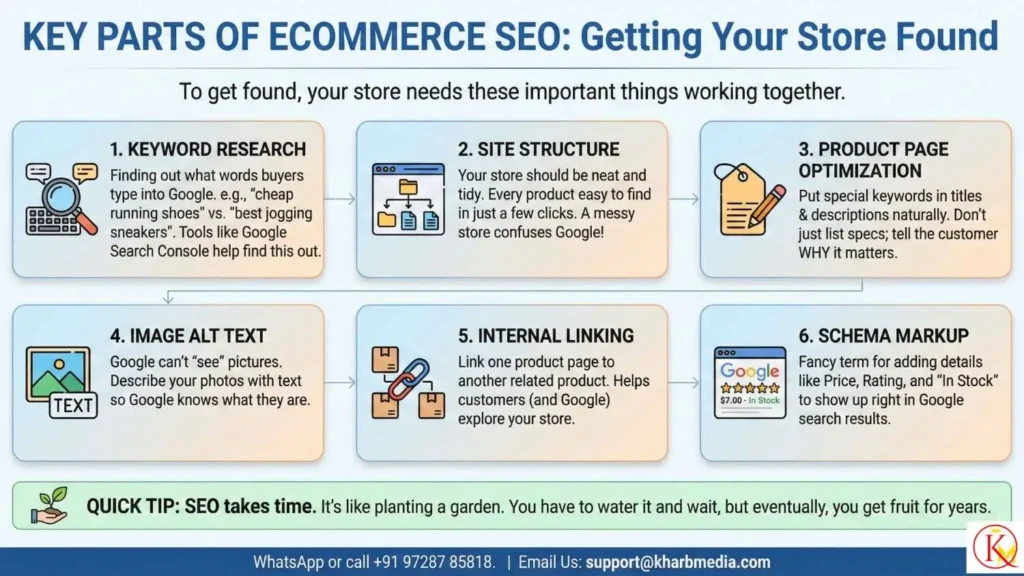
To get found on search engines, your store needs a few core SEO elements working together:
- Keyword Research: Start by finding what buyers type into Google when they look for your products. Tools like Ahrefs or Google Search Console help discover high-traffic keywords.
- Site Structure: A clean layout helps search engines crawl your site. Organize your store into clear categories so every product is reachable within a few clicks.
- Product Page Optimization: Focus on your title tag, meta description, and H1. For example, a page for a protein shaker should target “best protein shaker bottle” and use it naturally in the description.
- Technical SEO: This includes schema markup (adding structured data like price and rating) to help your products stand out with rich results.
Kharb Media Pro Tip: Do not ignore Image Alt Text. Describing each image clearly helps with SEO and supports users who rely on screen readers.
The ROI of SEO
SEO is the long game. It builds trust and keeps traffic flowing over time. Once your site ranks, you get consistent traffic without ongoing ad spend.
What is eCommerce PPC? (The Speed Accelerator)
PPC stands for pay-per-click. It lets you show ads for your products and only pay when someone clicks.
How It Works
You upload your product feed (titles, prices, photos) and run paid ads across platforms like Google or Facebook.
- Google Shopping Ads: These showcase your products directly to shoppers with a photo and price.
- Retargeting: Shows your ad again to interested shoppers who visited but didn’t buy.
The Power of Speed
If you launch a new product today, SEO might take months to rank it. PPC delivers fast results, sometimes within hours. For example, if you launch a new water bottle and run Google Shopping ads, a shopper searching “buy water bottle” sees your ad the same day. You get your first sale that evening.
SEO vs. PPC: The ROI Comparison Table
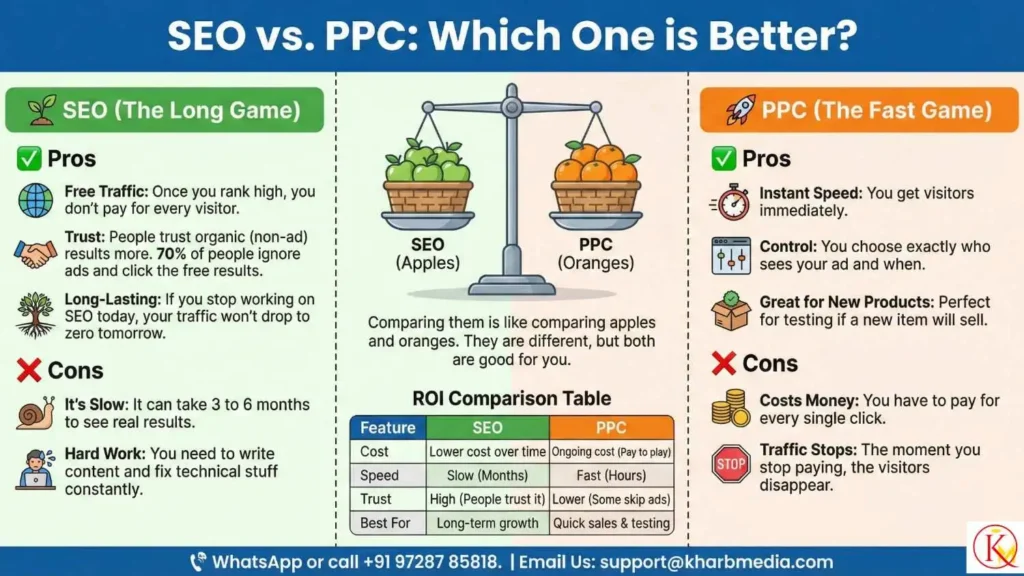
Many store owners struggle to decide. Here is a clear comparison based on our team’s analysis of ROI factors.
| Factor | SEO (Organic) | PPC (Paid Ads) |
| Cost over time | Lower long-term costs after setup | Ongoing ad spend required |
| Speed of results | Slow (3–6 months) | Immediate |
| Sustainability | Long-lasting traffic and visibility | Short-lived; stops without budget |
| Control | Less flexible (algorithm dependent) | Full control over targeting & budget |
| Credibility | High (users trust organic results) | Lower (some users skip ads) |
The Verdict: Relying on just one often slows progress or wastes money.
Why You Need Both: The “Hybrid” Strategy
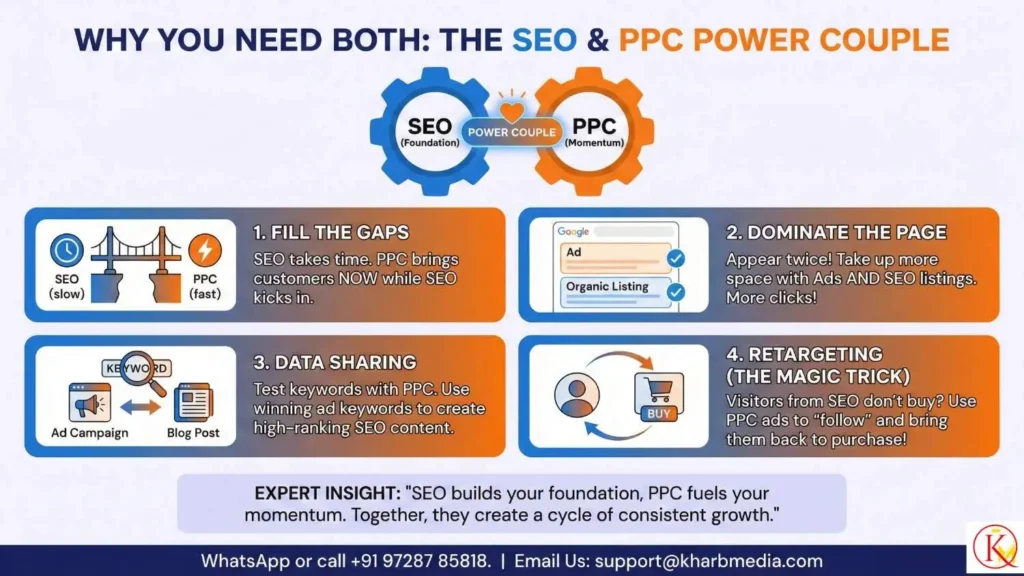
The truth is that using both brings stronger results. Smart brands don’t separate the two. They connect them.
1. SEO Fills the Gaps of PPC
PPC can drain your budget without a plan. If you stop paying, the traffic stops instantly. SEO builds long-term growth without constant spending.
2. PPC Feeds Data to SEO
You don’t need to guess which keywords work. PPC campaigns deliver fast, reliable data.
- Strategy: Run ads for a new product. See which keywords convert into sales.
- Action: Take those high-converting keywords and optimize your SEO content around them.
3. Dominate the Search Page (SERP)
When you combine SEO and PPC, you take up more “real estate” on the screen.
- PPC puts you at the very top for buyers ready to purchase.
- SEO ensures you appear in the organic listings below, building trust. This combination improves your online visibility and converts more visitors into buyers.
4. Retargeting: The Conversion Savior
Most shoppers don’t buy on their first visit.
- The Play: Use SEO to bring in free traffic.
The Follow-up: Use PPC retargeting ads to re-engage those people. Show them related products or reviews to close the sale.
2026 Update: How AI Overviews Affect SEO and PPC
Google’s new AI Overviews (SGE) are changing how search results look and work. Instead of sending users to websites, Google now shows full answers right on the page.
What does this mean for you?
- Fewer Organic Clicks: Fewer people might click search results, even if you rank well.
- PPC is Critical: As organic reach drops, paid ads keep your products in front of the right people.
- Content Must Be Better: If your product details are clear and useful, they may be shown inside the AI answer.
To survive in 2026, you must optimize your content for AI (schema, clear specs) while using PPC to guarantee visibility.
Kharb Media’s “Growth-First” Methodology
At Kharb Media, we don’t just offer advice. We bring over 15+ years of hands-on experience in SEO, PPC, and e-commerce growth.
We have helped brands scale with strategies that actually work. From Google Ads and Amazon PPC to full-funnel SEO, we know how to drive results.
Don’t Let Competitors Take Your Market Share. Secure Your Growth Strategy Today. Chat with an Expert
Our Approach:
- Launch with Speed: We use PPC to get immediate traffic and test your offer.
- Build Authority: We simultaneously build your SEO foundation so you aren’t dependent on ads forever.
- Integrate Data: We ensure your SEO and PPC teams share data to lower your acquisition costs.
- Client Insight: We often see that a strong SEO presence improves your Quality Scores, which actually reduces your PPC costs over time.
Conclusion: Don’t Choose, Combine.
So, do ecommerce sites need SEO and PPC? Without a doubt.
SEO builds your foundation. PPC fuels your momentum. Together, they create a cycle of consistent growth. Relying on just one is like trying to drive a car with three wheels you might move forward, but you won’t win the race.
You already know what’s possible. Now, it’s time to turn that into results.
Ready to Stop Guessing and Start Growing?
Don’t let your competitors take your market share. Let our team at Kharb Media build a custom strategy that puts your products in front of the right buyers.
Claim Your Free Digital Growth Strategy: Chat with an Expert
Contact Us Today:
- Phone: +91 97287 85818
- Email: support@kharbmedia.com
Frequently Asked Questions (FAQs)
Can I just do SEO and skip PPC?
You can, but it’s risky. Without PPC, you wait for traffic. You miss fast feedback and slow down page testing. If you need steady traffic and quick wins, you need both.
Is SEO still relevant in 2026?
Yes, SEO is more relevant than ever. With AI-driven search and growing competition, strong SEO ensures your brand remains visible and credible.
What is the 80/20 rule for SEO?
The 80/20 rule means that roughly 80% of your results come from 20% of your efforts—usually your highest-performing pages and keywords.
How much budget do I need for PPC?
You have full control. You can set daily budgets and only pay for actual clicks. Start small, measure your ROAS (Return on Ad Spend), and scale what works.