
Let’s be real for a moment. The way parents find schools has changed forever. Gone are the days when a simple flyer or word-of-mouth was enough to fill your classrooms. Today, if a parent is looking for the best education for their child, they aren’t just asking their neighbors they are asking Google.
In fact, recent data shows that 67% of people use search engines as their first step when researching colleges and schools. If your school’s website isn’t showing up on that first page of results, you are invisible to thousands of prospective families.
At Kharb Media, with over 15+ years of combined experience in digital growth, our senior strategists have seen this scenario play out countless times. A school offers incredible academics and a nurturing environment but struggles with enrollment simply because their digital presence is weak.
That ends today. We have compiled the most comprehensive guide on effective SEO tips for private schools, merging industry best practices with our own battle-tested strategies to help you dominate the search results in 2026.
Table of Contents
Why SEO Matters Now More Than Ever for Schools
You might be thinking, “We are a school, not an e-commerce store. Do we really need SEO?” The answer is a resounding yes.
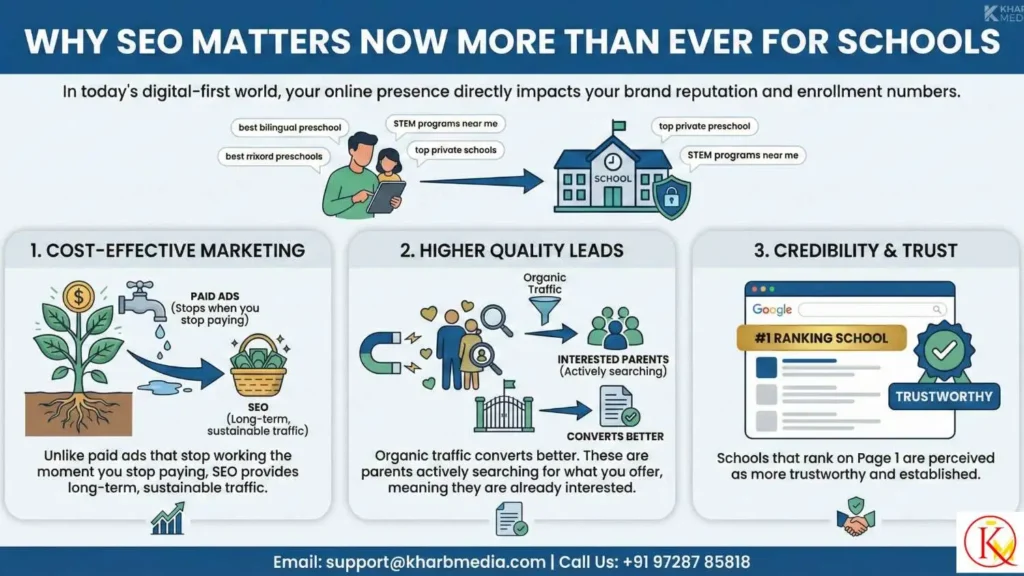
In today’s digital-first world, your online presence directly impacts your brand reputation and enrollment numbers. Parents are sophisticated. They are searching for specific terms like “best bilingual preschool” or “STEM programs near me”.
Stop guessing with your marketing. Get a custom 2026 digital growth roadmap from our senior strategist: Click here to chat on WhatsApp
Here is why SEO (Search Engine Optimization) is your best investment:
- Cost-Effective Marketing: Unlike paid ads that stop working the moment you stop paying, SEO provides long-term, sustainable traffic.
- Higher Quality Leads: Organic traffic converts better. These are parents actively searching for what you offer, meaning they are already interested.
- Credibility: Schools that rank on Page 1 are perceived as more trustworthy and established.
The Foundation – Technical Website Health Check
Before we dive into keywords, we need to look under the hood. A beautiful website is useless if Google can’t read it. Our technical team always starts with a “Health Check” to uncover hidden issues holding a site back.
1. Speed is Critical
Parents are busy. If your website takes too long to load, they will leave. Research indicates that 63% of organic search traffic comes from mobile phones.
- Pro Tip: Compress your images. High-quality campus photos are great, but if they are huge files, they will kill your load speed.
- Action: Use tools like Google PageSpeed Insights to test your site regularly.
2. Mobile Responsiveness
Google now uses a “mobile-first index”. This means Google predominantly uses the mobile version of your content for indexing and ranking. If your site looks bad on a phone, you will not rank well, period. Ensure your menus and text are easily readable on a smartphone.
3. Sitemaps and Architecture
Think of a sitemap as a blueprint for Google. It tells search engines exactly where your pages are and helps them find new content faster.
Turn your school’s website into your most powerful, 24/7 admissions officer with targeted SEO. Click here to chat on WhatsApp
- Check: Verify your robots.txt file isn’t accidentally blocking important pages like your admissions or contact page.
- Fix Broken Links: Dead links (404 errors) annoy parents and hurt your SEO score. Use a broken link checker to find and fix these regularly.
Keyword Research – Speaking Your Audience’s Language
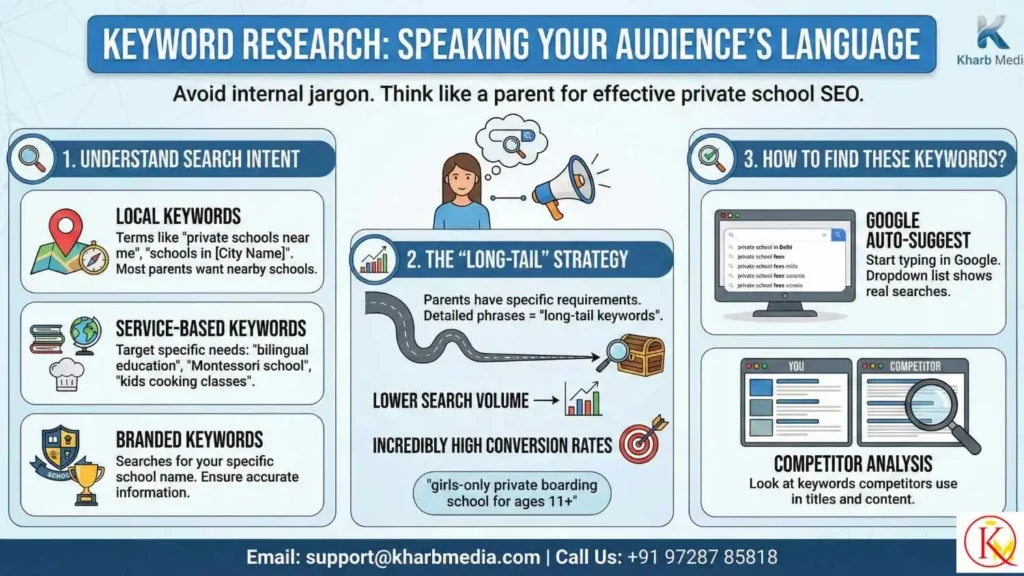
One of the biggest mistakes we see schools make is using internal jargon that parents don’t use. To implement effective SEO tips for private schools, you must think like a parent.
1. Understand Search Intent
Our team categorizes keywords into three buckets to ensure we cover all bases:
- Local Keywords: Terms like “private schools near me,” “schools in [City Name],” or “international schools in [Neighborhood]”. Most parents want a school within a reasonable driving distance.
- Service-Based Keywords: These target specific needs, such as “bilingual education,” “Montessori school,” or “kids cooking classes”.
- Branded Keywords: These are searches for your specific school name. You usually rank #1 for these easily, but you must ensure the information is accurate.
2. The “Long-Tail” Strategy
Parents often have very specific requirements. They might search for “girls-only private boarding school for ages 11+”. These detailed phrases are called “long-tail keywords.” While they have lower search volume, they have incredibly high conversion rates because the intent is so specific.
3. How to Find These Keywords?
You don’t need expensive tools to start.
- Google Auto-Suggest: Start typing “private school in [your city]” into Google and see what pops up in the dropdown list. Those are real searches people are making.
- Competitor Analysis: Look at what keywords your competitors are using in their titles and content.
On-Page Optimization – Making Your Content Shine
Once you have your keywords, you need to put them in the right places. This is known as “On-Page SEO.”
1. Optimize Page Titles and Meta Descriptions
Your page title is the first thing a parent sees in search results. It needs to be catchy and include your main keyword.
- Title Tag: Keep it under 60 characters. Example: “Best CBSE School in Rohtak | [School Name]”.
- Meta Description: This is the short summary under the title. Write a compelling 150-160 character description that encourages a click. Example: “Discover top-rated academics and sports at [School Name]. Enrolling now for 2026. Schedule a tour today!”.
- Avoid Duplicates: Every page on your site must have a unique title. Duplicate titles confuse Google.
2. Use Headers Correctly (H1, H2, H3)
Headers aren’t just for making text look big; they help Google understand your content structure.
- H1: The main title of the page (use only one per page).
- H2: Main sub-sections (like the ones in this blog).
- H3: Smaller points within the sections.
3. Image Alt Text
Google can’t “see” images; it reads the text attached to them. This is called “Alt Text.” Instead of naming an image IMG_1234.jpg, name it students-in-science-lab-at-private-school.jpg and add a descriptive Alt Text sentence. This improves accessibility and ranking.
4. Internal Linking
Don’t let visitors hit a dead end. Link your pages together. For example, on a blog post about your “Science Fair,” link to your “Admissions Page” or your “Curriculum Page”. This keeps users on your site longer, which signals to Google that your site is valuable.
Local SEO – Dominate Your Neighborhood
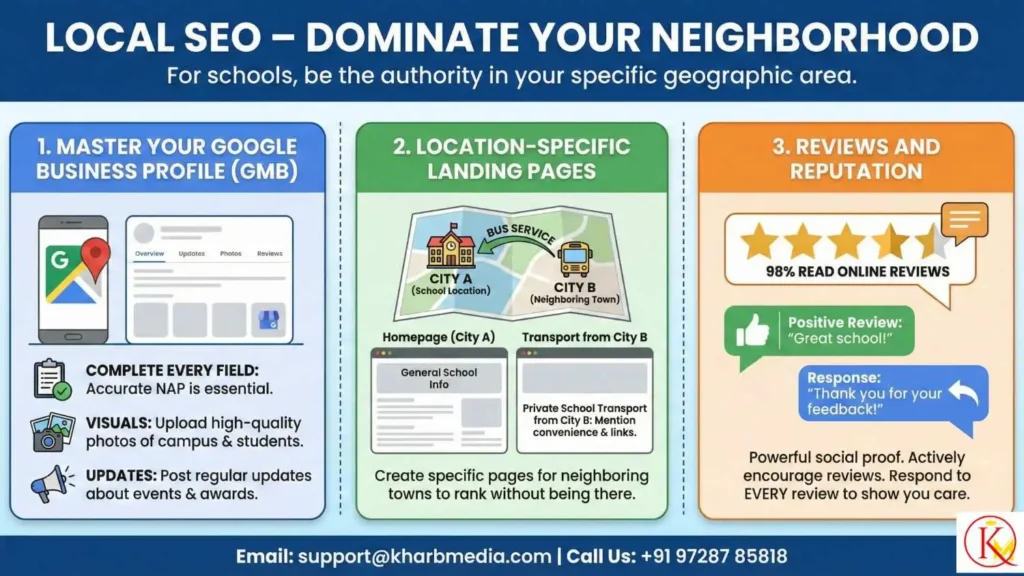
For schools, Local SEO is arguably the most critical piece of the puzzle. You need to be the authority in your specific geographic area.
1. Master Your Google Business Profile (GMB)
Your Google Business Profile is what shows up in Google Maps and the “Local Pack” (the map box at the top of search results). It is free and essential.
- Complete Every Field: Name, Address, and Phone number (NAP) must be 100% accurate and consistent across the web.
- Visuals: Upload high-quality photos of your campus, classrooms, and happy students.
- Updates: Post regular updates about open houses, events, or awards directly to your profile.
2. Location-Specific Landing Pages
Does your school draw students from neighboring towns? Don’t just rely on your homepage. Create specific landing pages for those areas.
- Example: If your school is in City A, but you offer bus service from City B, create a page titled “Private School Transport from City B.” Mention transport links and convenience. This helps you rank in City B without actually being there.
3. Reviews and Reputation
Reviews are powerful social proof. 98% of people read online reviews for local businesses. Actively encourage happy parents and alumni to leave positive reviews on Google. Respond to every review good or bad to show you are engaged and care.
Content Strategy – The “Skyscraper” Approach
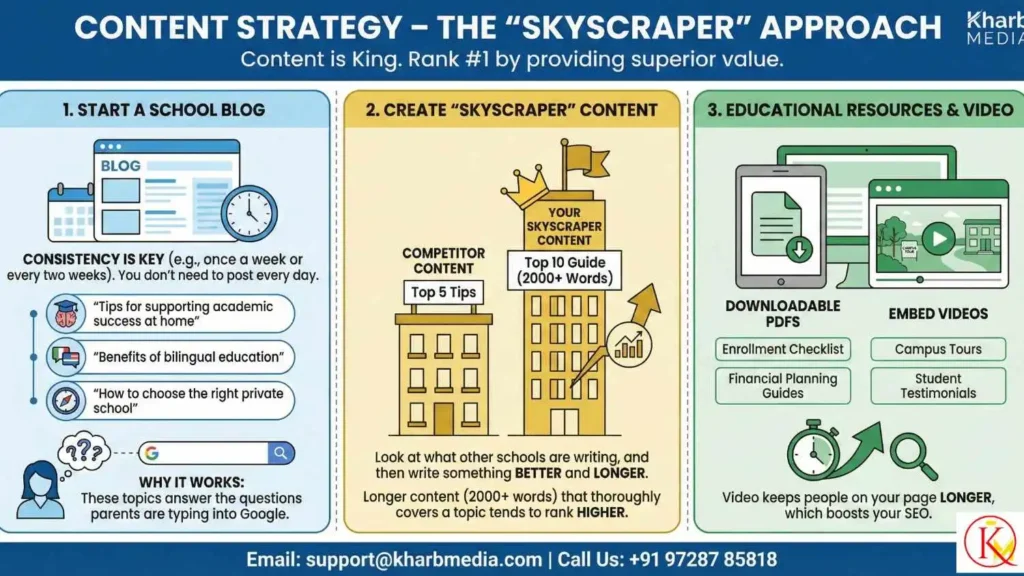
Content is King. To rank #1, you need to provide value. Search engines notice when you regularly publish fresh content.
1. Start a School Blog
You don’t need to post every day, but consistency is key (e.g., once a week or every two weeks).
- Topic Ideas:
- “Tips for supporting academic success at home”.
- “Benefits of bilingual education”.
- “How to choose the right private school”.
- Why it works: These topics answer the questions parents are typing into Google.
2. Create “Skyscraper” Content
Look at what other schools are writing, and then write something better and longer. If a competitor has a “Top 5 Tips” list, you write a “Top 10 Guide.” Longer content (2000+ words) that thoroughly covers a topic tends to rank higher.
3. Educational Resources & Video
Offer downloadable PDFs (like an “Enrollment Checklist”) or financial planning guides. Also, embed videos of campus tours or student testimonials. Video keeps people on your page longer, which boosts your SEO.
Off-Page SEO & Authority Building
Off-page SEO is about building your school’s reputation elsewhere on the internet.
1. Build Quality Backlinks
A “backlink” is when another website links to yours. Google sees this as a vote of confidence. The more “votes” you have from reputable sites, the higher you rank.
- Where to get them: Local news websites, education blogs, alumni networks, and local business directories.
2. Social Media Integration
While social media doesn’t directly boost your SEO ranking, it drives traffic to your website and builds brand awareness. Share your blog posts and event photos on Facebook, Instagram, and LinkedIn to get more eyes on your content.
2026 Bonus Strategy: International Recruitment
If your school accepts international students, you need a global SEO strategy.
- Country Folders: Create specific sections of your site for different countries (e.g., yourschool.com/fr for France) tailored to those parents’ search behaviors.
- Language: Ensure this content is optimized for the keywords used in those regions.
Conclusion: Take Control of Your Enrollment Pipeline
Implementing effective SEO tips for private schools is not an overnight fix. It is a long-term strategy that builds momentum over 3-6 months. However, the results a steady stream of qualified inquiries and a full enrollment roster are worth the effort.
By fixing your technical foundation, targeting the right keywords, creating valuable content, and dominating local search, you can turn your website into your school’s most powerful admissions officer.
Ready to see exactly where your school stands?
Don’t guess with your digital future. Our senior team at Kharb Media is ready to help you analyze your current standing and build a roadmap to #1.
Claim Your Free SEO Audit & Competitor Analysis: Click here to chat on WhatsApp
Contact Us Today:
- Phone: +91 97287 85818
- Email: support@kharbmedia.com
People Also Ask (FAQs)
How long does it take to see results from SEO for schools?
SEO is a marathon, not a sprint. While some changes (like GMB updates) can show immediate results, comprehensive SEO typically shows significant improvements in traffic and rankings within 3-6 months.
Should schools invest in paid advertising (PPC) alongside SEO?
Absolutely. We often recommend a hybrid approach. Paid ads can drive immediate traffic during critical enrollment periods, while SEO builds long-term, free traffic. They work best together.
Can we do SEO in-house?
You can certainly start in-house with free tools like Google Search Console. However, partnering with an experienced agency like Kharb Media saves time and ensures you are using the latest, most effective strategies without the learning curve.
What is the difference between branded and unbranded keywords?
Branded keywords include your school’s name (e.g., “Kharb Academy Tuition”). Unbranded keywords are general searches (e.g., “best private schools near me”). Unbranded searches are harder to rank for but are essential for attracting new families who don’t know you yet.