If you are a small business owner, you likely wear many hats. You are the CEO, the accountant, the HR manager, and often, the marketing department too. But here is a hard truth we have seen over our 15+ years of combined experience at Kharb Media: treating Search Engine Optimization (SEO) as a “side task” or a DIY experiment is often the reason why 96.55% of content gets zero traffic from Google.
We have audited hundreds of small business websites, from local bakeries in Haryana to B2B manufacturers in the US. The pattern is almost always the same. Business owners want visibility, but they unknowingly commit errors that push their websites to Page 10 of Google.
The good news? These mistakes are fixable.
In this comprehensive guide, our senior strategy team has compiled the Union of all major SEO errors combining insights from technical audits, content reviews, and local search analysis. We aren’t just listing problems; we are giving you the fixes.
Table of Contents
Part 1: Strategic & Mindset Mistakes
Before we touch a single line of code, we need to address how you think about SEO.
1. Lacking a Clear SEO Strategy (The “Throwing Spaghetti” Method)
Many small businesses try to “do SEO” without a plan. You might write a blog post today, change a title tag tomorrow, and then forget about the website for a month. The Fix: SEO is not a checklist; it is a campaign. You need 6-month and 12-month goals. Are you trying to rank for informational queries or transactional ones? Without a roadmap, you are driving in the dark.
2. Treating SEO as a Sprint, Not a Marathon
We often hear clients say, “We did SEO last month, but sales haven’t increased.” The Reality: SEO is a slow burn. It takes time for Google to crawl, index, and trust your content.
Pro Tip: If you need instant leads tomorrow, use PPC (Pay-Per-Click). If you want sustainable, free traffic for years, invest in SEO. Do not confuse the two.
3. The “DIY” Trap & Relying on Web Designers for SEO
This is a classic error. You hire a fantastic web designer to build a beautiful site. You assume they “did the SEO.” Our Experience: Most designers are artists, not marketers. They may build a stunning site that is invisible to Google because they missed meta tags, redirects, or proper hierarchy. The Fix: Always have an SEO specialist audit a new site before launch.
Part 2: Keyword Research Failures
Keywords are the bridge between what people want and what you offer.
4. Neglecting Keyword Research Entirely
Writing about what you think is important versus what your customers are actually searching for is a major disconnect. You might call it “Premium Sliced Bread,” but your customer is searching for “Best sandwich bread near me.”
5. Targeting Broad vs. Long-Tail Keywords
A small shoe store in Rohtak tries to rank for the keyword “Shoes.” Why this fails: You are competing with Amazon, Nike, and massive global brands. You will not win. The Fix: Go for Long-Tail Keywords. Instead of “Shoes,” target “Orthopedic running shoes in Rohtak” or “Affordable leather formal shoes for men.” These have lower volume but much higher conversion intent.
6. Keyword Stuffing (Living in 2005)
Example: “We are the best bakery. If you need a bakery, come to our bakery for bakery items.” Google’s algorithms (like Panda and SpamBrain) hate this. It looks spammy and hurts your user experience.
The Kharb Media Rule: Write for humans first, Google second. Keep your primary keyword density around 1-2% naturally.
7. Focusing on Volume Instead of Intent
High traffic does not equal high revenue. Ranking #1 for a keyword like “free SEO tips” might bring 10,000 visitors who never buy. Ranking #5 for “SEO Agency for Manufacturers” might bring 50 visitors who all become high-paying clients.
Part 3: On-Page & Content Errors
Content is King, but only if it’s optimized.
8. Producing “Thin” or Low-Quality Content
“Thin content” refers to pages with very little text (under 200-300 words) that provide no value. If your service page just says “We do plumbing, call us,” Google has no context to rank you. The Fix: Aim for comprehensive content (500+ words for service pages) that answers the Who, What, Where, When, and Why.
9. Duplicate Title Tags and Meta Descriptions
We frequently see websites where every single page has the same title: “Home – MyBusinessName.” Why this hurts: You are missing the most valuable real estate in search results. The Fix: Every page needs a unique identity.
- Bad: Home | Kharb Media
- Good: B2B Digital Marketing Agency in India | Kharb Media
10. Misusing Header Tags (H1, H2, H3)
Headers are not just for making text big and bold. They are for structure.
- The Mistake: Using five H1 tags on one page, or skipping from H1 to H4.
- The Fix: Use one H1 (Main Title) per page. Use H2s for main sections, and H3s for sub-points. This helps Google bot understand your outline.
11. Ignoring Image SEO
Uploading images named IMG_5928.jpg is a wasted opportunity. Google cannot “see” images; it reads filenames and Alt Text. The Fix: Rename files before uploading. Use modern-office-furniture-delhi.jpg and add descriptive Alt Text for accessibility.
Don’t let another month of traffic go to waste. Contact our senior team directly: Click here to chat on WhatsApp
Part 4: Technical SEO & User Experience (UX)
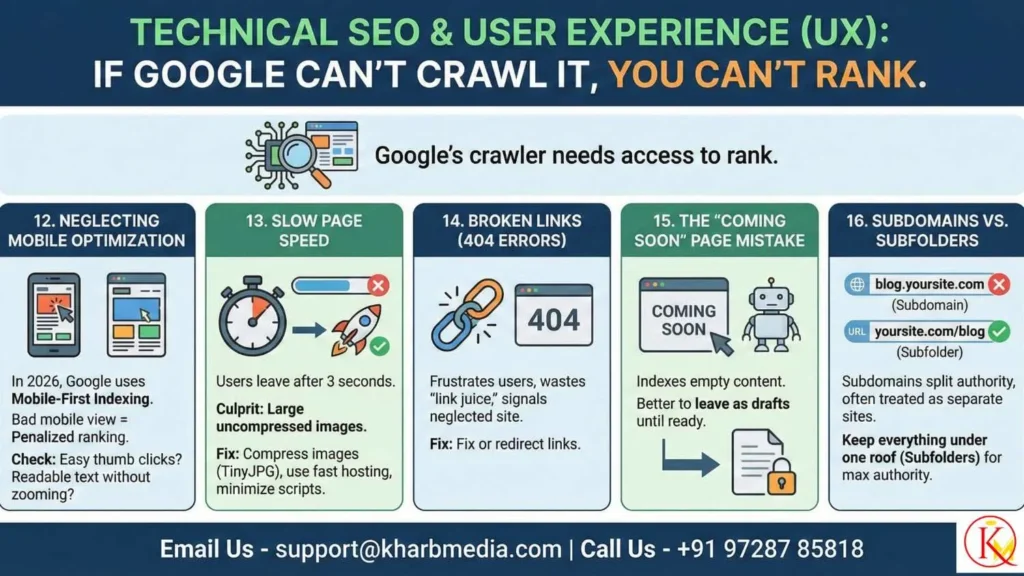
If Google can’t crawl it, you can’t rank.
12. Neglecting Mobile Optimization
In 2026, Google uses Mobile-First Indexing. If your site looks bad on a phone, it doesn’t matter how good it looks on a laptop Google will penalize you. The Check: Can a user easily click buttons with their thumb? Is the text readable without zooming?
13. Slow Page Speed
Users leave if a site takes more than 3 seconds to load. Large, uncompressed images are usually the culprit. The Fix: Compress images using tools like TinyJPG, use a fast hosting provider, and minimize heavy scripts.
14. Broken Links (404 Errors)
Linking to pages that no longer exist frustrates users and wastes your “link juice.” It signals to Google that your site is neglected.
15. The “Coming Soon” Page Mistake
Launching a site with “Coming Soon” pages allows Google to index empty content. It is better to leave those pages as drafts until they are ready.
16. Subdomains vs. Subfolders
Putting your blog on blog.yoursite.com (Subdomain) instead of yoursite.com/blog (Subfolder) splits your authority. Google often treats subdomains as separate websites. Keep everything under one roof (subfolders) to maximize authority.
Part 5: The Local SEO Blindspot
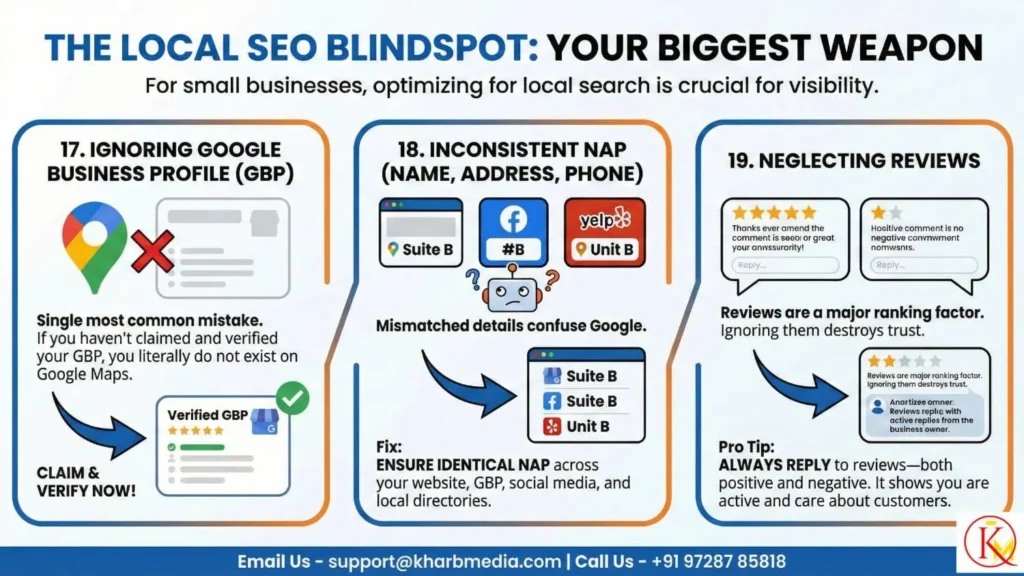
For small businesses, Local SEO is your biggest weapon.
17. Ignoring Google Business Profile (GBP)
This is the single most common SEO mistake small businesses make. If you haven’t claimed and verified your GBP, you literally do not exist on Google Maps.
18. Inconsistent NAP (Name, Address, Phone)
If your website says “Suite B” but your Facebook says “#B” and Yelp says “Unit B,” Google gets confused. The Fix: Ensure your NAP is identical across your website, GBP, social media, and local directories.
19. Neglecting Reviews
Reviews are a major ranking factor for local search. Ignoring them (or worse, getting fake ones) destroys trust.
Pro Tip: Always reply to reviews both positive and negative. It shows you are active and care about customers.
Part 6: Analytics & Authority
20. Ignoring Internal Linking
You need to link your own pages together. If you write a blog post about “SEO Mistakes,” link it to your “SEO Services” page. This passes authority from one page to another and keeps users on your site longer.
21. Flying Blind (No Analytics)
How do you know if you are winning if you aren’t keeping score? The Fix: Install Google Analytics 4 (GA4) and Google Search Console immediately. These free tools tell you who is visiting, what keywords they used, and where your technical errors are.
Conclusion: Don’t Let These Mistakes Cost You Growth
SEO is not magic; it is engineering. The common SEO mistakes small businesses make are rarely malicious they are just oversights. But in a competitive digital market, oversights cost money.
At Kharb Media, we believe that small businesses deserve the same high-level strategy as big corporations. You don’t have to navigate these algorithm updates alone.
Ready to stop guessing and start ranking?
If you are tired of seeing competitors above you in search results, let our team look under the hood of your website. We will identify exactly which of these 21 mistakes are holding you back.
Get Your Free SEO Audit Today: Click here to chat on WhatsApp
- Phone: +91 97287 85818
- Email: support@kharbmedia.com
Frequently Asked Questions (People Also Ask)
Why do small businesses fail at SEO?
Most often, it is due to a lack of consistency and strategy. Many treat it as a one-time task rather than an ongoing process.
How much do SEO mistakes cost a business?
It is hard to put a number on it, but you are paying in “Opportunity Cost.” Every customer who clicks your competitor’s link instead of yours is lost revenue.
Is Page Speed really a ranking factor?
Yes. Google has confirmed that Core Web Vitals (which includes speed) are ranking signals. A slow site will rank lower.
Can I do SEO myself?
You can do the basics (like claiming your GBP). However, technical SEO and competitive keyword strategy often require professional tools and expertise to see real ROI.