
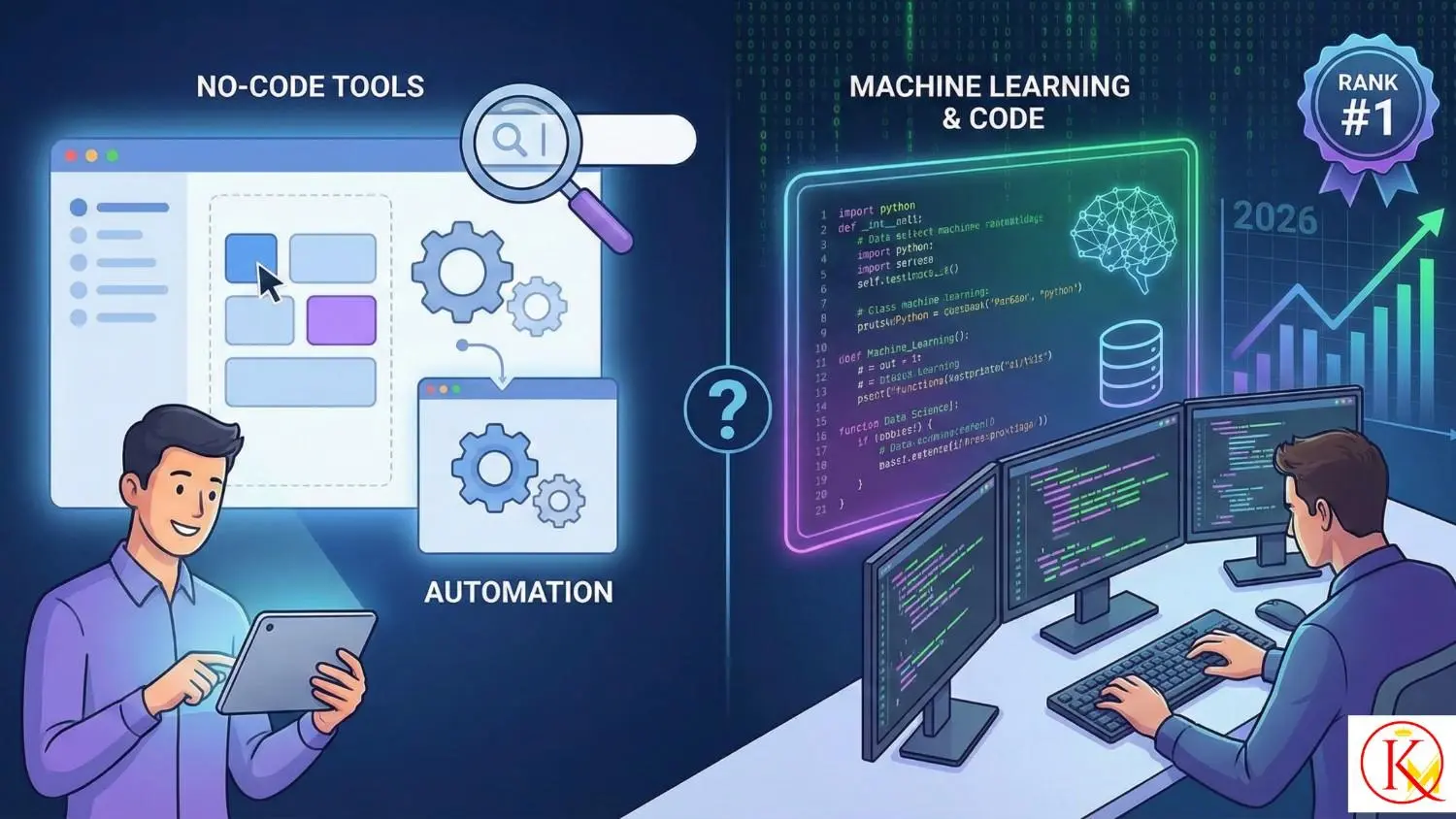
The landscape of search engine optimization has shifted beneath our feet. Gone are the days when keyword stuffing and basic meta tags were enough to rank #1. Today, we are dealing with intelligent algorithms like RankBrain and BERT that understand context better than some humans do.
This rapid evolution brings up a burning question for every modern marketer and business owner: Do you need programming skills for machine learning in SEO?
At Kharb Media, with over 15+ years of combined experience in the digital trenches of the US and Indian markets, we hear this question daily. The short answer is nuanced. No, you do not strictly need to be a coder to survive. But if you want to thrive and dominate in 2026? That is a different story.
In this comprehensive guide, our senior strategists break down exactly where coding fits into the modern SEO puzzle, how to leverage Machine Learning (ML) without writing a single line of code, and when learning Python might just be the superpower your career needs.
Table of Contents
The Short Answer: Can You Survive Without Code?
Let’s be direct. You do not strictly need programming skills to leverage machine learning for SEO.
If you are a business owner or a marketing manager, you can breathe a sigh of relief. The market is currently flooded with powerful software that packages complex machine learning capabilities into user-friendly interfaces.
The “No-Code” SEO Reality (Level 1)
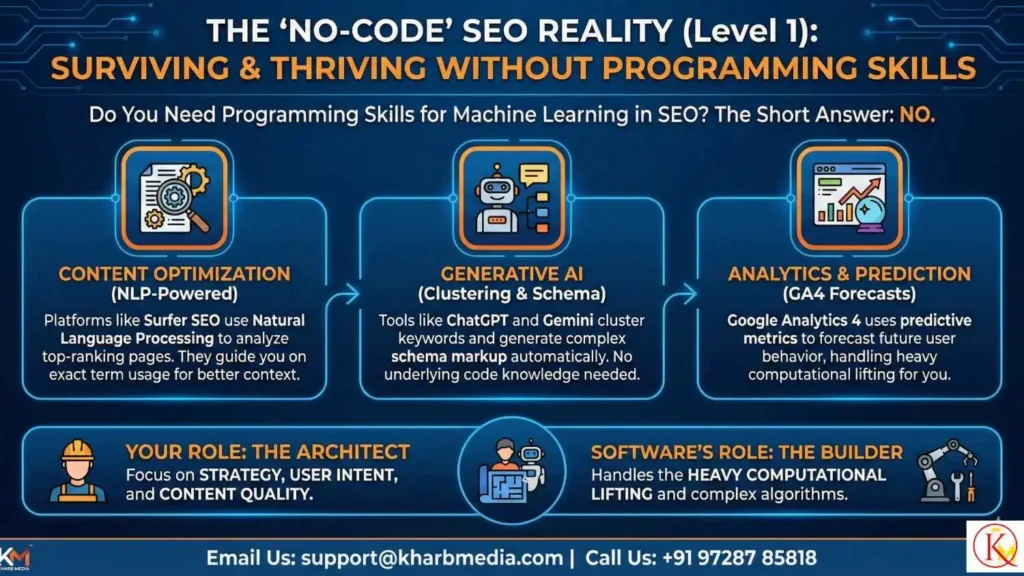
Most modern SEO tools act as a bridge between you and complex algorithms. When our team at Kharb Media conducts an initial audit, we often utilize tools that have ML built-in.
- Content Optimization: Platforms like Surfer SEO use Natural Language Processing (NLP) to analyze top-ranking pages and tell you exactly what terms to use.
- Generative AI: Tools like ChatGPT and Gemini can cluster keywords and generate schema markup without you needing to understand the underlying code.
- Analytics: Google Analytics 4 (GA4) uses predictive metrics to forecast user behavior automatically.
At this level, your role is to be the architect, not the builder. You focus on strategy, user intent, and content quality, while the software handles the heavy computational lifting.
Why The Industry is Shifting: The Role of ML in Modern Search
To understand why this question is even being asked, we must look at how Google has changed. Google has moved far beyond simple “retrieval models” (matching keywords) to “interpretation models.”
From Keywords to Intent
Systems like RankBrain and BERT allow the search engine to interpret the nuance behind a query. They don’t just look for the string of text; they look for the meaning.
- RankBrain: Looks at historical data to predict the best results for queries the engine has never seen before.
- Dynamic Adjustment: Unlike static algorithms that follow a strict checklist, ML models constantly adjust ranking criteria based on real-time user feedback.
This means that optimizing for a machine learning algorithm differs from optimizing for a static rule set. You cannot just tick boxes anymore; you have to align with user satisfaction signals.
The 10 Critical Areas Where Coding Knowledge Elevates Your SEO
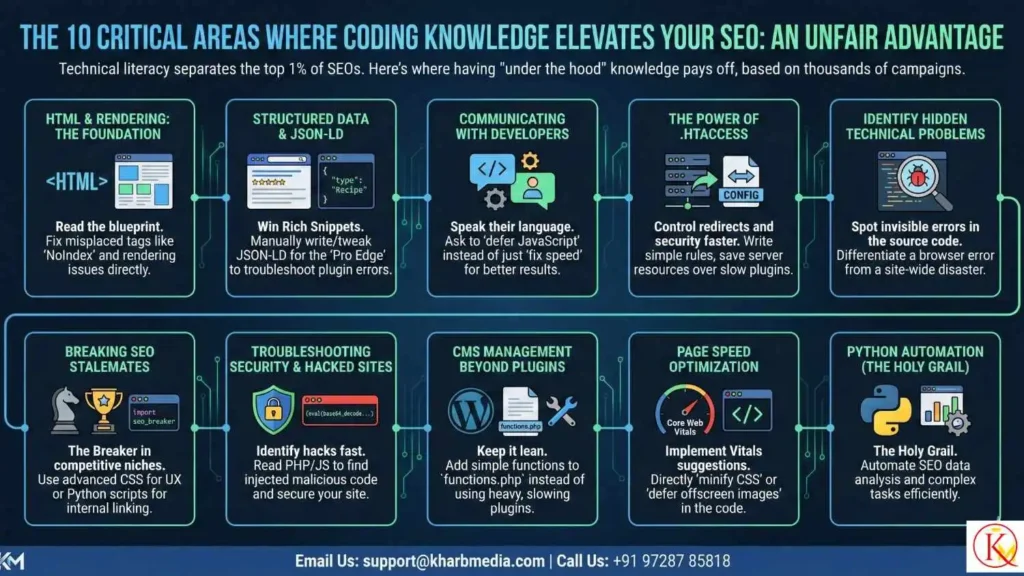
While you can survive without coding, our team has seen that technical literacy is what separates the top 1% of SEOs from the rest. Based on our analysis of thousands of campaigns, here are the specific areas where having “under the hood” knowledge gives you an unfair advantage.
1. HTML & Rendering: The Foundation
Websites are built on HTML. If you don’t understand the foundation, you can’t fix the cracks. Search engine experts who understand HTML can instantly spot if a “NoIndex” tag is misplaced or if a Facebook pixel code in the <head> section is breaking the page rendering. You don’t need to build a site from scratch, but you must know how to read the blueprint.
2. Structured Data & JSON-LD
Winning “Rich Snippets” (those star ratings and recipe cards in search results) requires Structured Data. While plugins can generate this, they often break or bloat your site.
- The Pro Edge: Knowing how to manually write or tweak JSON-LD code allows you to troubleshoot errors that plugins can’t fix, ensuring you get those coveted visual spots on Google.
3. Communicating with Developers
This is perhaps the biggest “soft skill” benefit. Developers and SEOs often speak different languages. If you ask a developer to “fix the speed,” they might ignore you. But if you tell them, “The JavaScript execution time is blocking the main thread for 2 seconds, can we defer these scripts?” you get respect, and you get results.
Do you need programming skills for machine learning in SEO: Click to Chat on WhatsApp
4. The Power of .htaccess
The .htaccess file is a powerful configuration file on your server. It can control redirects, block spammy IP addresses, and force HTTPS connections.
- Why it matters: Using a plugin for every redirect slows down your site. Writing a simple rule in .htaccess is faster and cleaner. A little coding knowledge here saves massive server resources.
5. Identify Hidden Technical Problems
Some errors are invisible to the naked eye but obvious in the source code. A “400 Bad Request” might look like a server failure to a novice, but a coder knows it’s often just a browser request error. Coding literacy helps you differentiate between a site-wide disaster and a simple typo.
6. Breaking SEO Stalemates
In hyper-competitive niches (like Finance or Law), everyone has good content and good links. It’s a stalemate.
- ** The Breaker:** Technical implementation. Being able to implement advanced CSS for a better User Experience (UX) or using Python to find internal linking opportunities that others missed can be the tie-breaker that pushes you to #1.
7. Troubleshooting Security & Hacked Sites
When a site drops in rankings, it might be a hack. Malicious code is often injected into JavaScript files or PHP headers. If you can’t read the code, you can’t find the injection. Basic familiarity with PHP and JS helps you identify if that drop in traffic is an algorithm update or a security breach.
8. CMS Management Beyond Plugins
WordPress is great, but relying on 50 plugins will kill your site speed. Coding knowledge allows you to add simple functions to your functions.php file instead of installing a heavy plugin for a simple task. This keeps your site lean and fast.
9. Page Speed Optimization
Google’s Core Web Vitals are a ranking factor. Tools like PageSpeed Insights give you suggestions, but implementing them often requires touching the code. You might need to “minify CSS” or “defer offscreen images.” These are coding tasks.
10. Python Automation (The Holy Grail)
This deserves its own section below. Python is the industry standard for SEO data analysis.
When Programming Becomes a Superpower (Level 2 & 3)
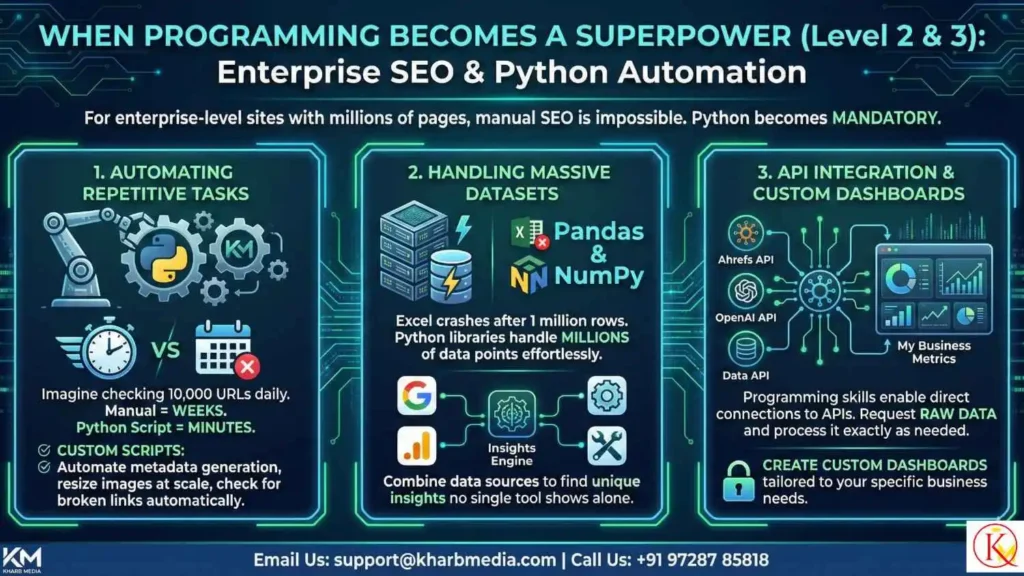
For enterprise-level sites with millions of pages, manual SEO is impossible. This is where Python becomes mandatory for Machine Learning in SEO.
Automating Repetitive Tasks
Imagine checking the status codes of 10,000 URLs every morning manually. It would take weeks. With a simple Python script, our team at Kharb Media can do this in minutes.
- Custom Scripts: We use Python to automate metadata generation, resize images at scale, and check for broken links automatically.
Handling Massive Datasets
Excel crashes after 1 million rows. Python libraries like Pandas and NumPy can handle millions of data points effortlessly. This allows us to combine data from Google Search Console, Google Analytics, and third-party tools to find insights that no single tool can show alone.
API Integration
Programming skills enable you to connect directly to APIs (Application Programming Interfaces). This lets you request raw data from tools like Ahrefs or OpenAI and process it exactly how you want, creating custom dashboards that fit your specific business needs.
The “Union Strategy”: Best Programming Languages for SEO
If you decide to learn a language to boost your SEO career in 2026, where should you start?
- HTML/CSS: The absolute basics. Mandatory for on-page SEO.
- Python: The best language for Machine Learning, data analysis, and automation.
- JavaScript: Crucial for technical SEO, especially for auditing modern websites built on React or Angular.
- SQL: Useful for querying large databases and organizing historical performance data.
The Hybrid Approach: Low-Code SEO
There is a middle ground. You can use the “Hybrid Approach” where you use AI to write the code for you.
- AI as the Builder: You can ask ChatGPT to “Write a Python script that clusters these 5,000 keywords by semantic intent.”
- You as the Architect: You take that code and run it in a simple environment like Google Colab.
Warning: Never run AI-generated code on your live server without testing. AI can “hallucinate” commands that might break your site. You need enough coding knowledge to read the code and verify it, even if you didn’t write it from scratch.
Conclusion: Future-Proofing Your Career
So, do you need programming skills for machine learning in SEO?
If you are a small business owner, the answer is no. You need a strategic partner who understands these tools for you. If you are an SEO professional wanting to reach the top 1% in 2026, the answer is yes. Data literacy and basic coding are becoming mandatory skills to interpret the complex signals search engines provide.
The algorithms will continue to change, but the need for intelligent, data-driven analysis will remain constant.
Need Help Navigating the Technical Landscape?
You don’t have to become a software engineer to rank #1. You just need the right team behind you.
At Kharb Media, we combine advanced Machine Learning strategies with human creativity to deliver growth-engineered results. Whether you need a technical audit or a complete digital overhaul, we are here to help.
Get Your Free SEO Audit & Strategy Session: Click to Chat on WhatsApp
Contact Us Today:
- Phone: +91 97287 85818
- Email: support@kharbmedia.com
FAQs: Common Questions
Is Python required for everyday SEO tasks?
No. For keyword research, content writing, and basic link building, you do not need Python. It is only required for advanced data analysis and automation on large sites.
an I do technical SEO without coding?
You can identify issues using tools like SEMrush or Ahrefs, but fixing them usually requires developer assistance or coding knowledge.
Will AI replace SEO experts?
No. AI and Machine Learning support better decision-making by analyzing data faster. However, strategy, empathy, and creative execution still require human expertise.
What is the best way to start learning?
Start with HTML and CSS basics. Then, look into “Python for SEO” tutorials that focus specifically on scripts for automation.