
If you have looked at your recent billing invoice and asked yourself, “why are Google Ads so expensive?” you are definitely not alone. Many business owners feel like they are paying more money for fewer results every single year.
With over 15+ years of combined experience, our team at Kharb Media has seen how quickly ad costs can drain a marketing budget. You might be wondering if this platform is even worth your time anymore.
The truth is, high expenses are usually a symptom of a poorly optimized campaign, not a permanent problem. Google Ads pricing changes based on your strategy, your market, and how well you play by Google’s rules.
In this massive guide, we will explore exactly why Google Ads cost so much right now. More importantly, we will give you our exact playbook to lower your CPC (Cost Per Click), fix hidden leaks, and drive high-quality leads without increasing your budget.
Table of Contents
The Reality Check: What Counts as “Expensive”?
Before you panic about your Google Ads cost, you need to know what is normal for your specific market. Benchmarks help you see if you are actually overpaying or just competing in a high-value space.
The average Cost Per Click (CPC) across all industries is $2.69 for the Search network and $0.63 for the Display network. The average conversion rate is 3.75% on Search and 0.77% on Display.
However, your Google Ads pricing depends heavily on what you sell.
- Small Businesses & Local Shops: If you run a local restaurant or retail store, your average clicks might only cost $1.00 to $4.00.
- High-Value Services: If you are a lawyer, your average CPC jumps to $6.75. In fact, highly competitive terms like “personal injury lawyer” can easily reach up to $50 per click.
- Small Business Averages: The average CPC for small businesses on the Search Network often falls between $2 to $5.25.
Pro Tip: Do not fear a high CPC if the customer is highly valuable. If you pay $50 for a click, but that click brings in a client worth $5,000, your Google Ads cost is a great investment. Focus on your return, not just the click price.
How Google Ads Pricing Actually Works (So You Can Influence It)
To fix expensive ads, you first need to understand how Google decides what to charge you. It all happens in a lightning-fast Google auction system every time someone searches for a keyword.
The Lightning-Fast Google Auction System Explained
Google does not just give the top ad spot to the person with the biggest budget. Instead, they use a formula called Ad Rank to decide who wins the auction.
Your Ad Rank is determined by your max bid, your ad formats, and a massive factor called your Quality Score.
The Game Changer: Why Quality Score Matters More Than Money
If you learn nothing else from this guide, learn this: your Quality Score directly impacts your cost.
Google scores your ads on a scale of 1 to 10 based on how useful they are to the searcher. A higher Quality Score means Google will charge you less per click than a competitor with a lower score.
If you have a low Quality Score, you might be forced to pay up to 10 times more per click than an optimized competitor. You cannot just buy your way to the top with a big budget if your ads are poor quality.
Top Reasons Your Google Ads Are Too Expensive Right Now
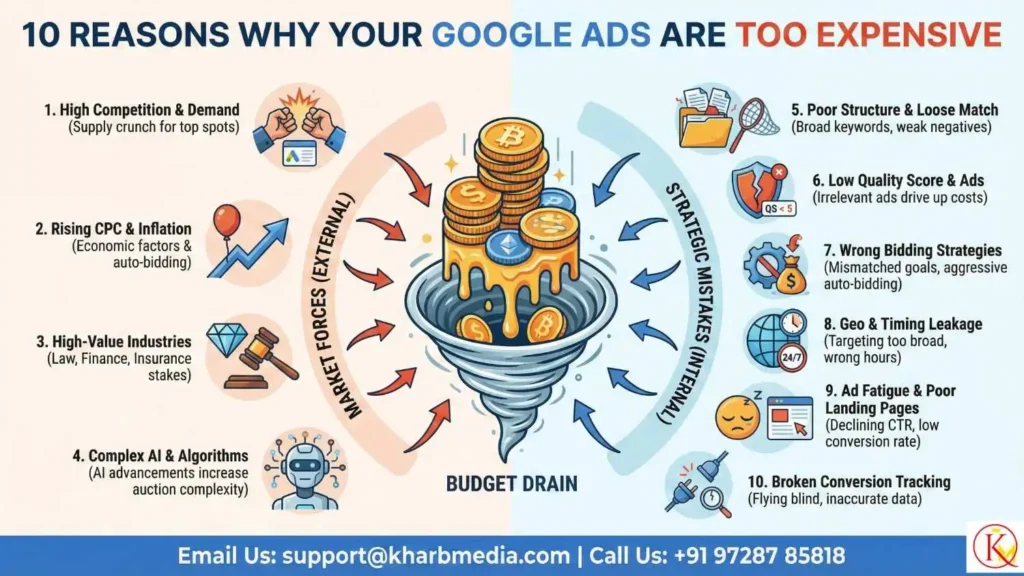
Why are Google Ads so expensive for your specific business? It usually comes down to a mix of market forces and strategic mistakes. Here are the top reasons your budget is vanishing.
1. Supply, Demand, and Increased Competition
Google Ads operates on the basic rules of supply and demand. More businesses are fighting for the same limited ad space at the top of the search results. When multiple advertisers target the exact same popular keywords, the competition intensifies and drives up the price.
2. Rising Cost per Click (CPC) and Inflation
General economic inflation raises expenses across all areas of business, including digital marketing. On top of that, automated bidding algorithms actively adjust bids to win conversions, which can push prices higher in busy markets.
3. Industry-Specific Factors & High-Value Keywords
Certain industries face higher costs because a single new client is extremely profitable. Sectors like law, finance, and insurance have higher stakes, so advertisers willingly pay premium prices to outbid competitors.
4. Algorithmic Priorities and Google’s AI
Google is constantly updating its artificial intelligence to optimize ad delivery. While AI offers precise targeting, it also increases the complexity of the auction. Advanced targeting options often require more investment to win the best spots.
5. Poor Account Structure and Loose Keyword Matching
If you use broad match keywords without a strong list of negative keywords, you will pay for irrelevant traffic. Bidding on vague, simple keywords (like “plumber”) wastes money because the searcher’s intent is not clear.
6. Low Quality Score and Ineffective Ads
Ineffective ads directly make your campaigns too expensive. If your ad lacks relevance to the search term, users will bounce, your Quality Score will suffer, and Google will charge you more for every single click.
7. Wrong Bidding Strategies and Budget Waste
If your bidding strategy does not match your goals, you will overspend. Automated options like Target CPA or Target ROAS use algorithms to chase conversions, which can aggressively raise your bids during highly competitive times. If your target is set too high, you will throttle your traffic and pay a premium for scarce results.
8. Geographic Location and Timing Leakage
Targeting major cities like New York or Los Angeles costs more because the competition is fierce. If you target a massive area instead of your true local market, you waste money competing with national brands. Additionally, running ads 24/7 without proper scheduling wastes budget during times when your audience is asleep or inactive.
9. Ad Fatigue and Poor Landing Page Experience
If you run the exact same ads for months, people stop clicking. Declining click-through rates (CTR) from ad fatigue ruin your Ad Rank and raise your effective CPC. Furthermore, if your landing page is slow or confusing, your conversion rate drops, which makes your Cost Per Acquisition (CPA) skyrocket.
10. Inaccurate Conversion Tracking (Digital Plumbing)
If your conversion tracking is broken, you are flying blind. Underreported conversions starve Google’s smart bidding algorithms of the data they need. This causes the system to overbid on low-quality users because it does not know what a real customer looks like.
The Hidden Costs in a Google Ads Budget
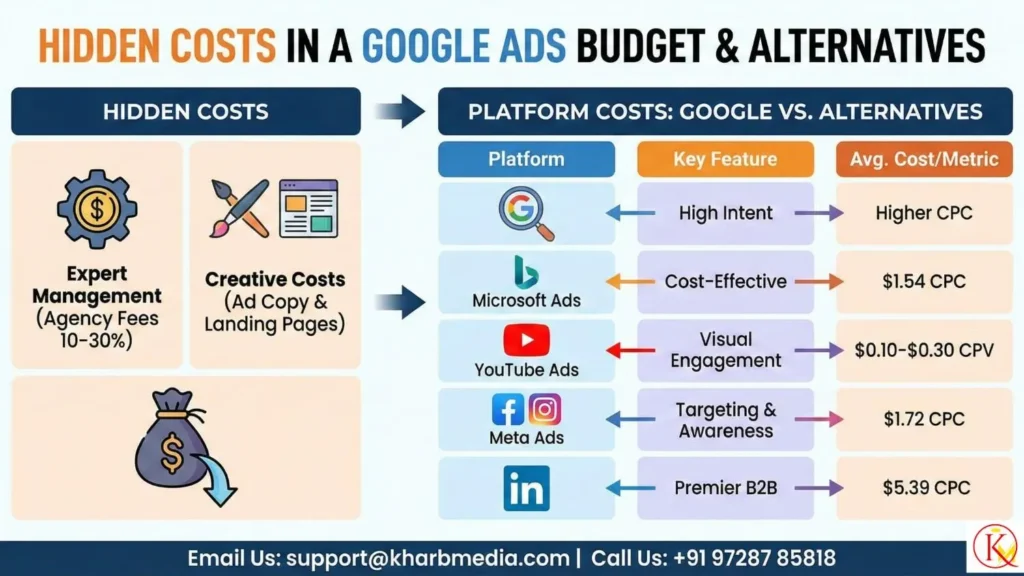
Your CPC is not the only thing draining your wallet. To understand your true Google Ads investment, you must factor in the hidden costs.
Expert Management and Creative Costs
Running a profitable campaign requires constant testing and adjustments. If you hire a professional agency, you will pay a management fee, often ranging from 10% to 30% of your ad spend. However, for most businesses, this expertise pays for itself because a badly run campaign will burn through cash faster than any agency fee. You also have to consider the costs of writing great ad copy and designing landing pages.
Platform Costs: Google Ads vs. Alternatives
Sometimes, Google Search intent is too expensive for your current budget. Google generally has higher CPC rates than social media platforms because searchers have a high intent to buy.
If your budget is tight, you might look at Google Ads alternatives:
- Microsoft Ads (Bing): Holds a smaller market share but is highly cost-effective, with an average CPC of $1.54 and a conversion rate of 2.94%. It caters to an older, educated demographic.
- YouTube Ads: Great for visual engagement. As the second-largest search engine, it boasts over 2.5 billion users. Advertisers generally pay between $0.10 and $0.30 per view.
- Meta Ads (Facebook & Instagram): Excellent for targeting specific ages and interests. Facebook has an average CPC of $1.72 and a strong average conversion rate of 9.21%. These platforms are cheaper for building awareness but often catch people in the discovery phase, not the buying phase.
- LinkedIn: The premier B2B platform. It offers advanced job title targeting but is more expensive, with an average CPC of $5.39.
The Kharb Media Playbook: How to Reduce Google Ads Cost and Lower CPC
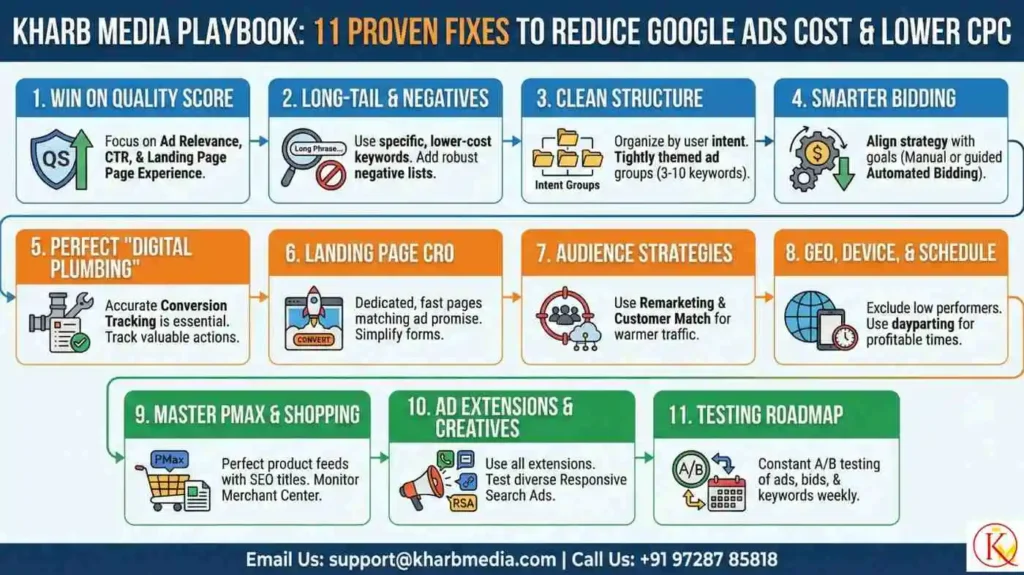
Our senior strategists have executed this exact playbook for countless clients. If you want to stop wasting money, follow these 11 proven fixes to lower your costs and boost your return on investment.
Fix 1: Win on Quality Score (The Game Changer)
Google rewards great advertisers with cheaper clicks. To improve your Quality Score, you must focus on three things: ad relevance, expected click-through rate (CTR), and landing page experience. Ensure your ad copy perfectly matches the keywords you are targeting.
Fix 2: Focus on Long-Tail Keywords and Robust Negatives
Stop bidding on broad, highly competitive one-word terms. Instead, use long-tail keywords. These are specific phrases with three or more words. For example, instead of bidding on “plumber,” bid on “emergency plumber in Chicago”. They cost less and attract highly qualified leads.
Equally important are negative keywords. These prevent your ads from showing up in irrelevant searches. If you sell luxury watches, add “cheap” as a negative keyword so you do not waste money on people looking for a bargain.
Fix 3: Clean Up Account Structure for Intent and Control
The fastest way to reduce waste is to organize your account by user intent. Theme your ad groups logically based on specific services. Limit each ad group to 3-10 tightly related keywords. Keep your branded search terms in a completely separate campaign so your budget does not get cannibalized.
Fix 4: Smarter Bidding and Budget Strategy
Align your bid strategy with your actual goals. Manual bidding lets you set the maximum CPC for total control. If you use automated bidding like Target CPA, start near your recent average CPA and step it down gradually.
Fix 5: Set Up Perfect “Digital Plumbing” (Conversion Tracking)
I do not care how beautiful your ads are; if you do not have your digital plumbing set up, you will fail. You must have proper communication channels between your website and Google Ads. Track valuable actions like form submissions and phone calls, not just clicks. When Google knows exactly what a good lead looks like, the algorithm will find more of them for you.
Fix 6: Landing Page Experience and Conversion Rate Optimization (CRO)
Your website quality directly affects your ad pricing. You must have a dedicated, single-focus landing page for each distinct ad group. Sending paid traffic to your generic Home page is one of the worst mistakes you can make. Optimize your pages for speed, make your forms simple, and ensure the message on the page matches the promise in your ad.
Fix 7: Audience Strategies and First-Party Data
Stop paying premium prices for cold traffic. Shift your mix toward audiences who already know you. Use remarketing to target people who have visited your site but did not buy. Upload your customer lists using Customer Match so Google can find similar, high-value users.
Fix 8: Geo, Device, and Schedule Optimization
Layer in controls where performance drops off. Exclude low-performing regions or set aggressive bid modifiers for high-value zip codes.
Use ad scheduling (dayparting) to concentrate your spending on the most profitable days and times. Turn off your ads during unproductive times, like weekends, to save your budget for when your audience is ready to buy.
Fix 9: Master Performance Max and Shopping Controls
If you use Google Shopping or Performance Max (PMax), your product feed must be perfect. Write SEO-quality product titles that include your brand, model, and key attributes. Keep an eye on your Merchant Center health and fix any item disapprovals immediately.
Fix 10: Ad Extensions and Creative Optimization
Versatile ad extensions make your ad larger and more informative. Use sitelinks, callouts, and structured snippets to highlight specific features. To combat ad fatigue, use Responsive Search Ads (RSAs) with 8-15 diverse headlines and let Google test the best combinations.
Fix 11: Testing Roadmap and Weekly Cadence
Lowering your Google Ads pricing sustainably requires constant testing. A/B test different versions of your ads, adjust your bids, and update your keyword lists regularly. Check your Search Terms Report weekly to find new negative keywords and promote winning phrases.
Maximizing Profit: How to Set a Profitable Starting Budget
There are no hard and fast rules on exactly how much you should spend on Google Ads per month. Your budget depends entirely on your business goals, your industry, and your local competition.
For small businesses, starting with $500 to $1,000 per month can be a good range to test the waters. However, larger companies in highly competitive fields will need to spend significantly more to see meaningful results.
Remember the ROI Mindset: If you pay $5 for a click, but that click leads to a customer who generates $500 in profit, that is an incredible investment.
Conclusion: Are Google Ads Worth the Money?
Yes, absolutely. Google Ads is still one of the most powerful digital advertising platforms in the world because of its unmatched ability to capture buyer intent.
You do not win in Google Ads by chasing the absolute cheapest clicks. You win by focusing on relevance, user intent, and measurable return on investment. Every single dollar you spend must be traceable to a phone call, a form submission, or a sale.
If your costs are rising, it simply means your strategy needs an update. By fixing your digital plumbing, optimizing your Quality Score, and managing your bids properly, Google Ads becomes a predictable, scalable growth engine instead of a frustrating guessing game.
Ready to stop wasting money on expensive clicks? Let us help you build a high-converting campaign that crushes your competition.
Claim Your Free Digital Growth Strategy Today: Message Us on WhatsApp
Email Us: support@kharbmedia.com
Call Us: +91 97287 85818
Frequently Asked Questions (People Also Ask)
Why are Google Ads so expensive?
Google Ads are expensive due to high competition for keywords, industry-specific factors, ineffective ad copy, improper bidding strategies, and targeting highly competitive geographic locations.
What is a good CPC for Google Ads?
A good CPC varies completely by industry. For some local businesses, $1 to $2 per click is perfectly reasonable. However, high-value sectors like law or finance might gladly pay $10 or more per click because their final conversions are incredibly profitable.
Are Google Ads more expensive than Facebook or TikTok?
Yes, Google Ads generally has higher CPCs. This is because Google captures strong “search intent.” People on Google are actively looking to buy a solution, while users on Facebook or TikTok are just browsing for entertainment.
How can I reduce my Google Ads cost fast?
Focus immediately on long-tail keywords, improve your Quality Scores by matching your ads to your landing pages, use a strict negative keyword list, and optimize your ad schedule to stop running ads during dead hours.