
Selling SEO services to local businesses can feel like an uphill battle.
Many local business owners rely heavily on traditional marketing methods like print ads and word-of-mouth. They often view digital marketing pitches with skepticism, struggling to see the immediate value of an SEO strategy.
With over 15+ years of combined experience, our team at Kharb Media has seen agencies make the exact same mistake: pitching algorithms and technical jargon instead of business growth.
Selling SEO services to local businesses isn’t about explaining backlinks and meta tags; it is about bridging the gap between what you are selling and what clients are actually buying which is visibility and revenue .
Claim Your Free SEO Audit Here: Chat on WhatsApp
This comprehensive guide covers everything from defining your target market to structuring your proposals and handling objections. Let us show you how to dominate the local SEO sales process.
Table of Contents
Step 1: Define Your Target Market and Niche

As an agency owner, you already know that not all clients are a good fit. Identifying and understanding your ideal clients is a crucial first step.
Think about your most successful SEO projects in the past. Your best clients likely shared specific characteristics:
- They understand the value of long-term investments.
- They have realistic expectations regarding SEO timelines.
- They are open to your strategic input and have budgets aligned with their goals.
On the other hand, challenging clients expect overnight results, resist making necessary website changes, and hold unrealistic budget expectations .
Pro Tip: Specialize in specific industries. Industry specialization allows you to develop deep expertise in specific SEO challenges, speak the client’s language, and command higher rates as a specialized expert.
Step 2: How to Promote and Find Local SEO Clients
Cold calling and mass emailing rarely work when selling SEO services to local businesses. Local business owners are bombarded by emails from marketers daily.
Because you are local, face-to-face interaction provides a massive advantage. The most direct way to sell SEO services is by building a genuine relationship first.
Utilize Meetup.com and Local Networking
Hosting free classes on Meetup.com is a highly effective way to meet prospects. You can teach simple, valuable topics like how to post on Facebook, how to write an optimized blog post, or how to go live.
By teaching these skills for free, you build trust and showcase your expertise. After the class, business owners will often approach you to handle their marketing for them.
Additionally, join networking groups like BNI to meet people and invite them to your free educational events.
Get Your Free SEO Audit
Struggling to rank your agency or your clients’ websites? Our senior strategists can help: Chat on WhatsApp
Step 3: Qualify Prospects and Ask the Right Questions
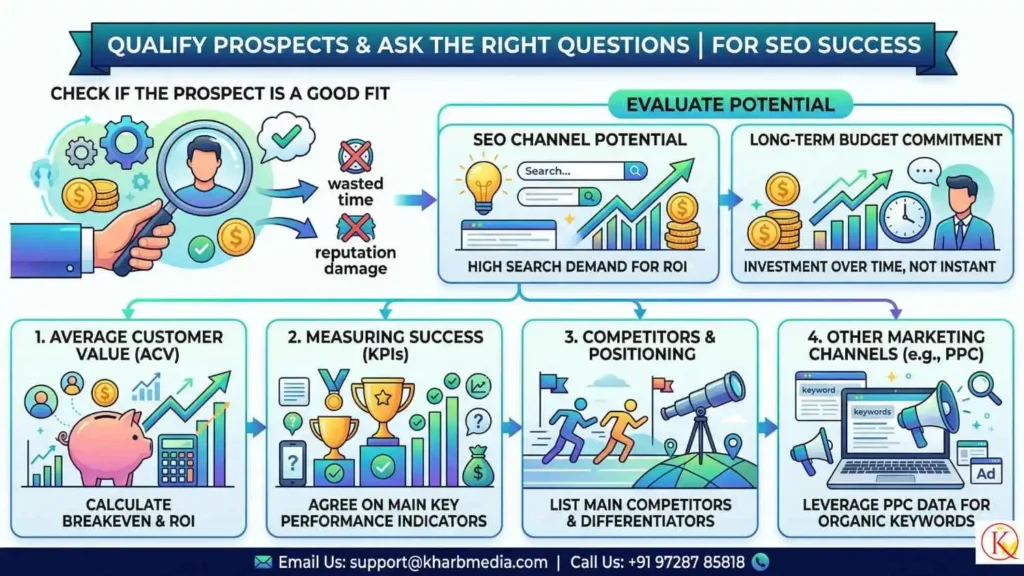
Before you try to close a deal, you must check if the prospect is a good fit. Working with a bad fit wastes time and can damage your reputation as a service provider.
Evaluate the potential of their SEO channel. Some local businesses have high search volume potential, while others simply do not have the search demand to make a positive ROI.
You must also confirm they have the budget to invest long-term, as SEO is not the fastest marketing channel .
Ask these crucial questions during your discovery phase:
- Average Customer Value: This helps you figure out the breakeven point for your services and calculate potential ROI.
- Measuring Success: Agree on a main KPI, such as leads, inquiries, or transactions .
- Competitors & Positioning: Ask for a list of their main competitors and how they differentiate themselves .
- Other Marketing Channels: If they run PPC ads, ask for a report of their top-converting queries so you can target those winning keywords organically .
Step 4: Communicate Value Over Technical Jargon
Your clients do not need to know every technical detail about search engines. What they actually care about is how SEO will impact their bottom line.
Translate technical concepts directly into business benefits.
Instead of saying, “We’ll optimize your meta descriptions,” say, “We’ll make your website more visible to potential customers actively searching for your services”.
Frame SEO improvements purely in terms of ROI.
For example, estimate the value of additional conversions based on their current traffic, conversion rate, and average customer value .
Visualize the SEO journey for them. Show a simple roadmap moving from Initial Optimization, to Increased Traffic, to Leads, and finally to Revenue .
Step 5: Address Common Objections Proactively
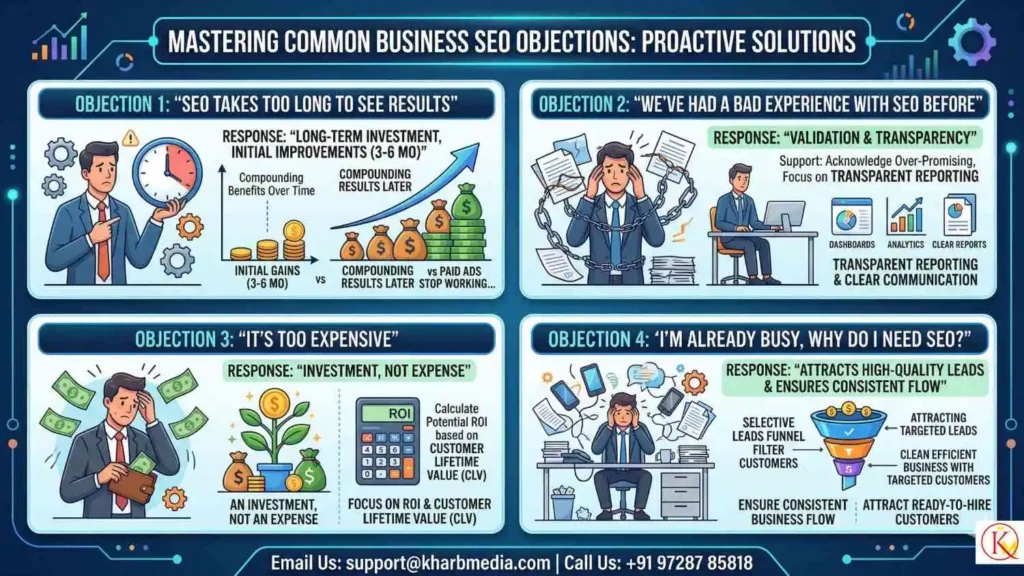
When selling SEO services to local businesses, be prepared for pushback. Address these common objections head-on:
Objection 1: “SEO takes too long to see results.” Response: Explain that while it is a long-term strategy, initial improvements often appear within 3-6 months. Emphasize that SEO benefits compound over time, unlike paid ads that stop working the second you stop paying.
Objection 2: “We’ve had a bad experience with SEO before.” Response: Validate their concern by acknowledging that many agencies over-promise and under-deliver. Reassure them by focusing on your transparent reporting and clear communication.
Objection 3: “It’s too expensive.” Response: Remind them that SEO is an investment, not an expense. Break down the potential ROI based on their customer lifetime value to show how it pays for itself.
Objection 4: “I’m already busy, why do I need SEO?”
Response: SEO attracts the right leads. It brings in customers who are actively searching and ready to hire, ensuring a consistent flow of business even when referrals slow down.
Step 6: The 3-Step SEO Services Value Ladder
A value ladder introduces inexpensive services with fast results, which eventually lead to larger, recurring contracts. This builds trust with local businesses before asking for a massive commitment.
Tier 1: Google Business Profile Setup and Optimization
A Google Business Profile is the second most important marketing channel for a local company, right after their website. It allows businesses to connect with consumers across Google Search and Maps. Offering a setup and optimization service is an easy, high-value first step.
Tier 2: Review Management
Customer reviews are essential, but local businesses often lack the systems to gather them efficiently. You can offer an automated review management service that encourages positive feedback. This requires minimal monthly maintenance but provides immense value.
Tier 3: High-Value Ongoing SEO
Once trust is established, move them to the top of your value ladder: ongoing monthly SEO. This includes technical SEO audits, monthly blog writing, on-page optimization, and off-page link building.
Step 7: Structuring a Winning SEO Proposal
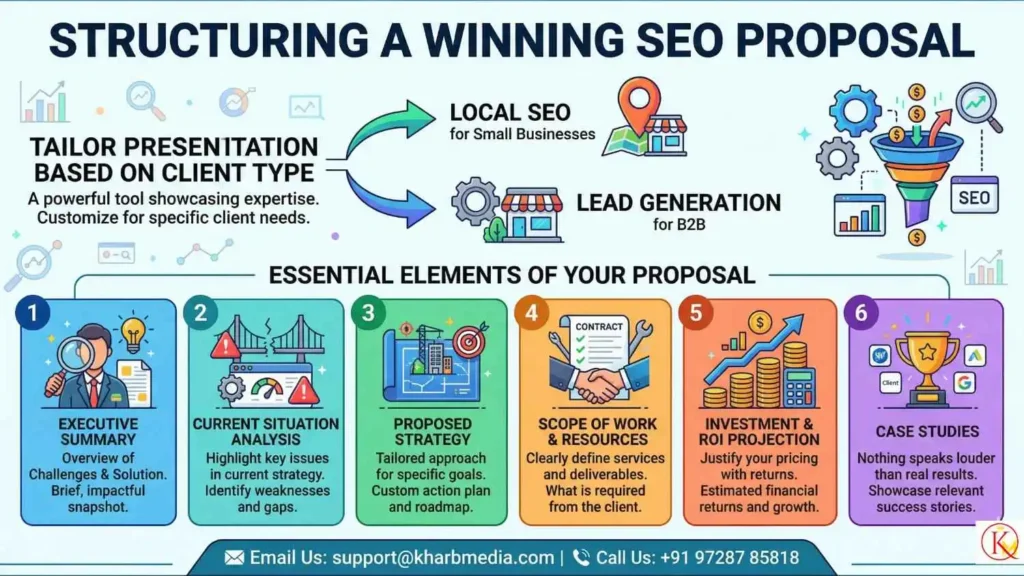
Your SEO proposal should be a powerful tool that showcases your expertise. Tailor your presentation based on the client type (e.g., local SEO for small businesses, lead generation for B2B) .
Include these essential elements in your proposal:
- Executive Summary: A brief overview of their challenges and your solution.
- Current Situation Analysis: Highlight key issues in their current strategy.
- Proposed Strategy: Outline your approach tailored to their specific goals.
- Scope of Work & Resources: Clearly define your services and what is required from the client.
- Investment and ROI Projection: Justify your pricing with potential financial returns.
- Case Studies: Nothing speaks louder than real results. Showcase relevant success stories to prove your competence.
Step 8: Pricing Strategies for SEO Services
Pricing your services correctly is critical. Price too high, and you scare off clients; price too low, and you undervalue your expertise.
Here are the most common pricing models:
- Monthly Retainer: Provides steady income and allows for long-term strategy, though it can be harder to sell to budget-conscious clients .
- Project-Based Pricing: Excellent for one-time optimizations (like site audits) and easier for clients to budget .
- Performance-Based Pricing: Aligns your success with the client’s, allowing for higher fees for great results, but carries more risk .
- Hourly Rates: Straightforward for small consulting tasks, but can be unpredictable for clients .
How do you determine your actual rates? You can mystery shop your competitors to see what the local market dictates . Alternatively, base your pricing on how much a new lead is worth to the client.
Step 9: Deliver Quick Wins and Nurture the Relationship
While clients understand SEO is long-term, they still want to see immediate impact. Provide quick wins within the first few months to solidify their trust.
Look for low-competition keywords that you can rank for quickly. Correct search intent mismatches on their existing pages . Perform basic on-page optimizations, like fixing meta titles that have search demand.
Once you secure the client, focus on nurturing a long-term relationship.
- Set realistic expectations from day one.
- Deliver consistent value beyond just rankings by offering strategic business recommendations .
- Communicate effectively using regular reports and absolutely zero jargon
Step 10: Upselling Content Marketing
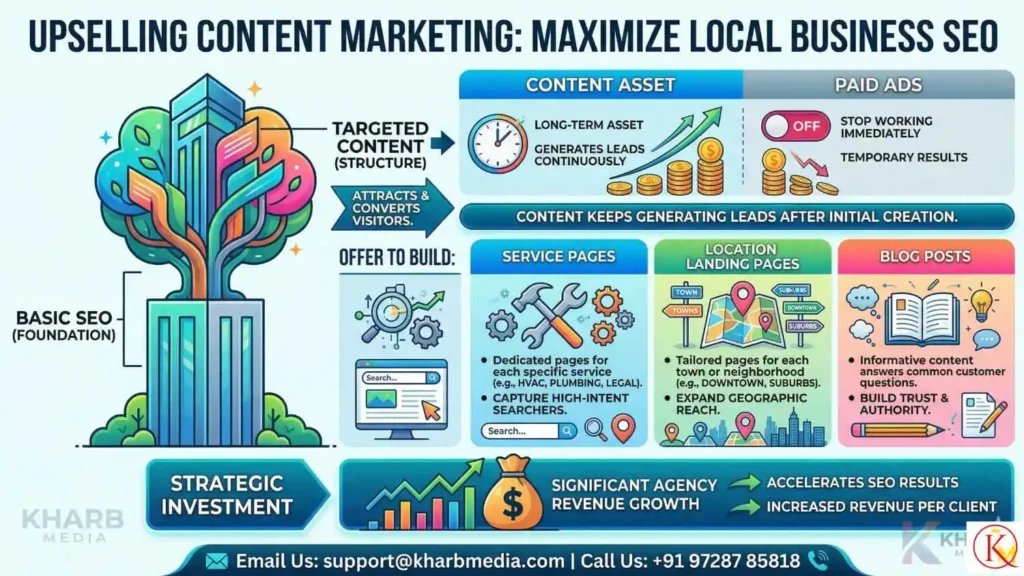
Basic SEO lays the foundation, but targeted content is the structure that actually attracts and converts visitors.
When selling SEO services to local businesses, always offer content creation as an upsell. Explain that content is an asset that keeps generating leads long after the initial creation, unlike paid ads.
Offer to build:
- Service Pages: Dedicated pages for each specific service they offer, capturing high-intent searchers.
- Location Landing Pages: Tailored pages for each town or neighborhood they serve, expanding their geographic reach.
- Blog Posts: Informative content that answers common customer questions, building trust and authority.
By positioning content creation as a strategic investment that accelerates SEO results, you can significantly increase your agency’s revenue per client.
Final Thoughts from Kharb Media
With over 15+ years of combined experience, our team at Kharb Media knows that selling SEO services to local businesses requires strategy, patience, and a deep understanding of business economics.
By focusing on revenue rather than rankings, addressing objections proactively, and utilizing a smart value ladder, you can transform hesitant local business owners into long-term, profitable partners. Start implementing these strategies today, and watch your agency grow.
Ready to scale your digital presence? Let’s talk: Chat on WhatsApp
Phone: +91 97287 85818
Email: support@kharbmedia.com
People Also Ask (FAQs)
How do I get my first local SEO client?
he most effective way is through in-person networking and offering immense upfront value. Host free educational marketing classes on platforms like Meetup.com, join local business groups like BNI, and offer free, basic website audits to build trust before pitching your services.
What is the best pricing model for local SEO?
Monthly retainers are generally the most profitable and allow for proper, long-term SEO strategy implementation. However, if a client is hesitant, start with a project-based fee for a specific task (like Google Business Profile optimization) to build trust before moving them to a retainer.
How do I explain SEO to a local business owner?
Avoid all technical jargon. Use analogies they understand. Explain that SEO is like having a storefront on the busiest street in town. Focus entirely on the business benefits: more visibility, higher quality leads, and increased revenue.