

If you run a design-build or construction business, your best clients aren’t across the country. They are usually right down the street.
Many construction companies struggle to stand out on Google Maps, which means they miss out on high-value potential clients in their own local market. You might do incredible work, but if your business doesn’t show up when a homeowner searches for “design and build contractors near me,” you lose the job.
With over 15+ years of combined experience, our team at Kharb Media has seen how digital visibility can make or break a local business. We know that if you rank well in Google, you will get more customers.
In this complete guide, our senior strategists will walk you through exactly how to master google maps seo for design-build firms. We will cover everything from optimizing your Google Business Profile to technical website fixes that drive real revenue.
Table of Contents
Why Local SEO Matters for Your Construction Business
Most people who run contracting or design-build businesses operate locally. Your crews and equipment stay inside a defined service area.
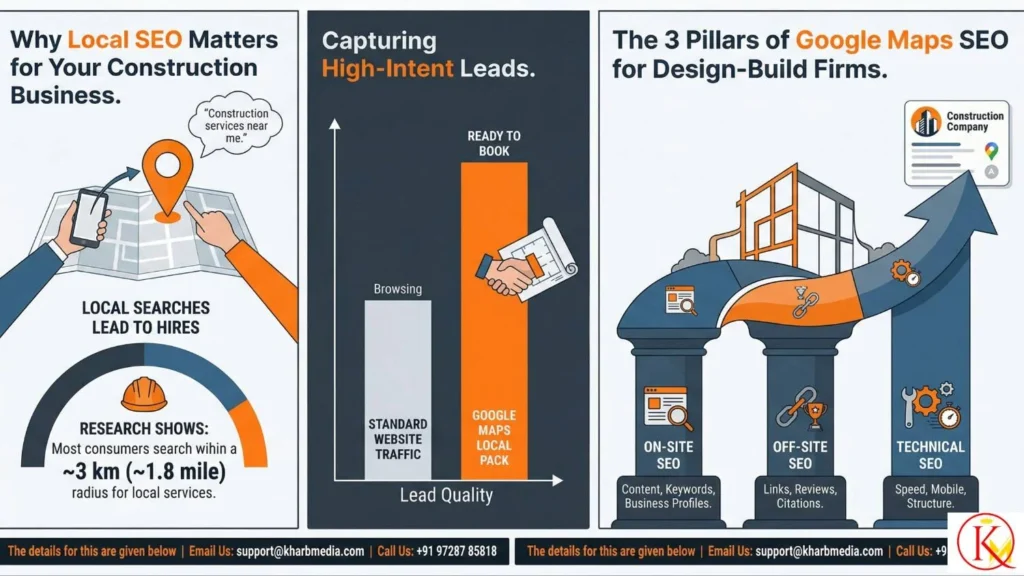
Because of this, local SEO is incredibly vital to your business. When a user searches for terms like “construction services near me,” local SEO directly improves your usability and allows clients to find you easily.
Research shows that most consumers search within about a 3 km (1.8 mile) radius for local services. This means Google prioritizes businesses that are physically closest to the user.
When someone searches for a “home addition contractor near me,” they are not just browsing. They are actively trying to solve a problem and want to hire someone soon.
By showing up in the top three map listings known as the Local Pack you meet these high-intent clients at the exact moment they are ready to book.
[Insert Graph: Standard Website Traffic vs. Local Pack Lead Conversion Rates]
The 3 Pillars of Google Maps SEO for Design-Build Firms
Google takes into account over 200 ranking factors when deciding how high up the rankings your website should appear.
Regardless of your industry, these factors are split into three main areas:
- On-site SEO
- Off-site SEO
- Technical SEO
Your strategy needs to target all three of these areas to improve your ranking positions and secure your spot on Google Maps.
Looking for a shortcut to the top. Stop guessing and start ranking. Get Your Free SEO Audit from our experts today: Chat On WhatsApp
Phone: +91 97287 85818
Email: support@kharbmedia.com
Step 1: Build a Strong Google Business Profile Foundation
For most design-build firms, your Google Business Profile (GBP) is the welcome mat of your online presence. It feeds directly into Google Maps and helps you appear in local search results.
Claiming and verifying this profile is the foundational step for improving your local SEO. Here is how you optimize it for maximum visibility.
Craft an Engaging Business Description
A well-structured description utilizes keyword research to incorporate terms that potential clients search for, such as “construction services”.
Be sure to highlight your expertise and explicitly state what makes your firm unique. Incorporating phrases that build trust can significantly impact your business’s positive perception.
Add Accurate Categories and Attributes
Choosing categories that match your exact services like general contractor, commercial construction, or remodeling services is essential.
This practice shapes your online reputation and helps Google align your business with relevant client needs. By categorizing your services correctly, you attract more local clients seeking specific solutions.
Use High-Quality Photos to Showcase Work
Utilizing high-quality photos to showcase your completed projects is a crucial part of optimizing your profile.
Upload before-and-after photos, shots of your jobsite, and pictures of your team. Visual content gives potential clients a clear view of your capabilities and builds immediate trust.
Collect and Respond to Customer Reviews
A staggering 90% of people read online reviews before visiting a business.
Getting reviews from past customers will help improve your Google Business Profile and push you higher in the Map Pack. Make it a habit to direct clients to your profile to leave a review.
Always respond promptly to both positive and negative feedback. Responding to criticism shows that you listen and learn, which customers highly appreciate.
Step 2: Implement High-Converting On-Site SEO
On-site SEO involves putting keywords in the right place on your website and ensuring you have relevant content for potential customers.
If you want to master google maps seo for design-build firms, your website needs to prove to Google that you are the local authority.
Target the Right Local Keywords
Solid local SEO begins with smart keyword research. You should avoid trying to rank for a generic word like “contractor”.
Instead, use long-tail local keywords like “kitchen remodeler in [city]” or “home renovation services in [city]”. You can use tools like Ubersuggest or Answer the Public to find relevant keywords and check their search volumes.
Optimize Title Tags and Meta Descriptions
Optimizing your title tags and meta descriptions is critical for visibility. These elements are the first impression users get on the search results page.
Make sure your title tag is descriptive and relates to both your service and your location. For example, if you build basements in London, your title tag should be “Basement Conversion Specialists in London”.
Create Unique, Location-Specific Service Pages
Nearly every service you sell should have its own dedicated page. For example, “design and build,” “house extensions,” and “loft conversions” should all have separate pages.
Furthermore, creating location-specific service pages allows you to target specific communities directly. Tailoring your content to a specific geographic area provides potential clients with relevant information that addresses their local needs.
Maintain NAP Consistency and Schema Markup
Ensuring your Name, Address, and Phone number (NAP) is completely consistent across your website, directory listings, and social profiles is crucial.
Additionally, integrating schema markup helps search engines understand your specific business information, like your location and the services you offer. This structured data improves your chances of being featured prominently on Google Maps.
Step 3: Build Authority with Off-Site SEO
You can view off-site SEO as building your company’s online reputation, with Google acting as the judge. The goal is to increase the total number of reputable websites that talk about and link to your firm.
Submit to Relevant Local Directories
Submitting to directories is the easiest way to get a good foundation of links.
Identify and submit to reputable, industry-specific directories where potential clients search for construction services. Directories like Houzz, Yelp, and your local Better Business Bureau help show Google that you are a real company with a real address.
Leverage Relationships and Sponsorships
Do you work regularly with building material providers, architects, or real estate agents?. You can use these relationships to get a backlink to your website.
Sponsoring local community events, sports teams, or charities is another powerful strategy. These sponsorships provide valuable backlink opportunities from event websites and signal local authority to search engines.
Track and Manage Your Citation Profile
Tracking your citation profile is essential for ongoing local SEO effectiveness.
Conduct regular audits of your online listings to ensure all information remains accurate and consistent across the web. Utilizing tools like Moz or BrightLocal can streamline this process and help you identify any discrepancies.
Step 4: Enhance Technical SEO and User Experience (UX)
The best content in the world cannot overcome a slow, confusing, or glitchy website. If your site takes forever to load, people will simply bounce and look elsewhere.
Ensure Mobile Compatibility
With Google searches on mobile devices constantly rising, your website must be ‘responsive’.
Google now uses a mobile-first index, meaning they rank your website based on its mobile view, not the desktop view. Having a site that adjusts seamlessly to different screen sizes improves user experience and keeps visitors engaged.
Optimize Website Load Speed
Google has explicitly stated that page speed is a ranking factor.
A swift-loading site engages potential clients and reduces bounce rates. You can test your website using Google PageSpeed Insights to identify areas for improvement, like image compression or minifying CSS files.
Provide Clear Navigation and CTAs
Creating easy navigation with clear sections dedicated to different service areas is crucial.
You must also provide clear Calls to Action (CTAs) and accessible contact information. Placing prominent buttons like “Call Now” or “Request a Quote” ensures potential clients can reach out with zero friction.
Feature Case Studies and Testimonials
Incorporating customer testimonials and real case studies on your site builds deep credibility.
Showcasing real examples of your completed projects helps address common concerns about reliability and quality. Highlighting positive feedback proves your expertise to local customers.
Step 5: Track ROI and Outsmart the Competition
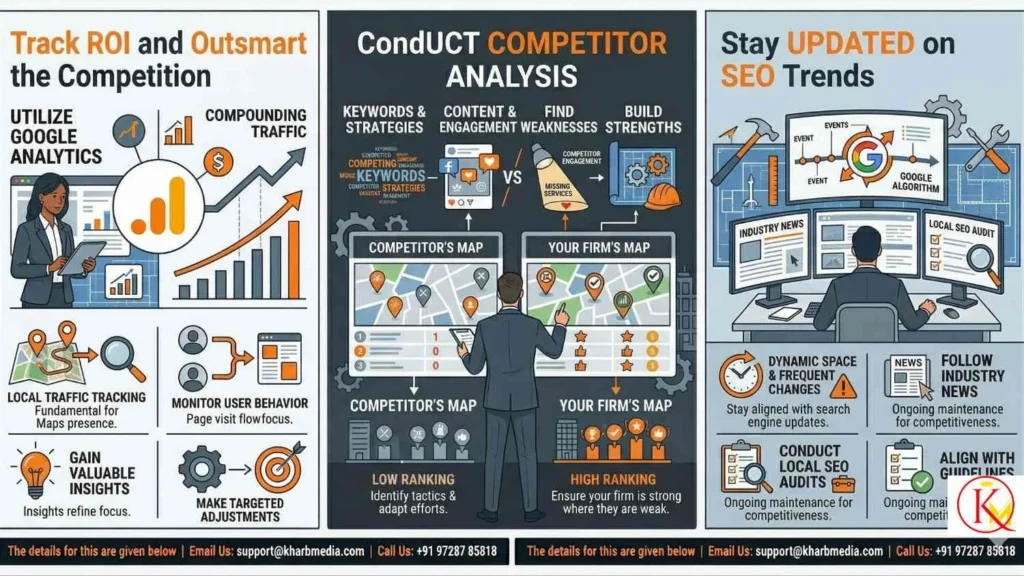
Local SEO results build gradually, but the compounding effect over time is incredibly powerful. To sustain your advantage, continuous monitoring and strategic adjustments are essential.
Utilize Google Analytics
Tracking local traffic with Google Analytics is fundamental to enhancing your presence on Google Maps.
By monitoring user behavior like which pages they visit and their geographical location you gain valuable insights into what attracts local clients. This allows you to refine your focus and make targeted adjustments.
Conduct Competitor Analysis
Examining the tactics used by top-performing competitors on Google Maps is a vital strategy.
By identifying the keywords, content strategies, and engagement techniques your competitors use, you can adapt your own marketing efforts. Find where they are weak, and make sure your firm is strong in those exact areas.
Stay Updated on SEO Trends
The digital space is constantly evolving, and Google’s algorithm changes frequently.
Regularly following industry news and conducting local SEO audits ensures you stay aligned with the latest search engine guidelines. This ongoing maintenance keeps you competitive in local search results.
DIY vs. Hiring a Digital Marketing Agency
When it comes to google maps seo for design-build firms, you have two options: do it yourself, or hire an expert who knows the ropes.
If you are hands-on, you can set up your GBP, collect reviews, and update project photos yourself. However, the tradeoff is that local SEO requires massive consistency, and you will need to carve out time every single month to monitor your performance.
Like most business owners, you are likely focused on doing what you do best running your construction jobs. The long process of learning and executing SEO often falls to the bottom of the priority list.
For many contractors, hiring an agency is not an expense it is a shortcut to showing up faster and earning better projects. A specialized team helps you rank in Google Maps, target profitable ZIP codes, and secure a steady flow of qualified leads.
Claim Your Local Market Today
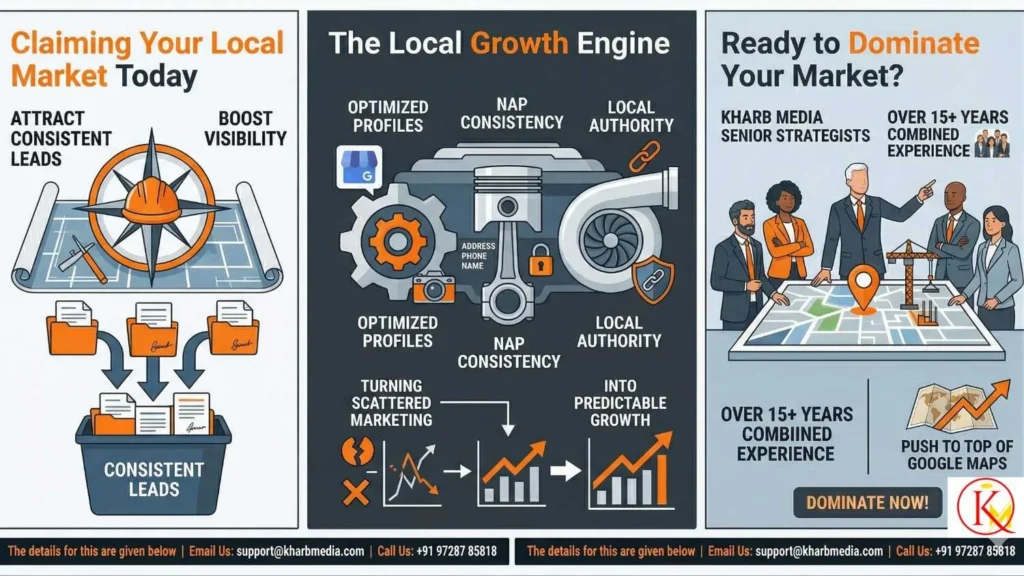
Local SEO is one of the most effective and affordable ways for design-build firms to attract consistent, high-quality leads. It ensures your business stands out when potential clients are actively looking for help.
By optimizing your profiles, maintaining NAP consistency, and building local authority, you can turn scattered marketing into a predictable engine of local growth.
Ready to dominate your local market?
With over 15+ years of combined experience, our senior strategists at Kharb Media know exactly how to push your firm to the top of Google Maps.
Get Your Free SEO Audit today and let us build your digital growth strategy: Chat On WhatsApp
Phone: +91 97287 85818
Email: support@kharbmedia.com
People Also Ask (FAQs)
Why do construction companies need SEO?
Because if you rank well in Google, you will get more customers. SEO helps potential leads find your company online, ensuring you have a steady stream of business each month.
What is the difference between general SEO and local SEO?
General SEO focuses on ranking a website globally or nationally. Local SEO specifically targets a defined geographic area so nearby homeowners can find your business when they search for local services.
How fast can local SEO generate qualified leads?
While SEO is a long-term strategy, optimizing your Google Business Profile can yield quick visibility improvements. However, building strong organic authority through citations, content, and backlinks typically takes a few months to show compounding, highly profitable returns.