

You just wrapped up a monthly marketing review, and the numbers do not add up.
Your social platforms claim credit for 180 leads, Google Ads claims 150, and your email team insists they brought in 90. Add them up, and you have 420 leads. But your CRM only shows 200 actual leads in the system.
Sound familiar? This is a fundamental challenge every business faces. When you cannot answer where your best customers are actually coming from, you are just burning budget and hoping something sticks.
With over 15+ years of combined experience, our team at Kharb Media has seen how poor tracking holds businesses back. Finding the right social media lead source identification methods is the foundation of every smart marketing decision.
In this guide, our senior strategists break down exactly how to track, analyze, and optimize your lead sources to drive real revenue.
Table of Contents
What is a Lead Source? (And Why Does It Matter?)
At its core, a lead source is the specific channel, campaign, or touchpoint that brings a potential customer into your business. It answers the simple question: “How did this person find us?”.
Knowing your lead source trends enables you to grow your leads effectively. If you track where potential customers first learn about your business, you can narrow down the most successful channels in your lead generation efforts and focus your budget there.
The main aim of tracking lead sources is to help organizations improve their lead generation campaigns. When you know which sources generate leads that actually convert to revenue, you can confidently scale what works and cut what does not work.
Types of Lead Sources: A Complete Breakdown
Different lead source categories attract prospects at different stages of awareness. Understanding these distinctions helps you set realistic expectations for your campaigns.
Top Online Lead Sources
- Paid Social Media Ads: Platforms like LinkedIn lead ads can be particularly effective for B2B targeting. Social platform ads interrupt a user’s feed, meaning you often catch prospects earlier in their buying journey.
- Organic Search (SEO): SEO-driven traffic represents people finding you through unpaid search results. These leads discover you while actively researching solutions.
- Paid Search (PPC): When someone clicks your Google ad, they are demonstrating active intent. They have a problem and are looking for solutions right now.
- Content Marketing: Blog posts, guides, and webinars attract prospects through value delivery. Content sources build your pipeline with leads you can nurture over time.
- Email Campaigns: Email as a lead source typically indicates someone taking the next step in their journey from subscriber to qualified lead.
Top Traditional Lead Sources
- Referrals: Word-of-mouth recommendations are powerful. Customer referrals make up 54 percent of B2B leads, leading the way in both digital and non-digital sourcing.
- In-Person Events: Attending conferences, seminars, and business openings are all opportunities to generate leads through networking.
- Cold Calling: Picking up the phone and calling your target audience remains a strategy many businesses rely on to source leads.
Why Traditional Tracking is Failing You Today
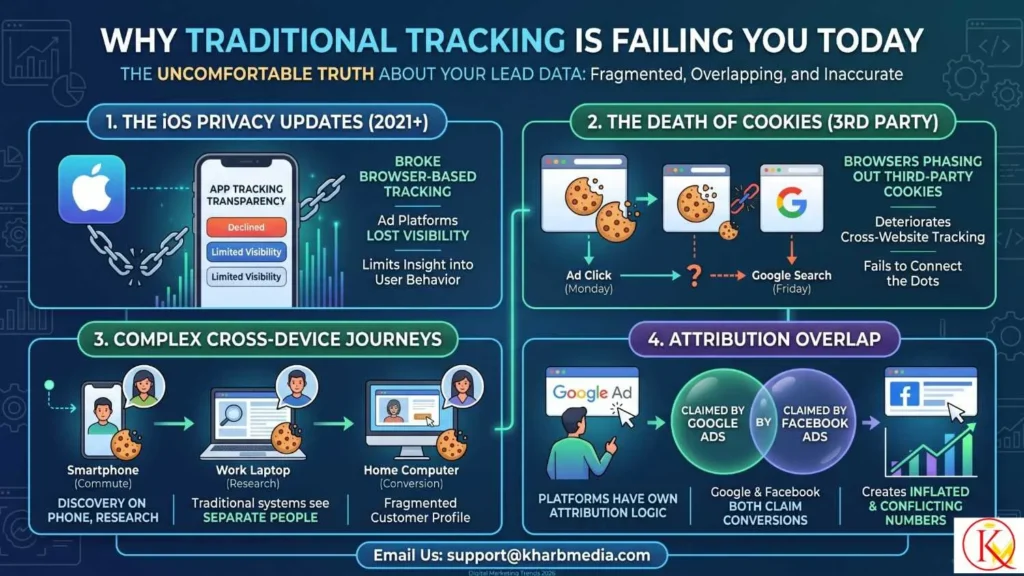
Here is the uncomfortable truth: the lead source data you are looking at right now is probably incomplete or overlapping. The foundation of traditional tracking has fundamentally shifted.
1. The iOS Privacy Updates The iOS privacy changes that rolled out starting in 2021 broke the browser-based tracking that marketers relied on for years. When Apple introduced App Tracking Transparency, ad platforms lost visibility into significant portions of user behavior.
2. The Death of Cookies As browsers phase out third-party cookies, the ability to track users across websites deteriorates. Traditional cookie-based tracking increasingly fails to connect the dots if a prospect clicks an ad on Monday but returns via Google search on Friday.
3. Cross-Device Journeys Someone might discover you on their phone during their commute, research on their work laptop during the day, and convert on their home computer in the evening. Each device looks like a different person to cookie-based tracking systems.
4. Attribution Overlap Each ad platform tracks conversions using its own attribution window and logic. If someone clicks your Google ad on Monday, clicks your Facebook ad on Wednesday, and converts on Friday, both platforms claim that conversion. This creates inflated numbers.
Proven Social Media Lead Source Identification Methods
Accurate tracking is not magic; it is infrastructure. The shift from guesswork to a data-driven strategy requires building a reliable system. Here are the top social media lead source identification methods our senior strategists recommend.
1. Get Granular with UTM Parameters
Start with proper UTM parameter implementation. UTM tags are the snippets you add to your URLs that identify the source, medium, campaign, and content of each link.
- Pro Tip: You need consistent naming conventions across all your campaigns, or you will end up with fragmented data. Create a UTM naming structure and document it.
2. Implement Server-Side Tracking
Server-side tracking represents the next evolution beyond browser-based methods. Instead of relying on cookies, server-side tracking captures data directly from your server when events occur.
This bypasses many privacy restrictions and tracking blockers. It is more reliable, more privacy-compliant, and gives you better data accuracy.
3. Integrate with a Powerful CRM
CRM integration is where lead source tracking transforms from interesting data into business intelligence. When you connect your marketing tools to your CRM, you can track leads through their entire lifecycle.
You will not just see which source generated a lead, but which sources generate leads that become opportunities and close as customers. A CRM easily tracks source and attribution data as part of its sales force automation technology.
4. Choose the Right Attribution Model
Attribution models determine how credit gets distributed across touchpoints.
- First-Touch: Gives all credit to the initial source.
- Last-Touch: Credits the final interaction before conversion.
- Linear: Spreads credit equally across all touches.
- U-Shaped: Emphasizes both the first and last touch while distributing some credit to middle interactions.
Most customer journeys involve multiple touches, so understanding the full path matters more than picking a single winner.
Transforming Lead Data Into Budget Optimization
Having accurate lead source data is pointless if you do not act on it. The real value emerges when you start analyzing sources by quality metrics.
Stop Measuring by Volume Alone A source that generates 100 leads sounds better than one that generates 20 leads. But if the first source converts at 2% to closed deals while the second converts at 30%, those 20 leads are worth far more.
Track Deal Size by Source Look at average deal size by source. Different channels often attract different customer profiles. Enterprise customers might discover you through content marketing and organic search, while smaller businesses come through paid social.
Feed Data Back to Ad Platforms Feeding accurate conversion data back to ad platforms improves their optimization algorithms. When you send Facebook or Google data about which leads actually converted to customers, their machine learning systems get better signals about what a valuable user looks like.
Best Practices for Dominating Lead Generation in 2026
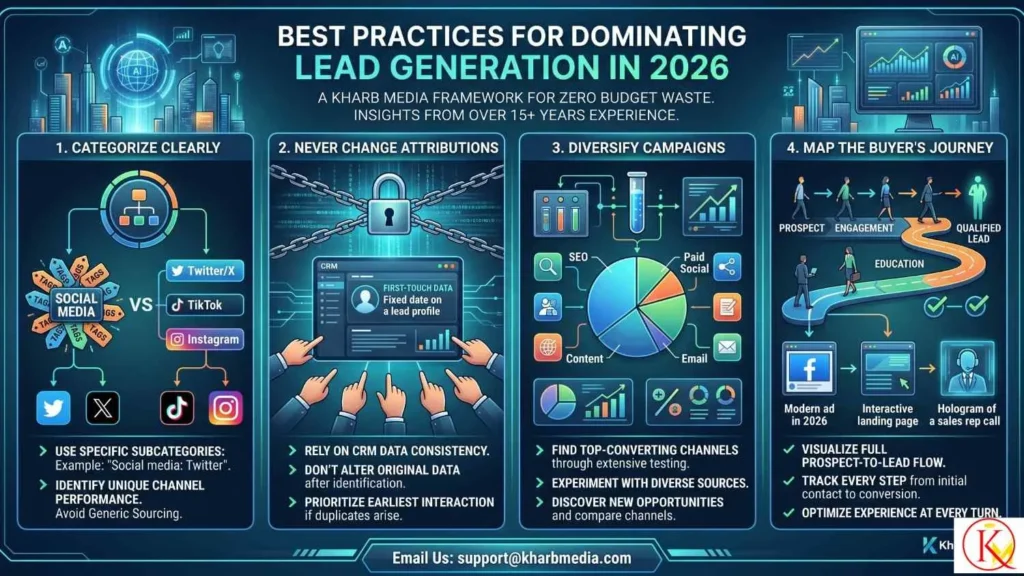
With over 15+ years of combined experience, our team at Kharb Media uses a specific framework to ensure zero budget goes to waste.
- Categorize Clearly: Listing “social media” as your source is not useful when you have ongoing campaigns on Twitter, Instagram, and TikTok. Use subcategories like “Social media: Twitter” to identify different channels.
- Never Change Attributions: Use CRM software to help you track sources properly. Never change an attribution once it is identified. If you encounter duplicate points of origin, reduce confusion by identifying the earliest known interaction.
- Diversify Campaigns: Finding your top-converting channel requires extensive trial and error. Diversifying your efforts uncovers new opportunities and lets you compare different channels.
Map the Buyer’s Journey: Facebook ads may lead a prospect from the ad to a sales landing page and then to your sales team. Map out what this looks like so you can improve the experience at every turn
Claim Your Free Digital Growth Strategy
Understanding lead sources is not just another marketing metric; it is the fundamental intelligence that separates confident budget decisions from expensive guesswork.
If you are tired of struggling to know where your best leads are actually coming from, it is time to build a system that works.
Get expert help from the Kharb Media team today email us: support@kharbmedia.com
Frequently Asked Questions (People Also Ask)
What is the best source for leads?
The best source for leads will vary by industry and audience. While social media and paid search are popular, referrals and email marketing may outperform them in certain sectors.
How do you track lead sources?
Lead tracking begins by determining the source of your lead’s first contact with your business. You can use CRM platforms, custom UTM properties, and server-side tracking to compile and analyze leads as they progress through the funnel.
Why do my ad platforms show more conversions than my CRM?
This is often due to attribution overlap. If a user clicks a Google ad and a Facebook ad before buying, both platforms will independently claim credit for that single conversion.