

Managing social media for multiple clients is rewarding but it also comes with challenges.
As your agency grows, creating content, replying to comments, designing graphics, scheduling posts, tracking analytics, and sending reports can quickly consume your team’s time.
This is where white label social media management becomes a game changer.
Instead of hiring a large in-house team, many successful agencies partner with white label providers who work behind the scenes while the agency keeps full ownership of the client relationship. The client sees your branding, receives professional results, and never knows a third-party team is involved. This reseller-style model, branded reporting, and behind-the-scenes execution are central ideas across the competitor material.
With 15+ years of combined experience, our team at Kharb Media has helped businesses understand that white label partnerships are not just about reducing workload they’re about building a scalable business that delivers consistent quality.
Whether you’re:
- A digital marketing agency
- An SEO company
- A web design agency
- A freelancer
- A branding consultant
- A marketing consultant
- A startup
this guide will help you understand everything about white label social media management, how it works, and how to choose the right solution for your business.
Table of Contents
Why White Label Social Media Management Is Growing in 2026
The digital marketing industry has changed dramatically over the last few years.
Clients expect agencies to provide:
- Social media marketing
- Facebook management
- Instagram growth
- LinkedIn marketing
- Short-form video content
- Community management
- Monthly reports
- Brand strategy
- Performance analytics
Offering all these services requires specialists in different areas.
Hiring designers, copywriters, strategists, video editors, and community managers can become expensive.
Instead, agencies are choosing white label social media management because it allows them to deliver professional services under their own brand without building a large internal team. This aligns with the competitor’s explanation that agencies can outsource production while presenting the work as their own brand.
What Is White Label Social Media Management?
White label social media management is a business model where a specialized company manages social media services on behalf of another agency, while the services are delivered under the agency’s branding.
Simply put:
- Your client hires your agency
- You partner with a white label provider
- The provider completes the work
- Everything is branded with your company name
- Your client believes your agency handled everything internally
The competitor guide describes this as a provider working behind the scenes while reports, communication, and deliverables carry the reseller’s branding.
Example
Imagine you own a digital marketing agency.
A client asks you to manage:
- TikTok
Instead of recruiting five different specialists, you outsource the work to a trusted white label partner.
The partner:
- Creates content
- Designs graphics
- Schedules posts
- Monitors engagement
- Generates reports
Your agency reviews the work, sends it to the client with your branding, and remains the primary point of contact.
The client experiences a seamless service while your agency keeps control of the relationship.
How Does White Label Social Media Management Work?
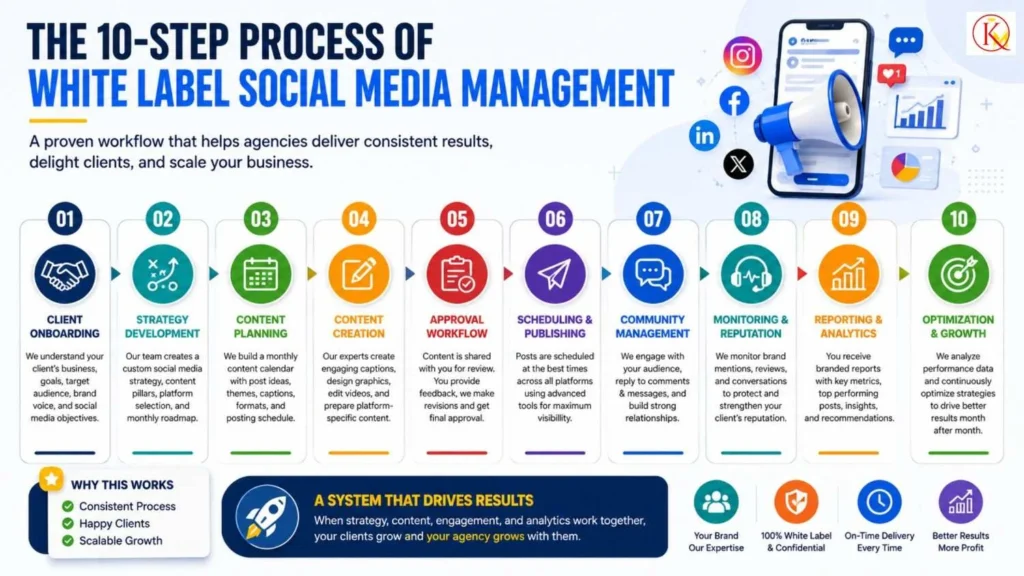
A successful white label partnership follows a structured workflow.
Step 1: Client Onboarding
The agency collects information about:
- Business goals
- Target audience
- Brand guidelines
- Competitors
- Preferred social platforms
- Marketing objectives
A strong understanding of the client’s brand voice and goals is emphasized in the competitor content before execution begins.
Step 2: Strategy Development
The white label team creates:
- Social media strategy
- Content themes
- Posting schedule
- Campaign roadmap
- KPI tracking plan
The agency reviews the strategy before client approval.
Step 3: Content Creation
Professional creators produce:
- Graphics
- Carousels
- Videos
- Captions
- Stories
- Reels
- Hashtags
The competitor highlights content planning, content calendars, and platform-specific content as core deliverables.
Step 4: Approval Process
The content is shared with the agency.
The agency:
- Reviews
- Requests revisions if needed
- Approves final content
Only then is it presented to the client or scheduled for publishing.
The source also recommends batching approvals, using clear deadlines, and keeping everyone on a single version of the content plan to reduce delays.
Step 5: Publishing
Posts are scheduled across selected platforms.
This may include:
- X (Twitter)
- TikTok
- Google Business Profile
Step 6: Community Management
The white label team may also:
- Reply to comments
- Respond to messages
- Moderate discussions
- Handle customer interactions
The competitor notes that active engagement helps build community and brand loyalty.
Step 7: Reporting
Each month, the agency receives branded reports showing:
- Reach
- Engagement
- Follower growth
- Clicks
- Conversions (where applicable)
These reports are then shared with the client under the agency’s brand. The competitor stresses that reports should focus on meaningful outcomes and include a concise explanation of what worked and what changes are planned.
Why Agencies Choose White Label Social Media Management
White label partnerships are popular because they help agencies grow without proportionally increasing headcount.
1. Scale Faster
Instead of recruiting and training a larger internal team, agencies can increase capacity by relying on experienced fulfillment partners.
This supports serving more clients while maintaining consistent delivery.
2. Reduce Operational Costs
Hiring a full social media department involves:
- Salaries
- Software
- Training
- Equipment
- Management overhead
White label partnerships reduce many of these ongoing costs while giving agencies access to established expertise. The competitor also highlights savings on hiring, training, and software.
3. Access Specialized Expertise
Social media changes quickly.
Algorithms evolve.
Content formats shift.
New features appear regularly.
Experienced white label providers keep up with these changes so agencies can continue offering current strategies. The competitor recommends staying updated with trends and adapting strategies over time.
4. Deliver Professional Results Under Your Brand
Clients remember your agency not the fulfillment partner.
That strengthens your reputation, encourages referrals, and helps position your business as a full-service marketing partner.
5. Improve Client Retention
When clients can receive SEO, PPC, web design, email marketing, and social media management from one agency, they’re less likely to look elsewhere.
The competitor similarly notes that offering a complete digital marketing package can improve long-term client retention.
White Label Social Media Management vs Traditional Social Media Management
| White Label Social Media Management | Traditional In-House Management |
| Lower hiring costs | Higher staffing costs |
| Faster scaling | Growth depends on hiring |
| Access to specialist expertise | Expertise limited to internal team |
| Flexible capacity | Fixed team size |
| Reduced operational overhead | Higher management overhead |
| Branded deliverables | Branded internally by your company |
| Supports agency growth | Best suited for organizations with dedicated in-house resources |
Pro Tip (Kharb Media): The best white label partnerships work when responsibilities are clearly defined. Set expectations for deliverables, approval timelines, reporting, and communication from the start to keep projects running smoothly.
What Services Are Included in White Label Social Media Management?
Not every provider offers the same package.
Some only schedule posts.
Others manage the entire social media operation.
Before choosing a provider, it’s important to understand exactly what services are included.
A complete white label social media management package typically includes:
- Social Media Strategy
- Content Planning
- Content Calendar
- Caption Writing
- Graphic Design
- Video Editing
- Reel Creation
- Carousel Design
- Hashtag Research
- Post Scheduling
- Community Management
- Comment Moderation
- Direct Message Management
- Influencer Coordination
- Monthly Reports
- Analytics
- Competitor Analysis
- Reputation Management
The competitor guide similarly describes comprehensive services that include content creation, scheduling, community management, analytics, and reporting under the agency’s branding.
1. Social Media Strategy Development
Every successful campaign begins with a strategy.
Without one, social media becomes random posting instead of purposeful marketing.
A white label provider should create a customized strategy based on:
- Business objectives
- Target audience
- Industry trends
- Competitor research
- Customer behavior
- Platform selection
- Brand positioning
The competitor document also emphasizes understanding brand voice, audience, and goals before building a strategy.
At Kharb Media, Our Strategy Includes:
- Audience Research
- Content Pillars
- Competitor Benchmarking
- Platform Selection
- KPI Planning
- Campaign Calendar
2. Content Planning & Monthly Content Calendar
One of the biggest mistakes agencies make is creating content one day at a time.
Professional agencies plan content weeks in advance.
A monthly content calendar typically includes:
- Publishing dates
- Platform selection
- Content topics
- CTA for each post
- Content format
- Caption approval
- Graphic status
The competitor identifies the content calendar as one of the core monthly deliverables.
Example Monthly Calendar
| Week | Content Type |
| Week 1 | Educational Posts |
| Week 2 | Case Studies |
| Week 3 | Testimonials |
| Week 4 | Promotional Campaign |
Pro Tip: Planning an entire month at once reduces stress, improves consistency, and makes client approvals much easier.
3. Professional Content Creation
Content is still the biggest factor in social media success.
A white label provider should create content that is:
- Original
- Engaging
- Brand-specific
- Educational
- Visually appealing
- Conversion-focused
The competitor repeatedly highlights valuable, platform-specific content as the foundation of successful social media management.
Content Types Included
Educational Posts
Teach customers something valuable.
Example:
7 Ways to Increase LinkedIn Engagement
Promotional Posts
Highlight offers, products, or services.
Behind-the-Scenes Content
Humanizes the brand.
Customer Success Stories
Builds credibility and trust.
Industry News
Keeps followers informed and positions the brand as an authority.
User-Generated Content
Encourages engagement while showcasing real customer experiences.
4. Graphic Design & Visual Branding
Visual content captures attention far faster than text alone.
Professional white label services often include:
- Social Media Graphics
- Infographics
- Carousel Designs
- Story Templates
- Cover Images
- GIFs
- Promotional Banners
Consistency matters.
Every visual should follow:
- Brand colors
- Typography
- Logo usage
- Visual identity
5. Short-Form Video & Reel Creation
Video is one of the highest-performing content formats.
Modern white label providers may produce:
- Instagram Reels
- TikTok Videos
- YouTube Shorts
- Facebook Reels
- LinkedIn Videos
These can include:
- Motion graphics
- Captions
- Music
- Brand elements
- Calls to action
6. Caption Writing
Great visuals need equally strong captions.
Effective captions:
- Grab attention
- Provide value
- Encourage conversation
- Include a clear CTA
For example:
Instead of:
“New product available.”
Write:
“Looking for an easier way to manage your marketing? Discover how our latest solution can save time and help your business grow. Tell us your biggest marketing challenge below.”
7. Hashtag Research
Hashtags still help improve discoverability on several platforms.
A good white label partner researches:
- Industry hashtags
- Branded hashtags
- Trending hashtags
- Local hashtags (where relevant)
- Niche keywords
Instead of repeating the same set, they adapt hashtags based on the campaign and platform.
8. Scheduling & Publishing
Publishing manually every day is inefficient.
White label providers typically schedule content using social media management tools.
Common publishing tasks include:
- Scheduling posts
- Cross-platform publishing
- Platform-specific formatting
- Time optimization
- Campaign management
The competitor lists scheduling and publishing as a standard deliverable in a packaged monthly workflow.
9. Community Management
Posting content is only half the job.
The other half is interacting with the audience.
Community management includes:
- Replying to comments
- Responding to direct messages
- Answering questions
- Moderating discussions
- Removing spam
- Escalating customer issues when needed
The competitor stresses that active engagement strengthens relationships and brand loyalty.
10. Brand Voice Management
One of the biggest challenges in white label social media management is maintaining a consistent voice across multiple clients.
Every client should have a documented brand guide covering:
- Tone (professional, friendly, playful, etc.)
- Preferred vocabulary
- Topics to avoid
- Emoji usage
- CTA style
- Hashtag policy
- Sample posts
The competitor recommends maintaining a one-page brief for each client so teams can switch between brands consistently.
11. Approval Workflow
Without a structured approval process, projects can quickly become delayed.
A recommended workflow is:
Step 1
Create one month’s content.
Step 2
Internal quality review.
Step 3
Agency review.
Step 4
Client approval.
Step 5
Schedule posts.
Step 6
Publish automatically.
The competitor advises batching approvals, setting deadlines, keeping feedback specific, and maintaining a single shared version of the content plan.
12. Monthly Performance Reporting
Reports demonstrate the value of your work.
A professional monthly report should include:
- Total Reach
- Impressions
- Engagement Rate
- Follower Growth
- Website Clicks
- Top Performing Posts
- Conversion Metrics (when available)
- Recommendations for the next month
The competitor notes that reports should be branded, consistent, focused on business outcomes, and include a concise performance narrative rather than just raw numbers.
13. Analytics & KPI Tracking
Good agencies rely on data not assumptions.
Track metrics such as:
- Engagement Rate
- Click-Through Rate (CTR)
- Follower Growth
- Reach
- Impressions
- Video Views
- Saves
- Shares
- Leads Generated
Use these insights to refine future campaigns, identify successful content themes, and improve ROI over time.
14. Online Reputation Management
Every brand receives both positive and negative feedback.
A white label partner should help agencies:
- Monitor mentions
- Respond professionally to complaints
- Address negative reviews
- Encourage positive customer feedback
- Protect the client’s brand image
The competitor highlights monitoring reputation and responding transparently to maintain audience trust.
Kharb Media Expert Insight
With 15+ years of combined experience, our senior strategists have found that agencies don’t lose clients because they lack creativity they lose clients because they lack consistent systems.
A repeatable workflow for strategy, approvals, publishing, engagement, and reporting allows agencies to scale while maintaining quality and protecting their brand reputation.
The Three White Label Social Media Management Models
Not every white label solution works the same way.
The competitor document divides the market into three primary models, each with different strengths and limitations.
Model 1: White Label Scheduling Software
This is the most common option.
The software allows agencies to:
- Add their logo
- Customize reports
- Use branded dashboards
- Invite clients under their own branding
However, your team is still responsible for creating every piece of content.
Typical tasks handled by your agency include:
- Writing captions
- Designing graphics
- Creating videos
- Researching hashtags
- Building monthly calendars
The competitor notes that these tools mainly white-label the dashboard and reporting while content production remains a manual responsibility.
Best For
- Small agencies
- Marketing consultants
- Businesses with an existing content team
Pros
- Lower monthly software cost
- Branded client experience
- Easy onboarding
- Greater editorial control
Cons
- Heavy production workload
- Difficult to scale without hiring
- Content quality depends entirely on your team
Model 2: White Label Done-for-You Services
In this model, another company creates the content for your clients while your agency resells it under its own brand.
Services may include:
- Social posts
- Captions
- Graphics
- Basic content calendars
The competitor explains that this approach offers wholesale fulfillment but may result in more generic content if not carefully managed.
Best For
- Agencies offering budget packages
- Freelancers managing multiple small clients
- Startups entering social media services
Advantages
- Less production work
- Faster delivery
- Easy to outsource
Challenges
- Limited customization
- Brand voice inconsistencies
- Greater dependence on the fulfillment partner
Model 3: AI-Powered White Label Platforms
The newest category combines automation with branding.
According to the competitor document, AI-powered platforms can:
- Generate captions
- Suggest hashtags
- Produce graphics
- Match brand voice
- Schedule posts
- Feed analytics into future content
while presenting the platform under the agency’s branding.
Instead of spending hours producing content manually, agencies review, refine, and approve AI-assisted drafts.
Benefits
- Faster production
- Improved scalability
- Consistent workflows
- Reduced manual effort
- Easier multi-client management
White Label Services vs White Label Software
Many agency owners confuse these two models.
They solve different problems.
| White Label Software | White Label Services |
| You create the content | Provider creates the content |
| Software handles scheduling & reporting | Provider handles execution |
| Higher internal workload | Lower internal workload |
| Greater creative control | Faster delivery |
| Better for experienced teams | Better for lean teams |
The competitor recommends choosing software if your bottleneck is presentation and services (or AI-assisted production) if your bottleneck is content creation.
Understanding White Label Reseller Programs
A reseller program allows agencies to purchase services or platform access at wholesale rates and sell them under their own brand.
The agency:
- Sets pricing
- Owns the client relationship
- Handles sales
- Provides account management
The white label partner:
- Delivers the agreed services
- Works behind the scenes
- Supports fulfillment
The competitor emphasizes that a strong reseller program should preserve your client ownership and leave enough margin between wholesale and retail pricing.
Why Reseller Programs Are Popular
They help agencies:
- Launch services faster
- Reduce hiring costs
- Increase recurring revenue
- Expand offerings
- Improve client retention
Pricing Models for White Label Social Media Management
Pricing should be predictable for both the agency and the client.
Common models include:
1. Flat Monthly Retainer
A fixed monthly fee for ongoing management.
Ideal for:
- Small businesses
- Local brands
- Long-term retainers
2. Tiered Packages
For example:
Starter
- 12 posts
- 2 platforms
- Monthly reporting
Growth
- 20 posts
- 3–4 platforms
- Community management
Premium
- Unlimited strategy support
- Video content
- Multiple platforms
- Advanced reporting
The competitor also recommends tiered packages with clearly defined deliverables to avoid scope creep.
3. Per Deliverable Pricing
Ideal for project-based work.
Examples:
- Content calendar
- Graphic pack
- Video bundle
- Campaign setup
- Monthly report
How Much Does White Label Social Media Management Cost?
Pricing varies based on:
- Number of platforms
- Posting frequency
- Content type
- Community management
- Reporting requirements
- Strategy involvement
The competitor groups solutions into broad tiers:
- Budget: Basic white-label scheduling tools with limited customization.
- Mid-tier: Stronger branding and reporting features.
- AI tier: Per-brand pricing with AI-assisted content production and branding.
Kharb Media Tip: Instead of competing on price alone, package your services around outcomes such as improved engagement, consistent branding, and measurable business growth.
Productize Your Deliverables
One of the smartest ideas highlighted in the competitor guide is to sell outputs instead of hours.
A standardized monthly package might include:
- Monthly content calendar
- Captions
- Custom graphics
- Scheduled publishing
- Community management (if included)
- Monthly analytics report
This makes pricing easier, improves consistency, and helps agencies scale without constantly renegotiating scope.
Why Approval Systems Matter
As agencies grow, approvals become one of the biggest operational bottlenecks.
The competitor recommends:
- Sending an entire month’s content at once
- Setting approval deadlines
- Collecting feedback in one shared workspace
- Limiting unnecessary revision cycles
At Kharb Media, we also recommend documenting:
- Approval timelines
- Revision limits
- Escalation process
- Emergency publishing rules
Clear expectations reduce delays and protect profit margins.
AI Is Changing Agency Economics
AI is reshaping how agencies deliver social media services.
The competitor contrasts traditional production-heavy workflows with AI-assisted review workflows, arguing that AI reduces manual production time and allows senior team members to focus on strategy and client relationships.
Potential benefits include:
- Faster content creation
- Improved consistency
- Better resource allocation
- Greater scalability
However, AI should support-not replace-human strategy, creativity, and quality control.
Building a Scalable Agency System
Scaling is not just about adding more clients.
It’s about creating systems that can support growth.
A scalable workflow often includes:
Step 1
Standardized onboarding
Step 2
Brand guidelines
Step 3
Monthly planning
Step 4
Content production
Step 5
Approval workflow
Step 6
Scheduling
Step 7
Community management
Step 8
Reporting & optimization
This structured approach reflects the operational focus found throughout the competitor guide, particularly around deliverables, approvals, and reporting.
Kharb Media Expert Insight
With 15+ years of combined experience, our senior strategists believe that successful agencies don’t scale because they work longer hours they scale because they build repeatable systems.
Whether you use a fulfillment partner, software, or AI-assisted workflows, success depends on:
- Clear processes
- Consistent quality
- Transparent communication
- Strong reporting
- Continuous optimization
These elements help agencies grow while maintaining client trust and long-term profitability.
How to Choose the Best White Label Social Media Management Provider
Not every provider delivers the same level of quality.
Choosing the wrong partner can lead to missed deadlines, inconsistent branding, and unhappy clients.
Before making a decision, evaluate providers based on these factors.
1. Industry Experience
Ask questions such as:
- How long have they been providing white label services?
- Which industries do they specialize in?
- Can they manage multiple niches?
- Do they have case studies or client success stories?
A provider with experience across different industries can adapt more quickly to changing client needs.
2. Complete Service Offering
A reliable provider should be able to handle more than just scheduling posts.
Look for services such as:
- Content Strategy
- Graphic Design
- Caption Writing
- Video Creation
- Community Management
- Analytics
- Reporting
- Reputation Management
The competitor material consistently presents these as core components of a complete white label solution.
3. Strong Approval Workflow
Content approvals often become the biggest bottleneck.
A good provider should have a structured workflow that includes:
- Monthly content approval
- Revision management
- Clear deadlines
- Shared review process
The competitor specifically recommends batching approvals, setting deadlines, and keeping everyone on a single version of the content plan.
4. Transparent Reporting
Reports should answer one question:
“Is the client’s business growing?”
Monthly reports should include:
- Reach
- Engagement
- Follower Growth
- Clicks
- Website Traffic
- Top Posts
- Recommendations
The competitor also emphasizes reports that focus on outcomes and include a short strategic narrative instead of only raw data.
5. Consistent Brand Voice
Your provider should understand how to maintain different brand personalities across multiple clients.
They should create documentation for:
- Tone
- Writing style
- Approved phrases
- Brand colors
- Content themes
- CTA preferences
The competitor recommends maintaining a one-page brand brief for every client to ensure consistency.
Common Mistakes Agencies Should Avoid
Even experienced agencies can run into problems when scaling.
Here are the most common mistakes and how to avoid them.
Mistake #1: Choosing Based Only on Price
The cheapest option isn’t always the best.
Low-cost providers may sacrifice:
- Content quality
- Turnaround time
- Customer support
- Brand consistency
Instead, evaluate value, reliability, and long-term fit.
Mistake #2: No Defined Scope of Work
Without a documented scope, misunderstandings are almost inevitable.
Define:
- Number of posts
- Platforms covered
- Community management responsibilities
- Reporting frequency
- Revision limits
The competitor stresses that clearly packaged deliverables reduce confusion between agencies, resellers, and clients.
Mistake #3: Ignoring Approval Timelines
Delays in approvals can disrupt publishing schedules.
Set clear expectations for:
- Review dates
- Approval deadlines
- Revision windows
- Auto-publish rules (if agreed upon)
Mistake #4: Focusing Only on Vanity Metrics
Follower count alone doesn’t determine success.
Instead, monitor:
- Engagement Rate
- Click-Through Rate (CTR)
- Website Visits
- Lead Generation
- Conversion Rate
- Customer Retention
Mistake #5: Neglecting Community Engagement
Publishing content without responding to comments or messages creates a poor customer experience.
The competitor highlights engagement as an essential part of building trust and loyalty.
Best Practices for White Label Social Media Management
Successful agencies consistently follow these practices:
Standardize Processes
Use the same onboarding, planning, approval, publishing, and reporting workflow for every client.
Build Detailed Brand Guides
Document:
- Brand voice
- Audience
- Visual style
- Messaging
- Goals
Batch Similar Tasks
Create:
- All captions together
- All graphics together
- All scheduling together
The competitor identifies horizontal batching as an effective way to reduce context switching and improve efficiency.
Review Performance Monthly
Every month, ask:
- What worked?
- What didn’t?
- Which posts performed best?
- What should change next month?
Stay Current with Platform Updates
Social media platforms frequently introduce:
- New features
- Algorithm updates
- Content formats
The competitor also recommends staying updated with trends and adjusting strategies regularly.
The Future of White Label Social Media Management
The white label market continues to evolve.
According to the competitor document, AI-assisted platforms are increasingly combining content production, branded client experiences, and streamlined workflows under one system.
For agencies, this means more time can be spent on:
- Strategy
- Client relationships
- Creative direction
- Campaign optimization
rather than repetitive production tasks.
At Kharb Media, we believe the future belongs to agencies that combine:
- Human creativity
- Data-driven decisions
- Efficient workflows
- Thoughtful use of AI
- Strong client communication
Key Takeaways
White label social media management helps agencies expand services without building large in-house teams.
Standardized deliverables, approval workflows, and reporting improve efficiency and client satisfaction.
Clear brand guidelines ensure consistent messaging across multiple client accounts.
AI can improve productivity, but human oversight remains critical.
Long-term growth comes from repeatable systems, strong partnerships, and measurable results.
Conclusion
White label social media management is no longer just a convenience it has become a practical growth strategy for agencies that want to scale efficiently while maintaining a consistent client experience.
The competitor content shows that successful white label operations depend on well-defined deliverables, structured approval workflows, consistent reporting, and strong branding across every client touchpoint.
At Kharb Media, our team brings 15+ years of combined experience helping businesses build digital marketing strategies that focus on long-term growth rather than short-term wins.
Whether you’re launching a new agency or scaling an established one, the right white label partnership can help you increase capacity, improve operational efficiency, and deliver greater value to your clients.
Ready to Scale Your Agency?
If you’re looking for a reliable white label partner or want to expand your digital marketing services, our team at Kharb Media is here to help.
Claim Your Free Digital Growth Strategy Email Us : support@kharbmedia.com
People Also Ask (FAQs)
What is white label social media management?
It is a service where a third-party provider manages social media work while the agency delivers it under its own brand.
Who should use white label social media management?
It is well suited for:
Digital marketing agencies
SEO agencies
Web design companies
Freelancers
Marketing consultants
Is white label social media management profitable?
It can be profitable when agencies package services effectively, define scope clearly, and maintain healthy margins.
Can freelancers use white label services?
Yes. Freelancers often use white label partners to expand service offerings without hiring full-time staff.
What’s the difference between white label and reseller programs?
A reseller program focuses on buying services or platform access and selling them at a markup, while white labeling ensures the client primarily experiences your agency’s branding.
How much does white label social media management cost?
Costs vary based on service scope, platforms, and pricing model. The competitor groups solutions into budget, mid-tier, and AI-focused pricing categories
How long does onboarding take?
The timeline depends on the provider and project complexity, but successful onboarding includes collecting brand guidelines, defining goals, and setting up workflows before publishing begins.
Is AI replacing social media managers?
No. AI can assist with research, drafting, scheduling, and automation, but human strategy, creativity, and quality control remain essential.