
With over 15+ years of combined experience, our team at Kharb Media has seen the digital landscape shift from simple keyword stuffing to the complex, AI-driven era of 2026. One thing remains constant: business owners are under pressure to do more with less. You need to increase sales and productivity while managing fewer resources.
That is where the synergy between marketing automation and Search Engine Optimization (SEO) becomes your “secret weapon.” While many view them as separate worlds, integrating them provides massive improvements to your visibility and how users engage with your brand.
In this guide, our senior strategists break down exactly how automation transforms SEO from a manual grind into a high-octane growth engine.
Table of Contents
What is SEO Automation?
Before we dive into the “how,” let’s define the “what.” SEO automation is the process of using specialized software to handle repetitive tasks that would otherwise take your team weeks to finish. This includes everything from keyword research and backlink analysis to site audits and rank tracking.
By pushing your platforms to handle these tactical chores, you allow your team to focus on high-level strategy, creative storytelling, and business-critical growth.
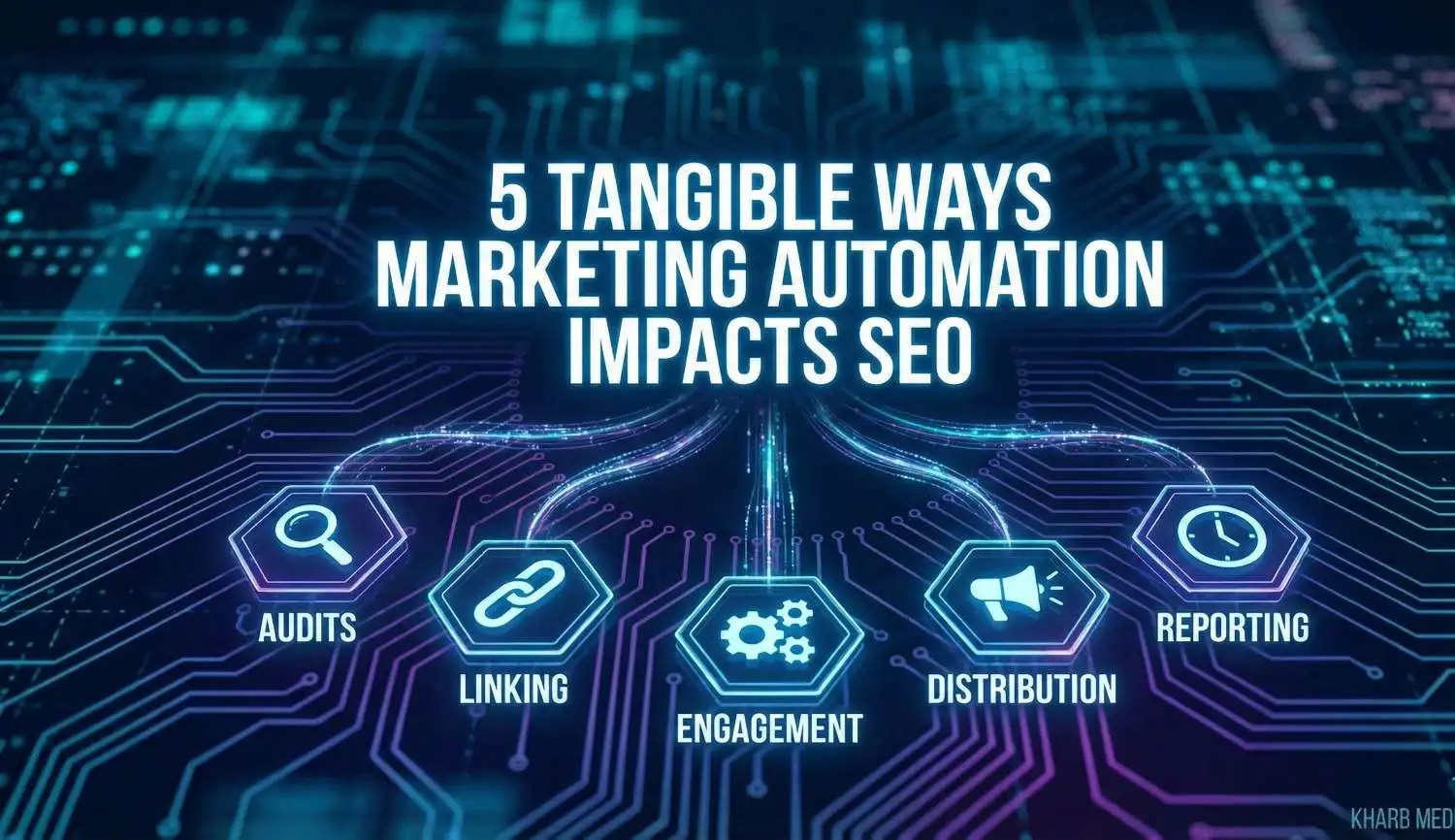
5 Tangible Ways Marketing Automation Impacts SEO
1. Enhanced On-Page Optimization and Rapid Content Audits
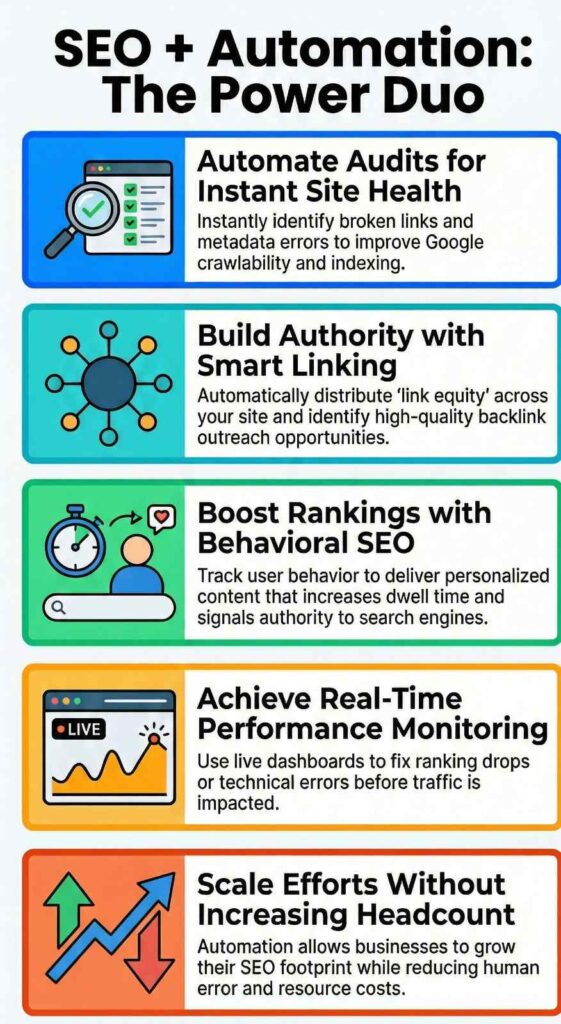
Manual site audits are a relic of the past. Our team uses automation tools to crawl thousands of pages instantly.
- Tangible Impact: You get immediate identification of broken links (404 errors), missing meta tags, duplicate content, and images without alt text.
- Result: This leads to improved site health and better “crawlability,” making it easier for Google to index and rank your pages.
2. Streamlined Internal Linking for Better Authority
Managing internal links across a massive website is labor-intensive. Automation tools can scan your content and automatically suggest relevant internal links based on your target keywords.
- Tangible Impact: Faster linking that distributes “link equity” (PageRank) effectively throughout your site.
- Result: An enhanced site structure that boosts the ranking potential for your most important pages.
3. Improving User Engagement Signals (Behavioral SEO)
Google’s 2026 algorithms prioritize how users actually interact with your site. Automation tracks user behavior and tailors their experience. By delivering personalized content based on past visits, you keep people on your site longer.
- Tangible Impact: Reduced bounce rates and increased “dwell time”.
- Result: These positive signals tell search engines your site is an authority, leading to higher rankings.
4. Efficient Content Distribution and Backlink Generation
Backlinks remain a cornerstone of SEO. Automation tools can now identify potential partners for backlink opportunities and promote your content across social and email channels instantly.
- Tangible Impact: Automated outreach workflows that secure high-quality links and increase your reach.
- Result: Increased domain authority and a steady stream of organic traffic.
5. Real-Time SEO Reporting and Performance Monitoring
Waiting for a monthly report means you’re always looking in the rearview mirror. Automation tools create real-time dashboards.
- Tangible Impact: You receive instant alerts the moment a ranking drops or a technical error appears in Google Search Console.
- Result: Faster, data-driven decisions that allow for immediate fixes before your traffic suffers.
The Core Benefits of Automating Your SEO Strategy
Our senior strategists at Kharb Media have identified several key advantages that change the game for B2B and B2C brands:
- Time and Cost Efficiency: Automation reduces the hours spent on keyword research and technical audits, saving your business significant resources.
- Accuracy and Consistency: AI algorithms detect patterns humans might miss, reducing the risk of human error in metadata or site audits.
- Scalability: As your business grows, automation lets you scale your efforts without needing to hire a massive new workforce.
- Enhanced Analytics: Gain a comprehensive view of your performance and your competitors’ strategies simultaneously.
Key Areas You Can Automate Today
If you are wondering where to start, these are the areas where our team sees the most immediate ROI:
- Keyword Research: Tools like Semrush or Keyword Magic Tool generate ideas and analyze competition levels in seconds.
- On-Page Optimization: Platforms like Surfer SEO provide real-time recommendations for headers and content structure.
- Backlink Monitoring: Automatically track the growth of your link profile and identify toxic links.
- Competitor Analysis: Monitor your rivals’ keyword rankings and content strategies without manual searching.
- Rank Tracking: Tools like AccuRanker provide daily updates on where you stand for your target terms.
Top SEO Automation Tools: A Quick Comparison
Based on our experience, here are the tools currently leading the market:
| Tool | Key Strengths | Best For |
| Surfer SEO | Comprehensive on-page optimization suggestions. | Content planning & creation |
| Alli AI | Bulk on-page optimization from one dashboard. | Large-scale site fixes |
| MarketMuse | Identifies content gaps and growth opportunities. | Content strategy |
| Jasper | AI-powered generation of SEO-optimized blog posts. | Scaling content volume |
| Frase | Generates SEO-focused content drafts quickly. | Topic research |
Why the “Human Touch” Still Matters
Despite the power of AI, our team believes the most effective strategy is a synergy between automation and human expertise. Think of the SEO professional as the “Captain of the Ship” who sets the course, while the automation tools are the “Crew” that execute tasks with precision.
The Kharb Media team’s role is to:
- Develop a strategy aligned with your specific business goals.
- Analyze the insights provided by AI to make high-level adjustments.
- Ensure that all content maintains a brand-specific, human-centric voice.
Beyond SEO: 11 Marketing Automation Strategies for Growth
To truly dominate your market, SEO shouldn’t live in a silo. Our senior strategists recommend these additional automation tactics:
- Welcome Email Sequences: Set the tone immediately when a customer signs up.
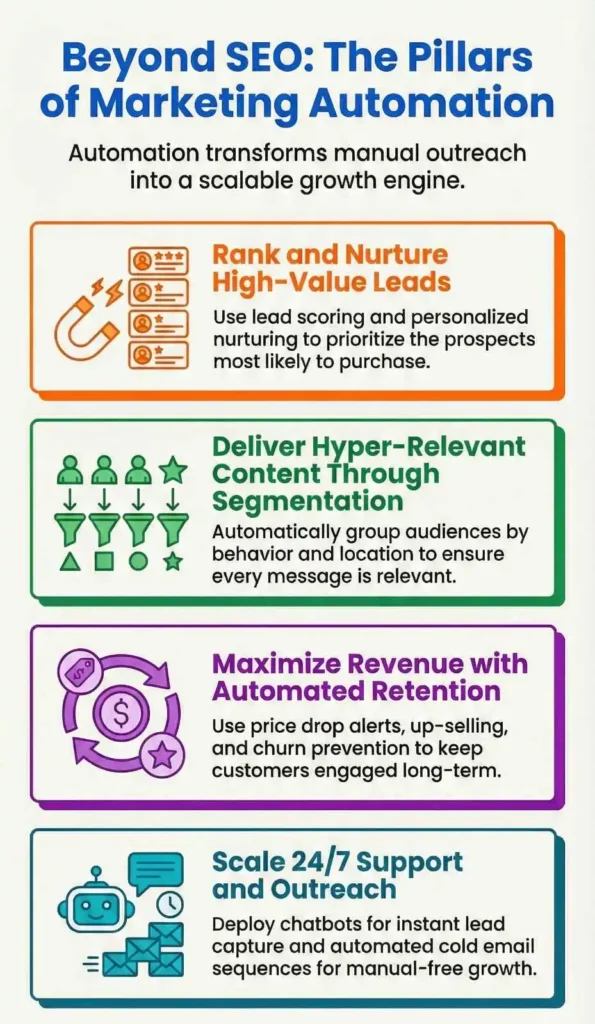
- List Segmentation: Deliver hyper-relevant content based on industry, behavior, or location.
- Lead Nurturing: Provide personalized information that nudges prospects closer to a purchase.
- Lead Scoring: Prioritize your sales team’s efforts by ranking leads based on engagement.
- Dynamic Website Content: Change website elements based on the visitor’s browsing history.
- Chatbots: Offer 24/7 support and capture lead data simultaneously.
- Cold Email Automation: Send personalized outreach at scale without the manual “insanity”.
- Up-selling & Cross-selling: Automatically suggest products based on past purchases.
- Price Drop Alerts: Re-engage customers by notifying them of deals on items they’ve viewed.
- Churn Prevention: Identify “at-risk” customers based on low activity and reach out before they leave.
- Behavior-Driven Drip Campaigns: Send specific info based on what a user downloads (e.g., a whitepaper).
Pro-Tip from the Kharb Media Strategy Team
“Don’t just automate for the sake of it. Start with a clear strategy and a thorough audit of your current processes. Identify the tasks that eat your time and prioritize those for automation first.”
Get Your Free SEO Audit & Growth Strategy Today!
- Phone: +91 97287 85818
- Email: support@kharbmedia.com
- WhatsApp Us: Click here to chat with an expert
Would you like me to create a customized automation roadmap for your specific industry?Ready to Dominate Search Results?
The 2026 search landscape is too competitive to handle manually. With over 15+ years of combined experience, our team at Kharb Media knows how to blend the precision of automation with the creativity of human strategy to get you to #1.
Frequently Asked Questions
Is marketing automation suitable for small businesses?
Absolutely. It is highly scalable, allowing small teams to achieve high conversion rates without a massive budget.
What is the biggest obstacle to automation?
The integration of technology and data. It requires aligning your tools with your business goals and having the right people to manage the system.
Can automation improve customer retention?
Yes. By delivering personalized follow-ups and engagement strategies, you turn first-time buyers into loyal advocates