
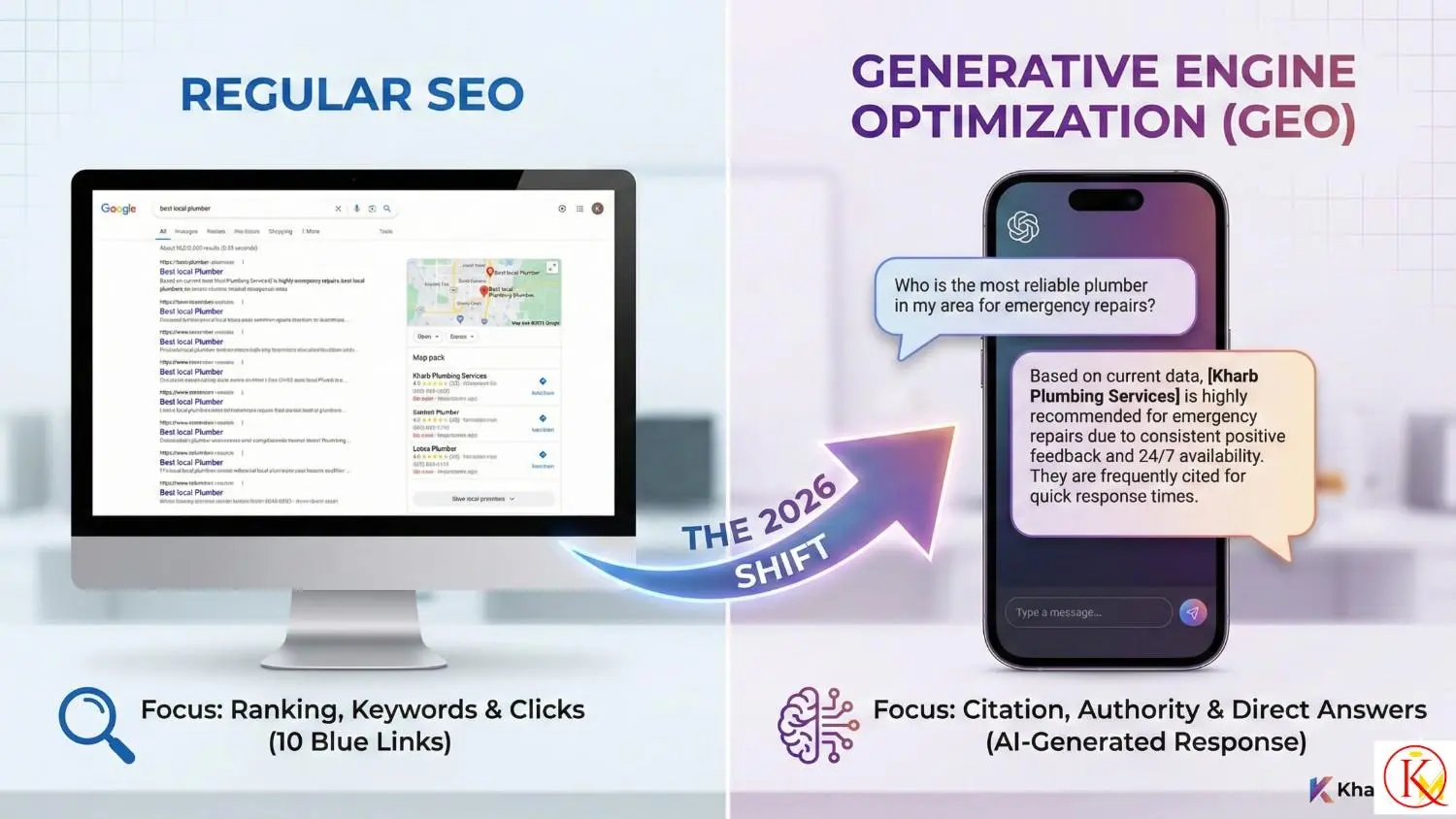
Search behavior is shifting faster than ever. If you are a small business owner relying entirely on standard keyword tactics to attract customers, your digital strategy might be on the brink of becoming outdated.
With over 15+ years of combined experience, our team at Kharb Media has seen the search industry evolve from simple directory links to highly complex algorithms. Today, we are experiencing the biggest shift yet: the rise of artificial intelligence as a primary search engine.
Consumers are no longer just typing questions into Google and clicking through ten blue links. Instead, they are asking tools like ChatGPT, Google Gemini, and Perplexity for direct answers.
This massive shift brings up a critical topic for modern business owners: generative engine optimization vs regular seo small local service business.
Which one do you need? Can you survive with just one? In this comprehensive guide, our senior strategists will break down everything you need to know to future-proof your digital presence and capture high-converting leads in 2026.
Table of Contents
The Foundation: How Each Approach Views Search
To understand how to win online, you first need to understand how the rules of the game have changed. Traditional SEO and Generative Engine Optimization (GEO) view the fundamental concept of “search” in completely different ways.
What is Traditional SEO?
Search Engine Optimization (SEO) operates on the premise that search engines are the middlemen connecting users to your website.
The primary goal has always been to rank higher on search engine results pages (SERPs).
When someone searches for a local service, traditional SEO tries to convince algorithms that your page deserves to appear above your competitors based on relevance, technical health, and backlinks. Success is measured by keyword rankings, click-through rates, and organic visitor volume.
What is Generative Engine Optimization (GEO)?
Generative Engine Optimization takes a radically different perspective. GEO recognizes that AI systems are no longer just pointing to your website they are synthesizing information to create original answers.
GEO focuses on becoming a cited source within AI-generated content.
Instead of chasing blue links, generative engine optimization vs regular seo small local service business strategies focus on making your brand the actual answer the AI delivers.
The Trio of Future Search: SEO vs GEO vs AEO
Any successful marketing strategy in 2026 must understand how different search methods collaborate.
- SEO (Search Engine Optimization): Helps your website get discovered on Google and Bing using keywords and backlinks.
- AEO (Answer Engine Optimization): Guarantees your content is featured in quick answer boxes, featured snippets, and voice search.
- GEO (Generative Engine Optimization): Ensures your brand is recognized and mentioned by conversational AI systems.
Collectively, they create a hybrid search approach. Our team at Kharb Media builds strategies that capture attention across all three channels simultaneously.
Generative Engine Optimization vs Regular SEO Small Local Service Business: Key Differences
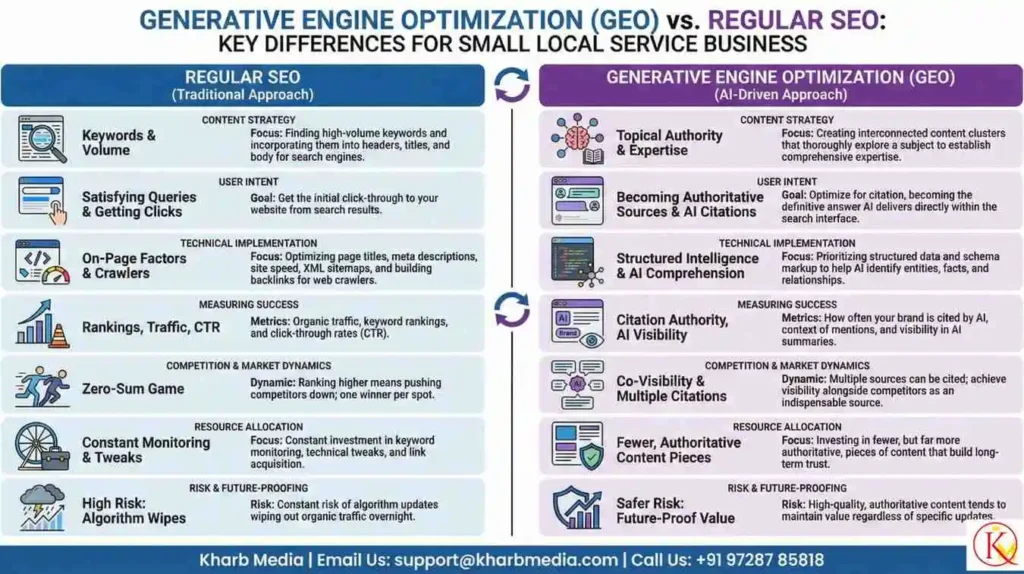
If you run a local service business, you need to know exactly how to shift your resources. Here is a breakdown of the key differences between the two strategies.
Content Strategy: Keywords vs. Expertise
Traditional SEO has long revolved around finding high-volume keywords and incorporating them into your headers, titles, and body content.
GEO, however, prioritizes topical authority and comprehensive expertise over keyword stuffing. While keywords remain relevant, GEO focuses on creating interconnected content clusters that thoroughly explore a subject from multiple angles.
User Intent: Satisfying Queries vs. Becoming Authoritative Sources
Traditional SEO assumes users will click through to your website after finding you in search results. Content is built to get that initial click.
Generative search changes this completely. Users increasingly receive comprehensive answers directly within the search interface. GEO requires you to optimize for citation. Even if users never visit your website, they will encounter your brand’s expertise through AI-generated responses.
Technical Implementation: On-Page Factors vs. Structured Intelligence
Traditional SEO relies heavily on optimizing page titles, meta descriptions, site speed, XML sitemaps, and building backlinks.
GEO prioritizes structured data and schema markup. This helps AI systems identify entities, facts, and relationships within your content. The focus shifts from optimizing for web crawlers to optimizing for AI comprehension.
Measuring Success: Rankings vs. Citation Authority
Traditional SEO success is measured through organic traffic, keyword rankings, and click-through rates.
Since AI responses often do not drive direct traffic, generative engine optimization vs regular seo small local service business metrics look different. GEO success is measured by how often your brand is cited by AI, the context of the mentions, and your brand’s visibility in AI summaries.
Competition and Market Dynamics
Traditional SEO is a zero-sum game. Ranking higher means pushing a competitor down.
Generative Engine Optimization creates a different dynamic. Multiple sources can be cited within the same AI response. You can achieve visibility alongside your competitors by becoming an indispensable source of information within your local area.
Resource Allocation and Strategy Focus
Traditional SEO demands constant investment in keyword monitoring, technical tweaks, and link acquisition.
GEO concentrates resources on becoming the definitive source for particular topics. You will invest in fewer, but far more authoritative, pieces of content that build genuine long-term trust.
Risk and Future-Proofing Considerations
Traditional SEO carries the constant risk of algorithm updates wiping out your organic traffic overnight.
GEO offers a safer risk profile. High-quality, authoritative content tends to maintain its value regardless of specific technological updates.
Why GEO Matters in 2026 and Beyond for Small Local Businesses
You might be wondering why a local plumber or accountant needs to care about AI algorithms. The answer is simple: user behavior is changing rapidly.
According to recent data, AI Overviews have over 1.5 billion monthly users but reduce direct website clicks by over 34%.
Fewer Clicks on Websites: With AI answers, users get what they need instantly. If your content isn’t optimized for generative AI, you risk total invisibility.
Citation Advantage and Brand Trust: People trust AI to simplify complex queries. When a brand is mentioned in an AI response, it immediately gains authority and trust from the user.
Early-Mover Advantage: GEO is still relatively new. Small local businesses that adopt generative engine optimization vs regular seo small local service business tactics today will dominate emerging generative search ecosystems tomorrow.
Best Practices for Integrating GEO with SEO for Your Local Business
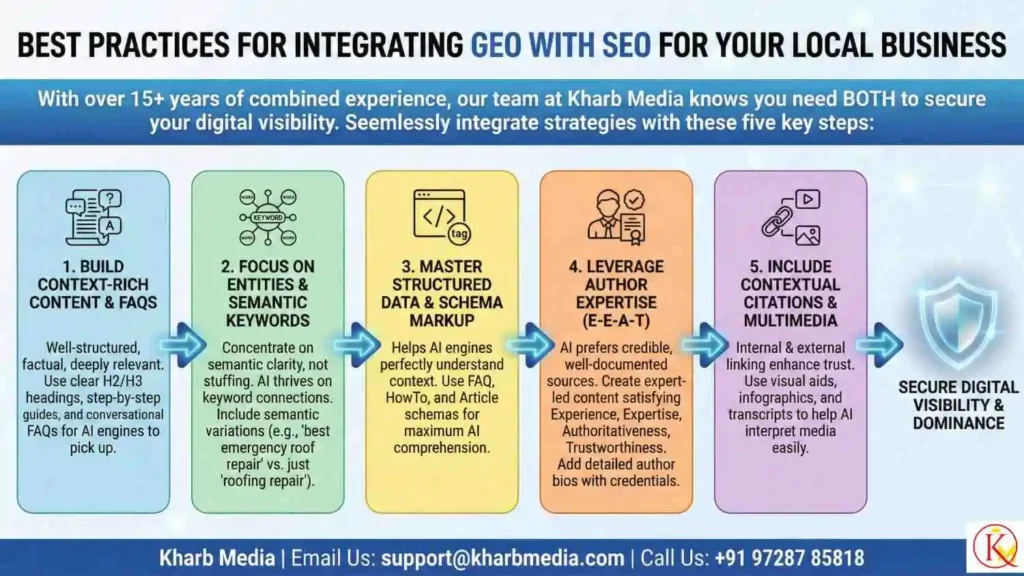
With over 15+ years of combined experience, our team at Kharb Media knows that you don’t need to choose between GEO and SEO. You need both to secure your digital visibility.
Here are the best practices to seamlessly integrate these strategies:
1. Build Context-Rich Content and FAQs
AI engines pick up content that is well-structured, factual, and deeply relevant to user questions. Use clear headings (H2, H3), provide step-by-step guides, and add conversational FAQs to your pages.
2. Focus on Entities and Semantic Keywords
Instead of stuffing exact-match keywords into a page, concentrate on semantic clarity.
AI thrives on connections between keywords. If you are a local roofer, don’t just use “roofing repair.” Include semantic variations like “best emergency roof repair services” or “how to fix a leaking roof in [Your City].”
3. Master Structured Data & Schema Markup
Adding schema markup helps AI engines perfectly understand your content context. Use FAQ schemas, HowTo schemas, and Article schemas for maximum AI comprehension.
4. Leverage Author Expertise (E-E-A-T)
AI prefers citing credible, well-documented sources. Create expert-led content that satisfies the E-E-A-T (Experience, Expertise, Authoritativeness, and Trustworthiness) guidelines.
Add detailed author bios with real credentials to prove your authority.
5. Include Contextual Citations and Multimedia
Internal linking to your own resources and external linking to credible sources enhance trust. Additionally, using visual aids, infographics, and transcripts helps AI easily interpret your media.
Tools to Build Your GEO Strategy
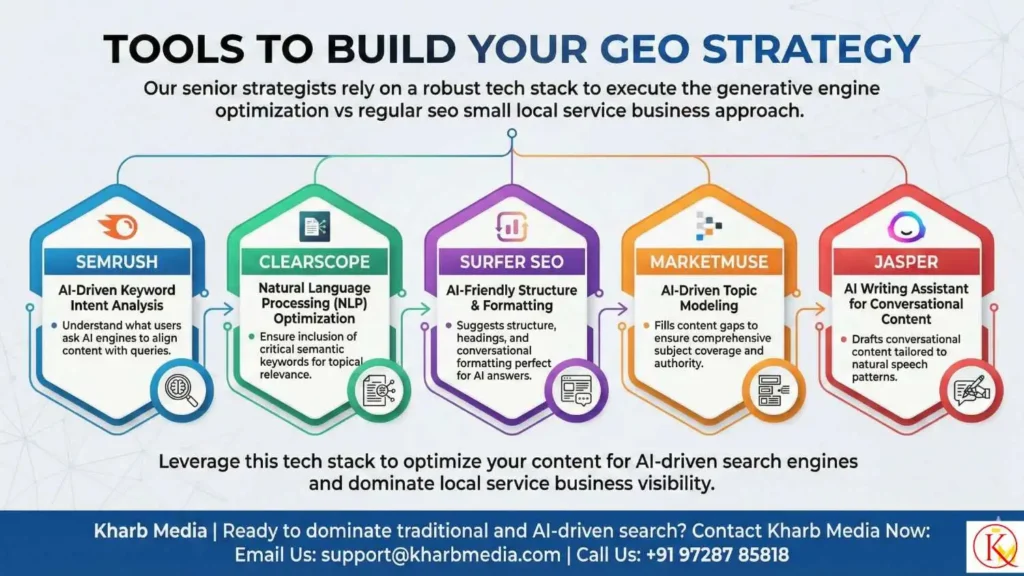
Our senior strategists rely on a robust tech stack to execute the generative engine optimization vs regular seo small local service business approach.
Here are some top tools to optimize your content for AI-driven search engines:
- Semrush: Excellent for AI-driven keyword intent analysis to understand what users ask AI engines.
- Clearscope: Uses natural language processing (NLP) to ensure you include critical semantic keywords.
- Surfer SEO: Suggests structure, headings, and conversational formatting perfect for AI answers.
- MarketMuse: Fills content gaps using AI-driven topic modeling to ensure you fully cover a subject.
- Jasper: An AI writing assistant that can help draft conversational content tailored to natural speech patterns.
Pro Tip: Do not use these tools individually. Combine them to create a full GEO optimization workflow.
Real-World Examples of Companies Using GEO vs Traditional SEO
Major brands are already dominating by embracing GEO strategies.
- HubSpot: Frequently appears in ChatGPT SEO summaries due to their brilliant semantic content structuring.
- Adobe: Uses structured data filled with entities to ensure AI systems correctly read and cite their product details.
- Perplexity SEO Models: Focus entirely on building highly referenced authority pages.
Smaller businesses can achieve the exact same results locally by optimizing for conversational queries and using hyper-local identifiers.
Will SEO Be Replaced by AI or Evolve with GEO?
A question we hear often from local business owners is whether AI will completely replace SEO. The answer is no.
Search engine optimization will evolve in parallel with GEO. Classical SEO is focused on discoverability, while GEO secures credibility within AI systems.
The overlapping principles remain the same: high-quality content, authority, and satisfying user intent. By integrating both, you ensure your business survives no matter how search technology shifts.
Conclusion & Next Steps
The marketing world has permanently shifted. Visibility is no longer just about being ranked; it is about being recognized, referenced, and trusted by artificial intelligence.
Understanding generative engine optimization vs regular seo small local service business strategies is the key to capturing high-intent customers in 2026. You need a partner that understands how to blend traditional search discoverability with next-gen AI answerability.
With over 15+ years of combined experience, our team at Kharb Media has the exact blueprint to make your business the definitive answer in your market.
Ready to dominate traditional and AI-driven search? Get Your Free SEO Audit today to see exactly where your business stands in the new era of generative search.
Contact Kharb Media Now:
- Phone: +91 97287 85818
- Email: support@kharbmedia.com
FAQs (People Also Ask)
What is the difference between traditional SEO and Generative Engine Optimization?
Traditional SEO ranks websites on search engines like Google to drive clicks. GEO ensures your content is cited directly in AI-generated answers from platforms like ChatGPT and Gemini.
Is Generative Engine Optimization helpful for small local businesses?
Absolutely. Smaller local businesses can bypass top Google rankings and gain massive visibility by being featured as the “suggested business” in AI recommendations.
How do I measure GEO success if it doesn’t always drive clicks?
You track AI citations, branded search query volume growth, and your brand’s visibility directly inside Google AI Overviews and ChatGPT responses.