
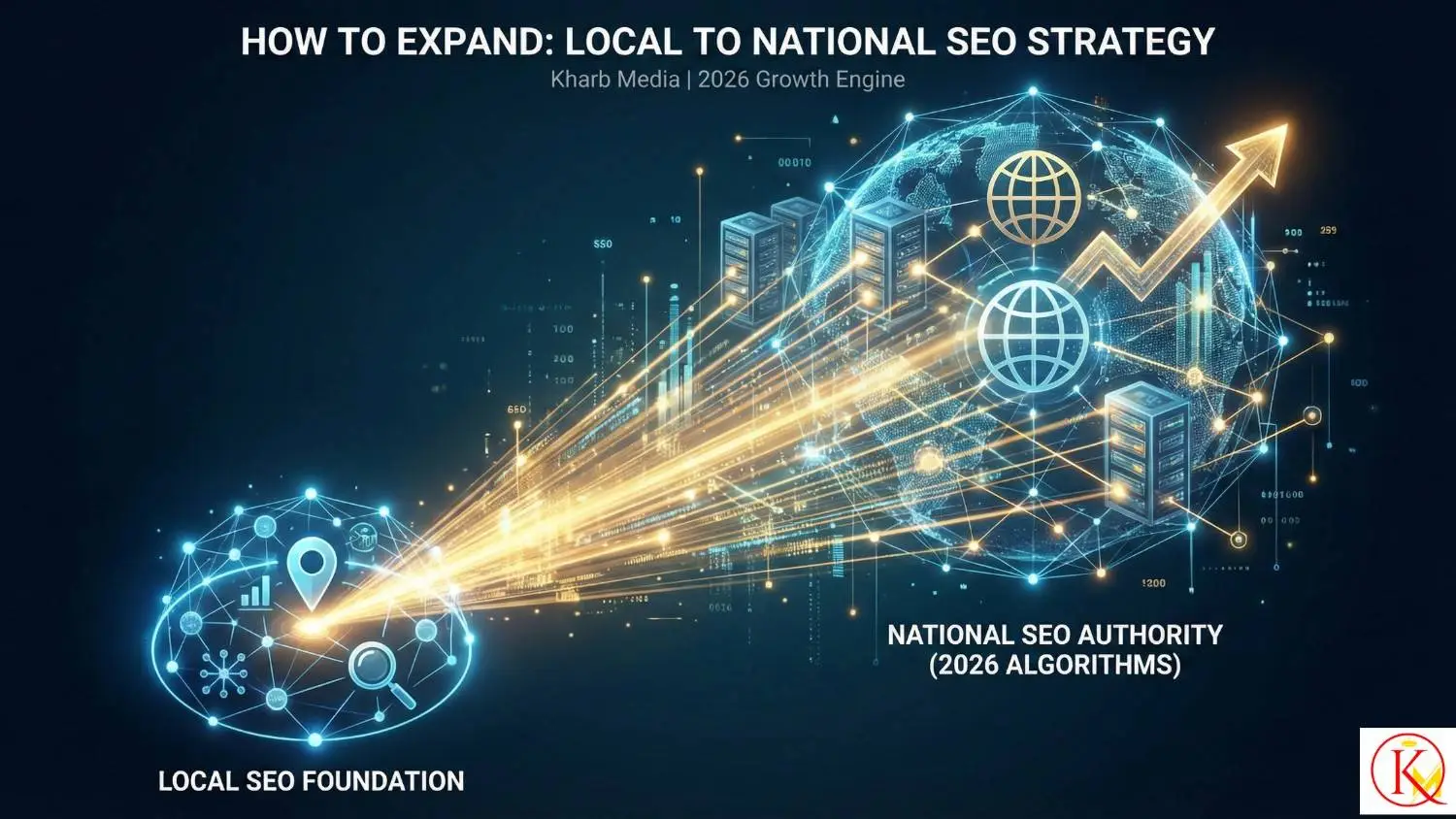
For many businesses, conquering the local market is the first big win. You dominate the “near me” searches, your Google Business Profile is buzzing with reviews, and the local community knows your name. But eventually, every ambitious business hits a ceiling. The leads stabilize, the traffic plateaus, and you realize you have outgrown your neighborhood.
If you are reading this, you are likely asking the big question: “How do I expand from local SEO to national SEO?”
At Kharb Media, with over 15+ years of combined experience in the digital landscape, we have guided countless businesses through this exact transition. It is not just about changing keywords; it is a fundamental shift in how you signal authority to Google.
In this comprehensive guide, our team will break down the exact strategies, technical shifts, and content plays required to dominate on a national scale in 2026.
Table of Contents
The Big Shift: Understanding Local vs. National SEO
Before you start optimizing, you must understand the battlefield. The transition from local SEO to national SEO requires a strategic approach because the rules of engagement change completely.
What is Local SEO?
Local SEO is like being the “friendly neighborhood Spider-Man.” It focuses entirely on a specific geographic area whether that is a city, region, or neighborhood.
- The Goal: Drive foot traffic and customers to a physical store or service area.
- The Triggers: It targets location-based queries like “dentist in Miami” or “best bakery near me”.
- Key Assets: Google Business Profile (GBP), local citations (NAP), and local reviews are your bread and butter.
What is National SEO?
National SEO aims to target a much broader audience, focusing on search queries that have no geographic component.
- The Goal: Rank for general terms and attract traffic from across the entire country.
- The Triggers: It targets broad, high-volume keywords like “best invoicing software” or “buy luxury furniture online”.
- Key Assets: Content depth, topical authority, and high-quality backlinks from national publications.
Key Differences at a Glance
Our senior strategists use this comparison to help clients visualize the shift:
| Feature | Local SEO | National SEO |
| Target Audience | Specific local area or region | Nationwide, across the entire country |
| Keywords | Location-based (e.g., “near me”) | Broad, general keywords |
| Competition | Other local businesses | Large national brands and major publishers |
| Google Business Profile | Essential for rankings | Not necessary for national rankings |
| Content Focus | Geographically focused (local events) | Broader content addressing national audiences |
| Link Building | Local directories & community sites | National news, industry blogs, & high-authority sites |
When Is the Right Time to Expand?
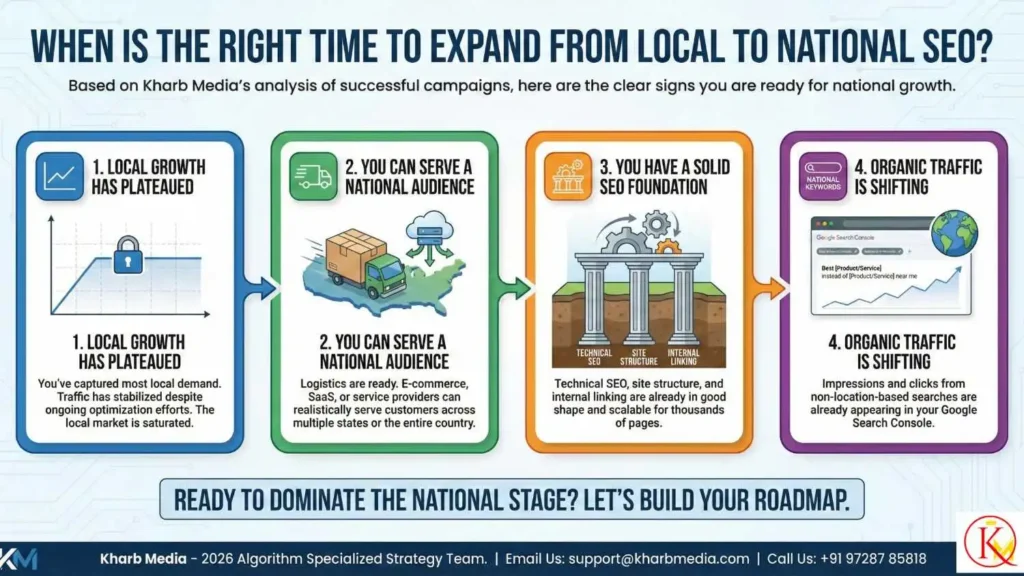
Expanding too early can dilute your efforts, but waiting too long limits your revenue. Based on our team’s analysis of successful campaigns, here are the clear signs you are ready to move from local to national SEO:
- Local Growth Has Plateaued: You have captured most of the local demand, and your traffic has stabilized despite ongoing optimization.
- You Can Serve a National Audience: Your logistics are ready. Whether you are an e-commerce store, a SaaS company, or a service provider, you can realistically serve customers across multiple states or the whole country.
- You Have a Solid SEO Foundation: Your technical SEO, site structure, and internal linking are already in good shape.
- Organic Traffic is Shiftng: You are already starting to see impressions and clicks from non-location-based searches in your Google Search Console.
Kharb Media Pro Tip: Do not abandon your local roots. Many successful businesses run local and national SEO in parallel. You can keep your local dominance while building your national empire.
Step 1: Shift Your Keyword Strategy (The “Skyscraper” Approach)
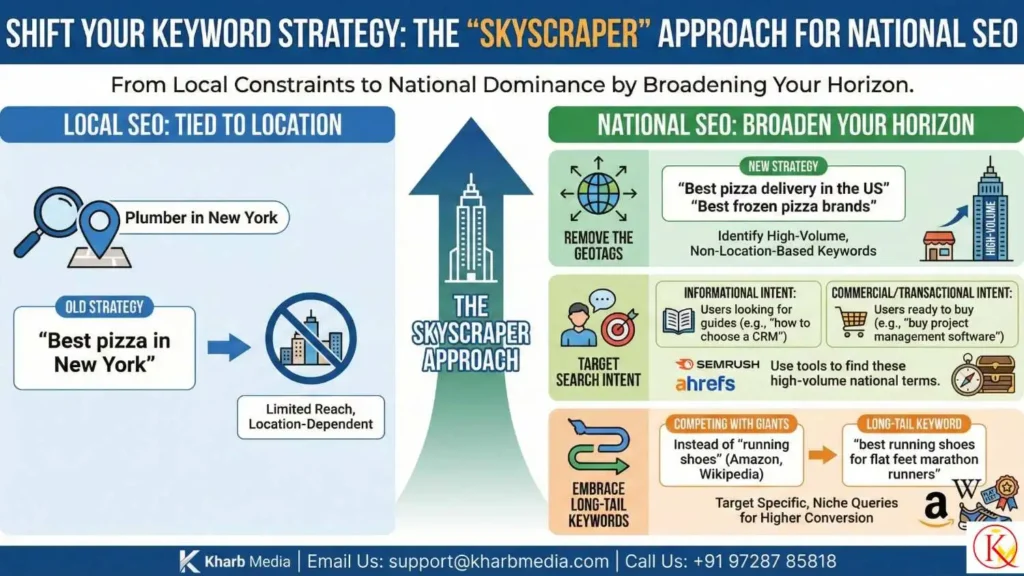
In local SEO, your keywords are strictly tied to a location (e.g., “Plumber in New York”). To expand from local SEO to national SEO, you must broaden your horizon.
1. Remove the Geotags
You need to identify high-volume, non-location-based keywords relevant to your business.
- Old Strategy: “Best pizza in New York”
- New Strategy: “Best pizza delivery in the US” or simply “Best frozen pizza brands”.
2. Target Search Intent
National keywords are more competitive, so you must understand why someone is searching.
- Informational Intent: Users looking for guides (e.g., “how to choose a CRM”).
- Commercial/Transactional Intent: Users ready to buy (e.g., “buy project management software”). Use tools like SEMrush or Ahrefs to find these high-volume national terms.
3. Embrace Long-Tail Keywords
Since you are now competing with giants (like Amazon or Wikipedia), you might not rank for “running shoes” immediately. Instead, target specific long-tail keywords like “best running shoes for flat feet marathon runners”.
Step 2: Optimize Your Website Architecture for Scale
A local website usually has a simple structure: Home, Services, About, and Contact. A national website needs a robust architecture to handle thousands of pages and broader queries.
1. Create Topic Clusters (Silos)
Do not just write random blogs. Structure your site into clear categories. For example, a digital agency shouldn’t just have a “Services” page; it should have categories like Digital Marketing > SEO > Technical SEO. This helps Google understand your expertise.
2. Technical Performance (Core Web Vitals)
National competitors invest heavily in performance. If your site is slow, you will not rank.
- Speed: Ensure fast loading times.
- Mobile-First: With most searches happening on mobile, your site must be responsive and mobile-friendly
- Crawl Budget: Search engines must be able to crawl your important pages efficiently without wasting resources on duplicates.
Step 3: Develop Authority-Driven Content
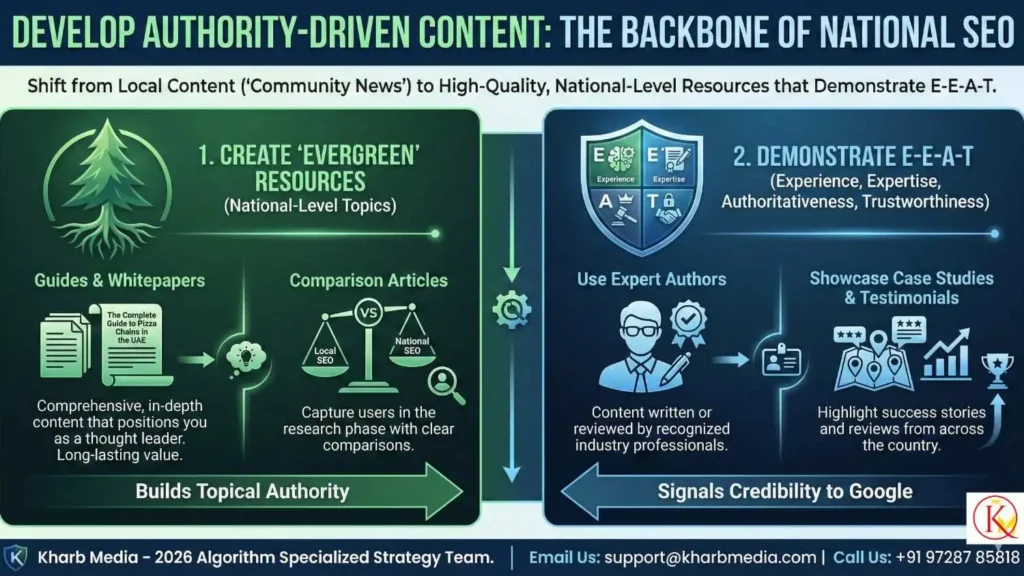
Content is the backbone of national SEO. Local content (like “Community News”) won’t rank nationally.
1. Create “Evergreen” Resources
You need to publish high-quality, informative content that addresses national-level topics.
- Guides & Whitepapers: Comprehensive guides (e.g., “The Complete Guide to Pizza Chains in the UAE”) position you as a thought leader.
- Comparison Articles: Articles like “Local SEO vs National SEO” help capture users in the research phase.
2. Demonstrate E-E-A-T
Google values Experience, Expertise, Authoritativeness, and Trustworthiness (E-E-A-T), especially for national rankings.
- Use expert authors for your content.
- Showcase case studies and testimonials from across the country
Step 4: Level Up Your Link Building
This is often the hardest pill to swallow for businesses transitioning from local to national. Local citations (listing your business in the local directory) have almost zero impact on national rankings.
1. The Quality Game
National SEO requires a strong backlink profile to rank against authoritative websites. You need links from:
- National publications and news outlets.
- High-authority industry blogs.
- Relevant educational or government sites.
2. Digital PR
Our team at Kharb Media focuses heavily on Digital PR. This involves creating newsworthy content (like research studies or infographics) that naturally attracts backlinks from major media sites.
Step 5: Don’t Kill Your Local SEO (The Hybrid Model)
A common fear we hear is, “Will expanding to national SEO hurt my local rankings?” The answer is no, provided you do it right.
In fact, improving your overall domain authority through national SEO often strengthens your local rankings.
- Maintain GBP: Keep your Google Business Profile updated and continue gathering local reviews.
- Location Pages: If you serve specific regions, keep those landing pages (e.g., “SEO Services in Gurgaon”) active. They capture the high-intent local traffic while your blog captures the national traffic.
- Localized Content: You can still create content that speaks to regional preferences while targeting a national audience.
Timelines & Expectations: How Long Does It Take?
We believe in radical transparency. National SEO is not a quick fix. It is more competitive than local SEO, so results take longer.
The Realistic Timeline
- Months 1-3 (Foundation): Technical audits, keyword research, and content planning. Rankings usually don’t move much here.
- Months 4-6 (Early Visibility): Pages begin indexing, and you start ranking for lower-competition keywords. Organic traffic shows early growth signals.
- Months 6-12 (Growth & ROI): Traffic quality improves, competitive keywords gain traction, and you start seeing a measurable return on investment.
Note: Factors like a weak backlink profile or a highly competitive industry can slow this down.
Common Mistakes to Avoid
In our 15+ years of experience, we have seen businesses make avoidable errors when trying to expand:
- Duplicating Location Pages: Do not just copy-paste your “About” page for every city in the country. This “doorway page” tactic is outdated and can get you penalized.
- Targeting “Head Terms” Too Early: Trying to rank for a single word like “Shoes” or “Insurance” right away is a recipe for failure. Start with long-tail keywords and build up.
- Ignoring Technical Debt: You cannot scale a house built on a shaky foundation. Technical issues that were minor in local SEO become critical blockers in national SEO.
Conclusion: Ready to Go National?
Expanding from local SEO to national SEO is an exciting growth opportunity. It opens the door to millions of potential customers and establishes your brand as an industry leader. However, it requires a deliberate shift in strategy moving from “proximity” to “authority”.
You need to broaden your keyword targeting, invest in “skyscraper” content, and build a backlink profile that commands respect.
Is your business ready to dominate the national stage
Don’t guess with your growth. Let the experts at Kharb Media audit your current standing and build a roadmap for your national expansion.
Get Your Free National SEO Audit & Roadmap: Chat with an Expert
Contact Our Strategy Team:
- Phone: +91 97287 85818
- Email: support@kharbmedia.com
Frequently Asked Questions (People Also Ask)
Can I do local and national SEO at the same time?
Yes! Most successful businesses use a hybrid approach. They maintain local pages for immediate service-based leads (“near me” searches) while building a national blog and service pages for broader brand awareness and lead generation.
How is National SEO different from Enterprise SEO?
These terms are often used interchangeably, but “Enterprise SEO” usually refers to managing massive websites (10,000+ pages) with complex technical needs. National SEO simply refers to the geographic reach of your target audience, regardless of your company size.
Do I need to remove my local pages when switching to national SEO?
No! Never delete pages that are bringing in traffic and conversions. Keep your high-performing local pages alive. They serve as a safety net of leads while you build your national presence.
Why is National SEO more expensive?
It requires more resources. You are competing with the biggest brands in the country, which means you need higher-quality content, more aggressive (and higher quality) link building, and advanced technical optimization. It is an investment in scalable, long-term asset building.