
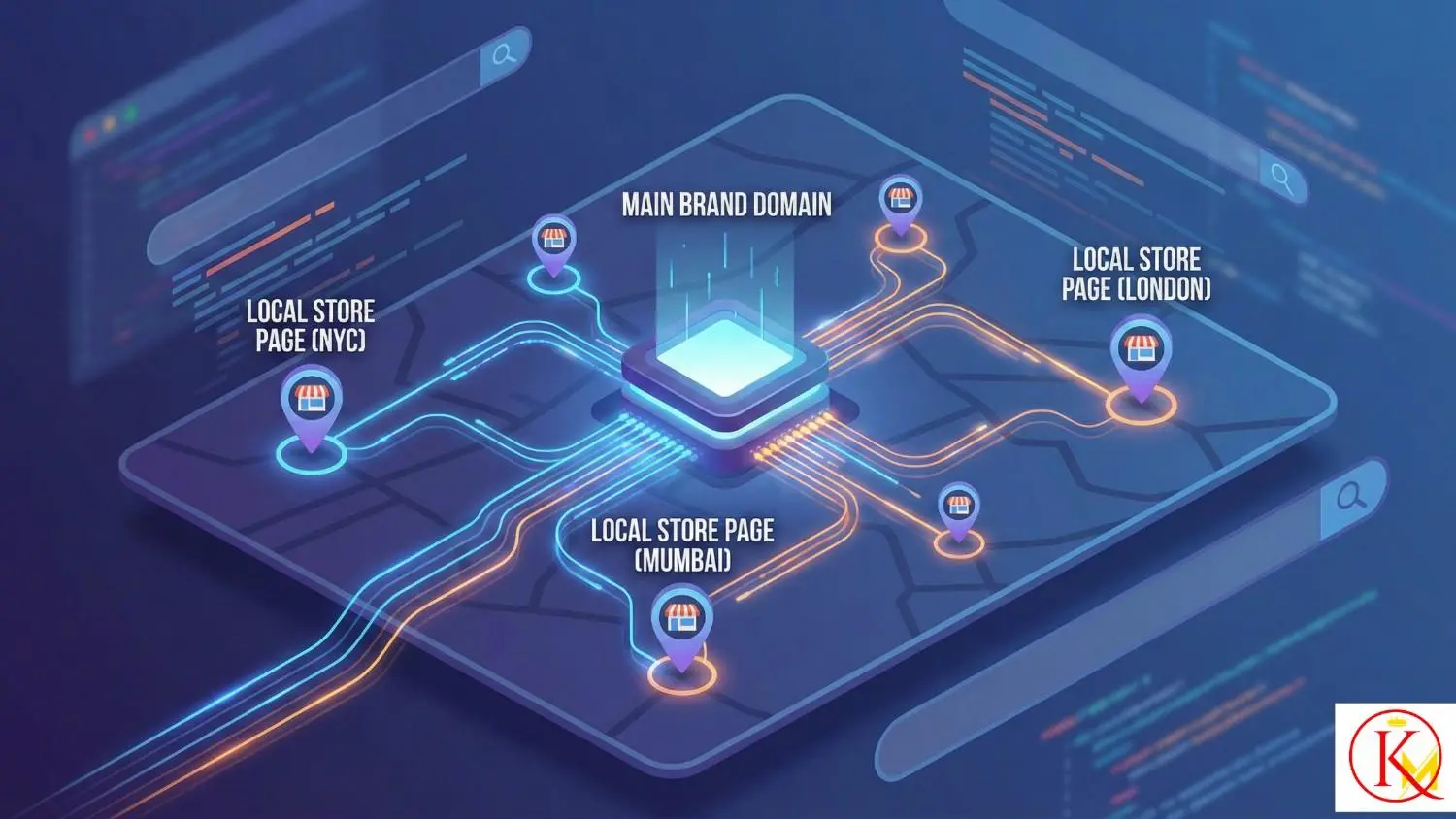
Did you know that over 46% of all Google searches are looking for local information?
At Kharb Media, we often sit down with franchise owners who are wrestling with a massive digital dilemma. They have established brands and multiple outlets, but they are invisible in local searches. The question they always ask is: “Do we need different websites for each branch to rank better?”
It is a valid concern. You want your New York outlet to rank for “pizza in New York,” not your Chicago homepage.
With over 15+ years of combined experience in the US and Indian markets, our strategy team has audited hundreds of franchise networks. The short answer is: Yes, you absolutely need separate URLs for each location.
But here is the critical catch: Separate URLs do not mean separate domains (different websites).
In this comprehensive guide, we will break down exactly how to structure your franchise website to dominate local search results without doubling your workload.
Table of Contents
The Core Question: Do Franchises Need Local SEO?
Before we dive into URL structures, let’s look at why this matters. Local SEO is the process of optimizing your online presence to dominate search results for location-based keywords, like “best coffee shop near me” or “plumber in [city].”
For a franchise, this is non-negotiable. Even if your brand is famous nationally, each specific outlet is a distinct unit that needs to acquire its own local clients.
Why You Can’t Just Use One Homepage
If all your locations share a single URL (like just your homepage), it becomes nearly impossible to rank for hyper-localized terms.
Ready to dominate your local market: Chat with an Expert
- Visibility: You miss out on the 46% of users searching locally.
- Targeted Traffic: You fail to pull in customers who are physically close to a specific outlet and ready to buy.
- Reputation: You lose the ability to showcase specific local ratings, which makes your business popular in the community.
The 3 Options: Domains vs. Subdomains vs. Subfolders
This is where most franchise owners get stuck. You know you need separate pages, but how do you build them? Our technical SEO team at Kharb Media strongly advises against guessing here.
Here is the breakdown of the three common structures:
1. Separate Domains (The “Don’t Do This” Option)
- Example: www.brand-newyork.com
- Verdict: Avoid.
- Why: You might think this gives each franchisee “ownership,” but it splits your SEO authority. Instead of one powerful website, you end up with 20 weak ones. It also skyrockets your maintenance costs because you have to manage hosting, SSL, and updates for every single site.
2. Subdomains (The “Middle Ground”)
- Example: newyork.brand.com
- Verdict: rarely the right move.
- Why: Search engines often treat subdomains like separate websites. This means your main site’s authority doesn’t fully pass down to the local pages, diluting your ranking power.
3. Subfolders (The “Winner”)
- Example: www.brand.com/locations/newyork/
- Verdict: Highly Recommended.
- Why: This keeps all SEO authority under one strong domain. It is easier to manage, faster for Google to crawl, and scalable whether you have 5 locations or 500.
Comparison Table: What Our Data Shows
| Approach | Pros | Cons | Kharb Media Verdict |
| Separate Domains | Strong local branding feel. | Authority split, high cost, inconsistent NAP. | Avoid (Unless legally required). |
| Subdomains | Some technical flexibility. | Diluted authority, difficult to manage tech stacks. | Use Caution |
| Subfolders | Best SEO value, easiest to scale. | Less “independent” feel for franchisees. | Recommended |
Why The “Single Domain + Subfolder” Strategy Wins in 2026
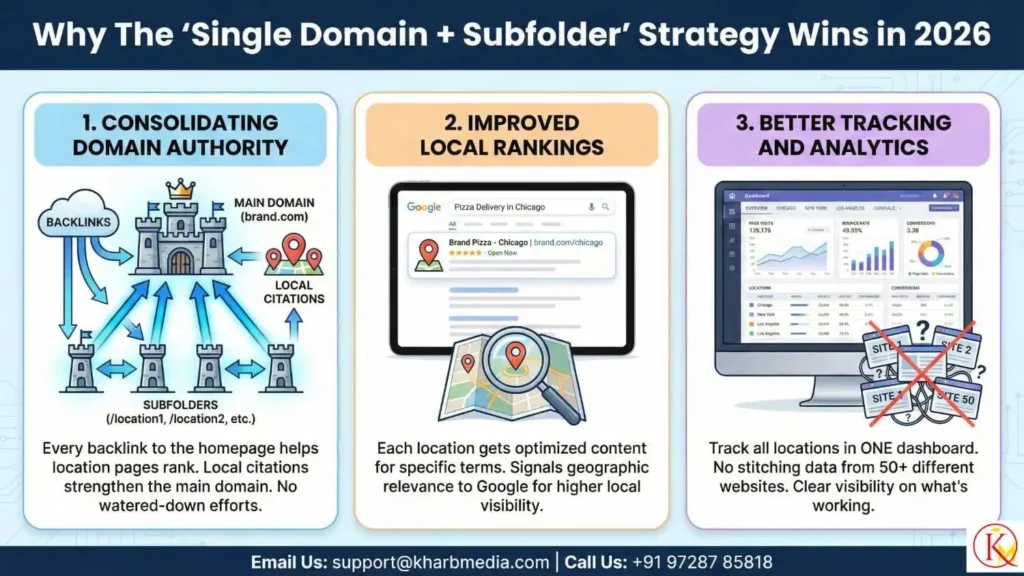
Our team has seen the pattern repeatedly: the winners in the franchise space use one strong main site with location pages in subdirectories.
1. Consolidating Domain Authority
When you use subfolders (brand.com/location), every backlink that points to your main homepage helps your location pages rank. Conversely, every local citation built for a location page strengthens your main domain. You aren’t watering down your efforts across different domains.
2. Improved Local Rankings
Each location gets its own optimized content. This allows a specific page to target terms like “Pizza Delivery in Chicago” or “New York pizza delivery.” When a franchise location has its own unique URL, it signals to Google that this page is specifically relevant to that geographic area.
3. Better Tracking and Analytics
From an agency perspective, this is huge. With a single domain, we can track page visits, bounce rates, and conversion rates for every location in one dashboard. We don’t have to stitch data together from 50 different websites to see what is working.
How Separate URLs Improve User Experience (UX)
SEO isn’t just about robots; it’s about people. Aligning with user intent is critical.
Customized Content for Local Audiences
A customer searching for your service in Chicago has different needs than one in Miami. By having distinct URLs, you can offer:
- Local Menus & Services: Highlight items specific to that region.
- Local Offers: showcase coupons valid only at that branch.
- Community Events: Promote partnerships or events happening nearby.
Let our experts analyze your URL structure and find your hidden growth opportunities: Chat with an Expert
This personalization reduces bounce rates because the user immediately sees, “Oh, this is for my city.”
Clearer Navigation
Imagine a user visits “Location A” one week and “Location B” the next. If they are separate websites, the layout might change, confusing the user. With a single domain strategy, the design stays consistent. The user knows exactly where to find the “Order Now” button, regardless of which location page they land on.
The “India” Context: A Special Note for Our Markets
If you are managing a franchise in India whether it’s a salon chain, coaching center, or restaurant this strategy is even more vital.
Search behavior in India has shifted heavily toward “near me” and hyperlocal intent. Google needs to know exactly which outlet serves which city (e.g., Delhi vs. Mumbai).
Our Recommendation for India: Use a structure like brand.com/locations/delhi/ or brand.com/locations/mumbai-andheri/. This aligns perfectly with Google Business Profile requirements and boosts visibility in local map packs.
Risks and Challenges (And How to Fix Them)
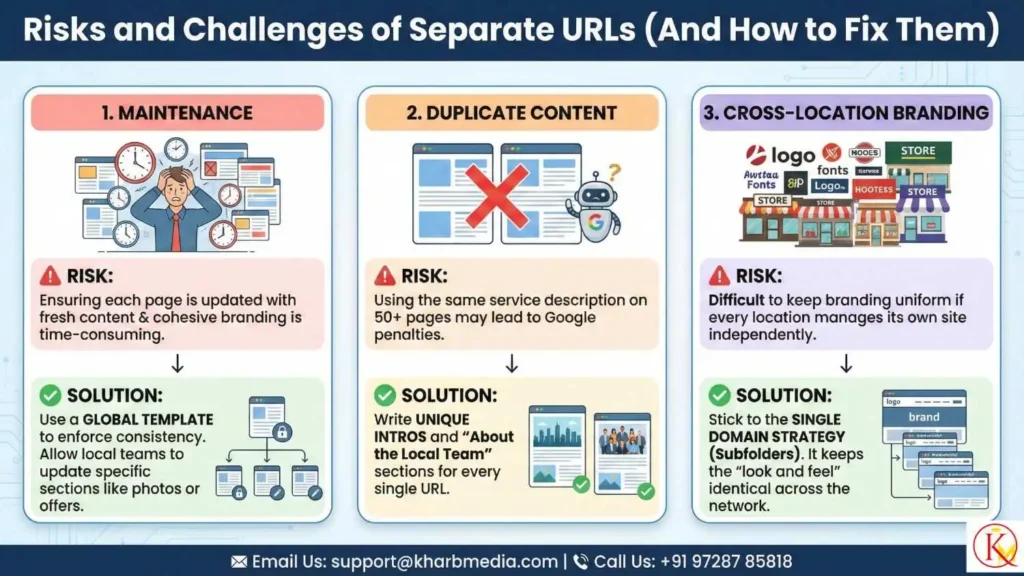
While separate URLs are the right choice, they require work.
- Maintenance: You must ensure each page is updated with fresh content and cohesive branding.
- Solution: Use a global template to enforce consistency, while allowing local teams to update specific sections like photos or offers.
- Duplicate Content: If you use the same service description on 50 pages, Google may penalize you.
- Solution: Write unique intros and “About the Local Team” sections for every single URL.
- Cross-Location Branding: It’s hard to keep branding uniform if everyone does their own thing.
- Solution: Stick to the single domain strategy. It keeps the “look and feel” identical across the network.
Conclusion: The Final Verdict
So, should franchises have separate URLs for local SEO?
Absolutely yes.
But remember the golden rule from our team at Kharb Media: These URLs should be subfolders on a single domain, not separate websites.
This structure allows you to:
- Boost Maps visibility.
- Rank for “near me” queries.
- Maintain a strong, unified domain authority.
If you are a franchise owner using separate domains, you are likely wasting budget and diluting your power. If you are using a single page for everyone, you are invisible locally.
Ready to dominate your local market?
Don’t let your competitors steal your local traffic.
Get Your Free SEO Audit: Chat with an Expert
Let our experts analyze your URL structure and find your hidden growth opportunities.
Contact Kharb Media:
- Phone: +91 97287 85818
- Email: support@kharbmedia.com
Frequently Asked Questions (People Also Ask)
Should each franchise location have its own URL?
Yes. Each location needs its own URL so Google can rank that specific outlet for local searches independently.
Are subdomains or subfolders better for franchise SEO?
Subfolders (brand.com/location/) are the best choice for 95% of franchises. They consolidate domain authority and are easier to manage than subdomains or separate sites.
Should all franchise Google Business Profiles link to the homepage?
No! Each Google Business Profile must link to its respective location page URL. This helps with local relevance.
Can I use the same content for all location pages?
Avoid this. While you can share some branding text, every location page needs unique local content (like team info, local news, or specific FAQs) to avoid duplication penalties.