
Are you confused about where to spend your marketing budget on platforms like Facebook and LinkedIn? You are not alone.
Many business owners throw money at social media without understanding the exact boosting vs posting promos differences in social media marketing.
With over 15+ years of combined experience, our team at Kharb Media has seen companies waste thousands of dollars on the wrong ad types. Understanding these smaller nuances can save you time, money, and a lot of headaches.
In this guide, our senior strategists break down exactly when to hit that “Boost” button and when to build a full paid promotion (ad campaign) from scratch.
Table of Contents
What Are Boosted Posts and Paid Social Ads?
To make smart decisions, you first need to understand the basic definitions. In social media marketing, “boosted posts” and “paid social ads” are often used interchangeably, leading to confusion.
Boosted Posts Explained
Boosting involves promoting existing posts from your profile to expand their reach beyond your followers. It is the most basic form of a social ad.
- The origin: You start with an organic post that already exists on your page.
- The setup: You select the post, define a basic target audience, set a duration, and add a budget.
- The location: Boosted posts live permanently on your profile.
Paid Social Ads (Promos) Explained
Paid social ads are advertisements created completely from scratch within a social platform’s ad management tool, like Meta Ads Manager or LinkedIn Campaign Manager.
- The origin: Instead of starting with content, you start with a specific goal and budget, then build your creative.
- The setup: These offer extensive control over your audience with detailed customization and various campaign objectives.
- The location: Paid advertising lets you create campaign-specific posts that appear in feeds, but those posts do not live permanently on your profile.
The Core Differences: Control, Targeting, and Placements
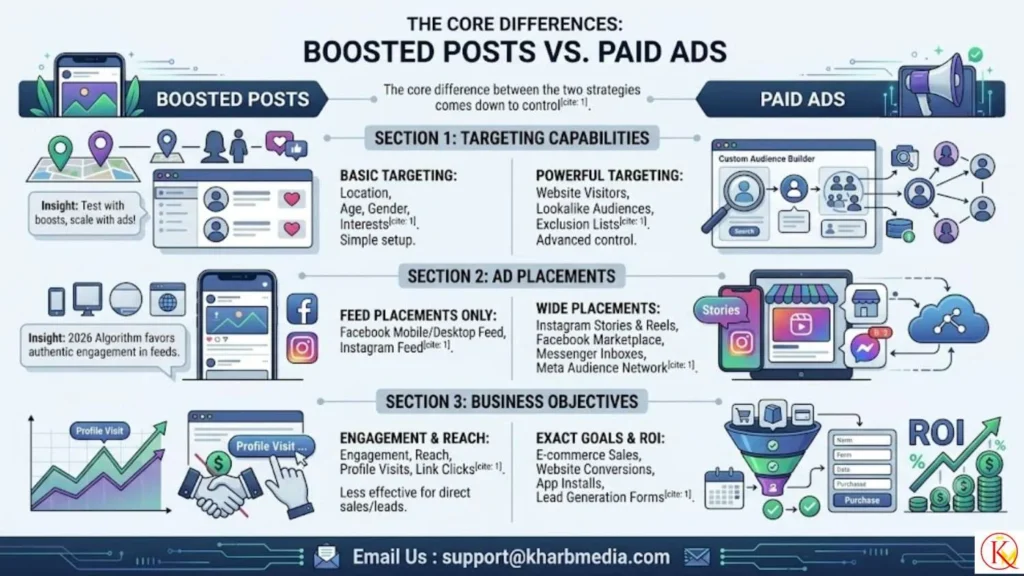
The core difference between the two strategies comes down to control. Our team at Kharb Media always looks at three main areas when deciding which route to take for our clients.
1. Targeting Capabilities
- Boosted Posts: These let you target by basic location, age, gender, and interests. They do not offer advanced targeting features such as custom audiences or detailed behavior tracking.
- Paid Ads: Full social ads unlock powerful targeting. You can build custom audiences from website visitors, create lookalike audiences, and use exclusion lists to avoid showing ads to people who already converted.
2. Ad Placements
- Boosted Posts: When you boost a post, it generally only appears in the standard social feed. On Meta, this is limited to the Facebook mobile feed, Facebook desktop feed, and Instagram feed.
- Paid Ads: Full campaigns open up much wider placements. You can place ads in Instagram Stories and Reels, Facebook Marketplace, Messenger inboxes, and the Meta Audience Network.
3. Business Objectives
- Boosted Posts: These are mostly aimed at engagement, reach, profile visits, or link clicks. They are less effective for driving direct sales or lead generation.
- Paid Ads: Ads allow you to pick exact goals like e-commerce sales, website conversions, app installs, and direct lead generation forms.
Pros and Cons of Boosting Posts
Boosting is an excellent tool when used correctly. Here is the breakdown.
The Pros:
- Simple to use: Boosting a post is straightforward and can be done directly from the social platform’s interface. It takes only minutes to set up.
- Great for existing content: Existing content can be quickly repurposed into boosted posts without creating customized content.
- Social Proof: Boosted posts preserve social proof, meaning all the likes and comments from the original organic post carry over.
The Cons:
- Fewer options: There’s less opportunity to curate a post that will speak to a specific audience since the content is already posted.
- Lower conversion rates: Boosted posts do not offer advanced ad types like form fills, making them less effective for driving sales.
- Hidden Fees: iOS users have to pay a 30% service fee on boosted ads created directly within the Instagram and Facebook iOS apps.
Pro Tip from Kharb Media: Test how boosting posts affects your organic content. Some marketers believe that frequent boosting signals to the platform that you are willing to pay for engagement, which may reduce the organic reach of your future posts over time.
Pros and Cons of Promoting (Paid Ads)
When you need serious ROI, paid ads are the heavy lifters.
The Pros:
- Precise alignment: Ads can be aligned more directly with target audience demographics, ensuring better ROI.
- Strategic formats: You have full creative control to use formats like carousels, slideshows, lead forms, and dynamic product ads.
- Detailed tracking: Ads provide full conversion tracking, pixel-based attribution, and detailed demographic breakdowns.
The Cons:
- Time-consuming: Developing ads from scratch is more complex and time-consuming than boosting.
- Learning curve: Tools like Meta Ads Manager and LinkedIn Campaign Manager are powerful but require time to learn the interface and campaign structure.
- No guarantees: There is no guarantee an ad will succeed, whereas boosted content is built from posts that already have proven high engagement.
Platform-Specific Differences
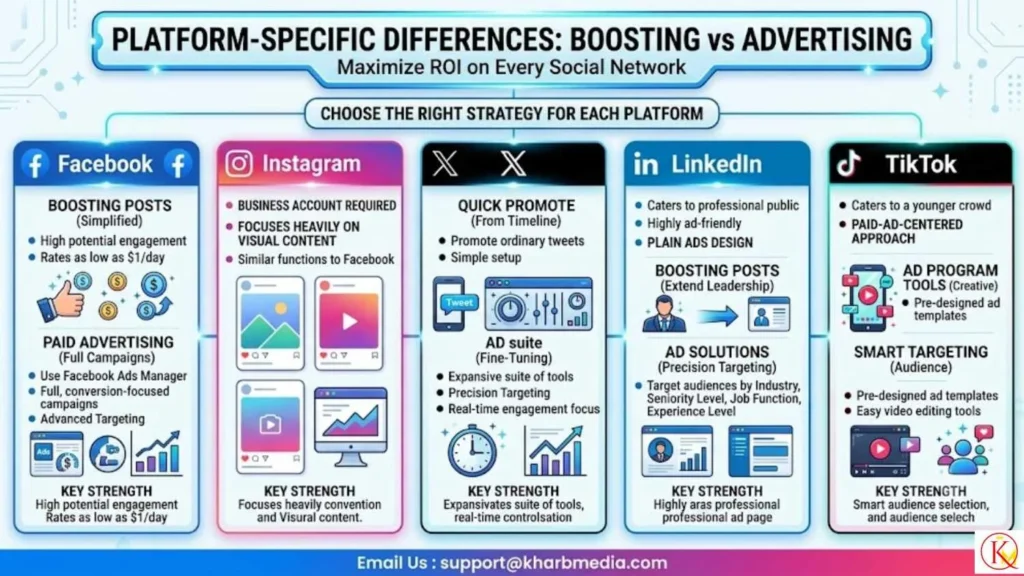
Does the platform make a difference? Absolutely. Each social media platform offers different features that influence your choice. Our senior strategists have executed campaigns across all major platforms.
- Facebook: Facebook posts tend to get better engagement than advertising, and you can find boosting rates as low as $1/day. However, you need to use Facebook Ads Manager for full, conversion-focused campaigns.
- Instagram: You need a business account to advertise here. Instagram offers similar boosting and promoting functions to Facebook but focuses heavily on visual content.
- X (formerly Twitter): X has a Quick Promote feature for ordinary tweets. If you click it, you gain access to an expansive suite of tools for fine-tuning your promotion.
- LinkedIn: LinkedIn is highly ad-friendly and caters to a professional public. You can boost posts or use their dedicated page for ads to target audiences by industry, seniority level, and job function.
- TikTok: This platform caters to a younger crowd, and its ad program is equipped with pre-designed ad templates and easy video editing tools.
When to Use Which Strategy
So, which is better? The choice to boost a post or craft a new ad is a judgment call based on your specific goals and budget.
When to Boost a Post
Boosted posts are the best solution when you want quick visibility and are targeting a broader audience.
- Announcements: Use boosts for an event or sale that needs more eyes quickly.
- Brand Awareness: Boosting is better as a brand awareness tool.
- Time-Sensitive Content: Boosts are great for timely content because full paid social ads often have a learning period that can take up to 14 days on Meta.
When to Run Paid Social Ads
Promoting posts (paid ads) provides precise targeting and is ideal for specific marketing objectives.
- Sales and Leads: If you are running a campaign to drive sales or capture contact info, stick to paid advertising.
- Retargeting: Show ads to people who visited your site but didn’t convert, which requires pixel-based custom audiences.
- Evergreen Campaigns: Ads excel in scenarios where continuous, consistent visibility and engagement are essential over time.
How Much Does It Cost?
Success in social media marketing hinges on strategic spending.
On Meta platforms, you can boost a post for as little as $1 per day. For LinkedIn, the minimum requirement is $10 per day for boosted posts.
For full ad campaigns, you need a larger budget. Meta generally recommends generating around 50 conversion events per week per ad set to exit their learning phase. If your cost per conversion is $10, you should plan for roughly $500 per week as a starting point.
Pro Strategy: The Kharb Media Union Approach
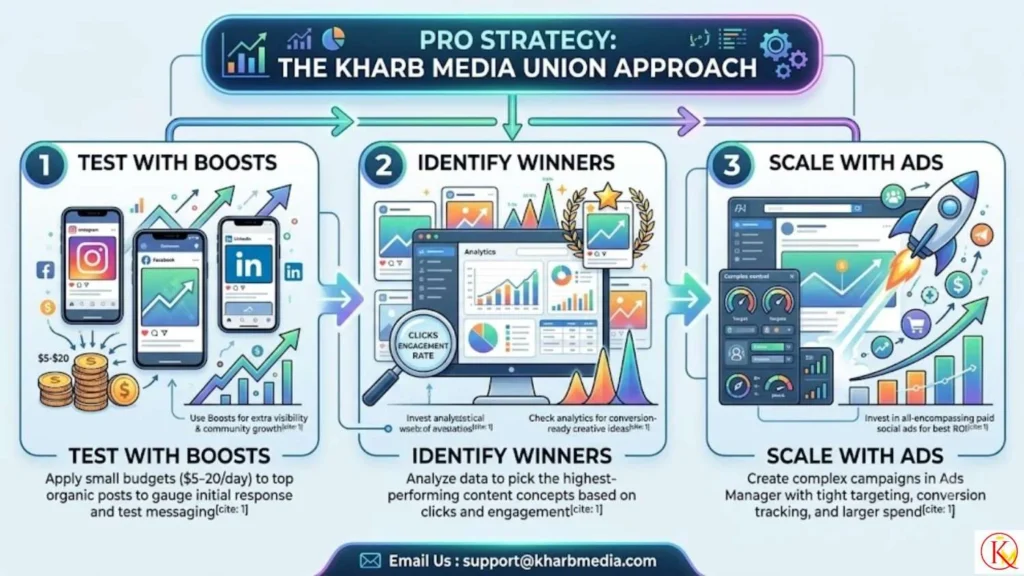
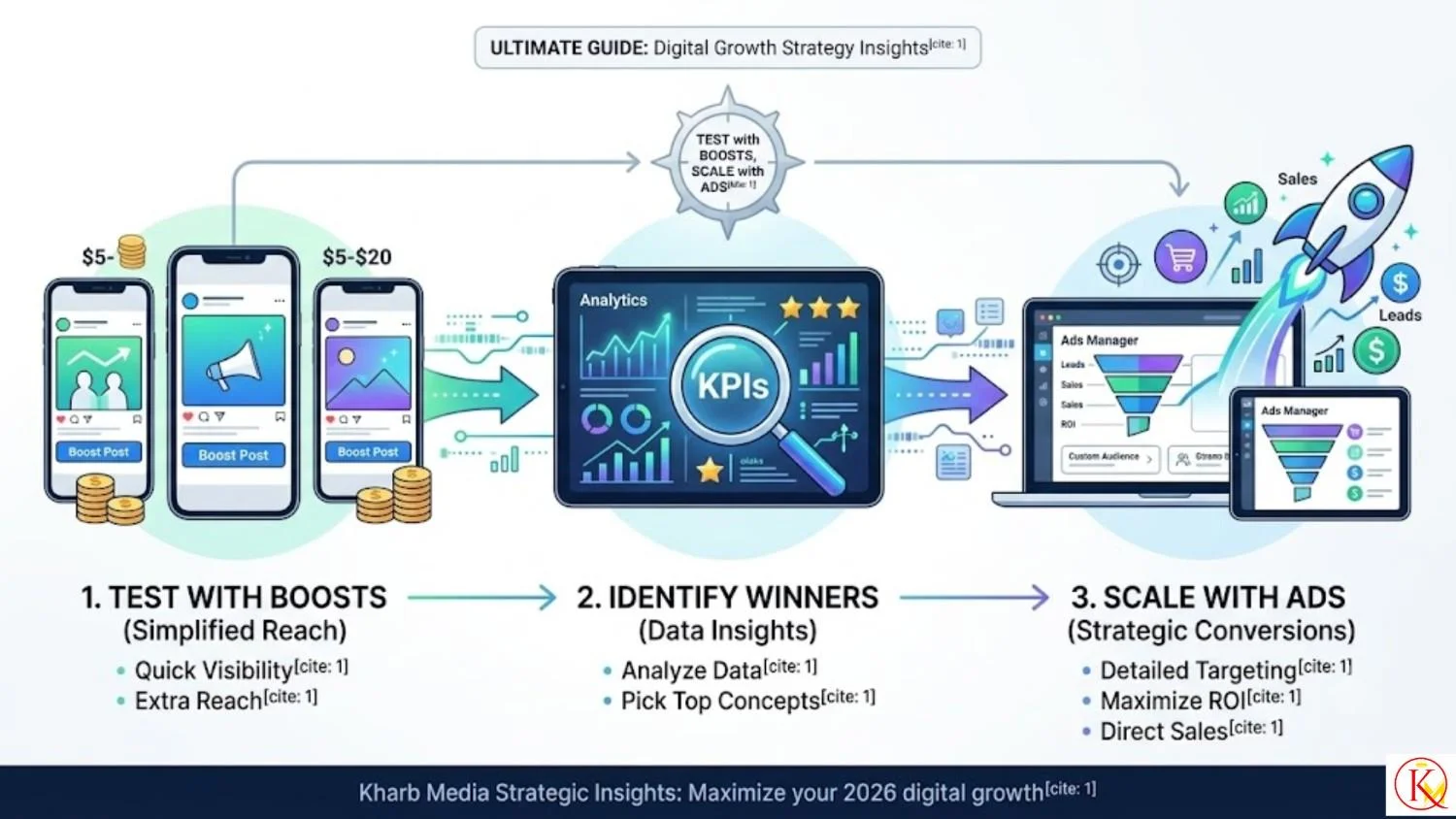
Our team at Kharb Media rarely relies on just one method. The smartest brands use boosted posts and full ad campaigns as complementary parts of a unified strategy.
Here is our exact workflow:
- Test with Boosts: We boost two or three organic posts with small budgets (like $5 to $20 a day) to see which gets the best response.
- Identify Winners: We check the analytics to see which post generated the most clicks and engagement.
- Scale with Ads: We take the winning creative concept and build a sophisticated campaign in Ads Manager with conversion tracking and tight targeting.
This method reduces wasted ad spend because you validate your messaging with real audience data first.
Conclusion
Understanding the boosting vs posting promos differences in social media marketing is the key to maximizing your marketing budget.
Boosts are quick, simple, and great for extra reach. Ads offer advanced targeting, custom goals, and better tracking. By weighing these considerations, businesses can harness the power of social media to achieve their objectives.
Stop guessing with your advertising budget.
Claim Your Free Digital Growth Strategy Are you ready to stop wasting money on ineffective social media tactics email us : support@kharbmedia.com
Our Social Media Managers and PPC Consultants specialize in crafting tailored strategies that fit your exact business goals.
People Also Ask (FAQs)
Should I boost every high-performing organic post?
No. You should boost strategically based on your business goals, prioritizing posts that align with specific objectives like event promotions or product launches.
Can I convert a boosted post into a full ad campaign?
Yes. You can take the creative concept and messaging from a successful boosted post and build a more sophisticated campaign in Ads Manager with better tracking and retargeting.
How do I avoid the 30% Apple fee on boosted posts?
iOS users have to pay a 30% service fee on boosted ads created inside the mobile apps. You can avoid this by boosting posts from a desktop browser, adding prepaid funds, or using third-party management tools.