
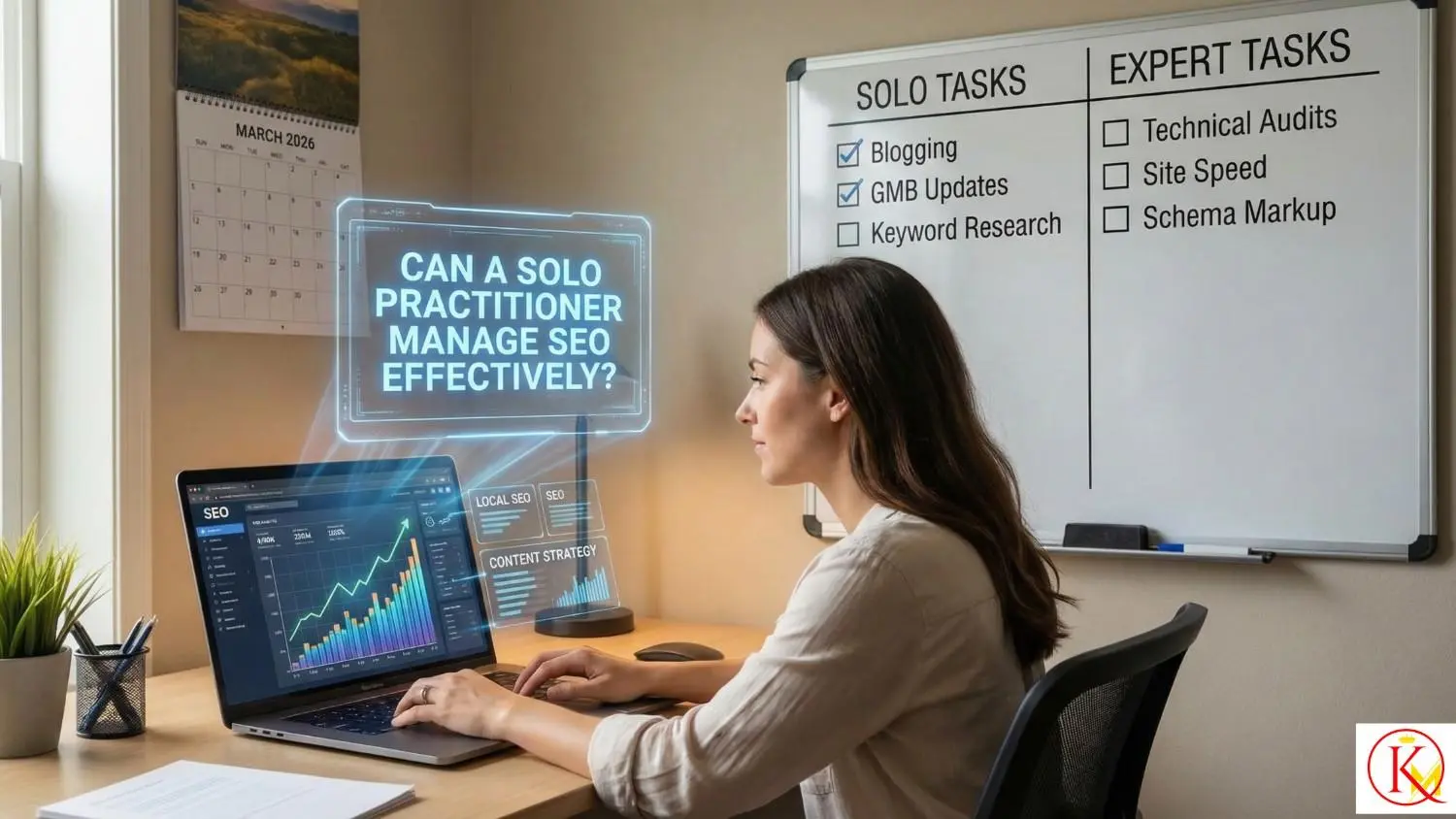
If you are running a business alone, you wear a lot of hats. You manage sales, handle customer service, and balance the books.
Now, you are looking at your website traffic and asking a critical question: can a solo practitioner manage SEO effectively?
The short answer is yes. However, it takes focus, the right tools, and a solid plan.
With over 15+ years of combined experience, our team at Kharb Media has seen countless business owners try to tackle search engine optimization on their own. Some succeed brilliantly by owning their local niche. Others burn out trying to compete with massive corporations.
In this ultimate guide, we will break down exactly what you can handle on your own, what tasks you should avoid, and how to build a ranking strategy that actually works in 2026.
Table of Contents
Evaluating Your Workload: Do You Really Need an SEO Team?
Before diving into keyword research and technical tweaks, you must set realistic expectations.
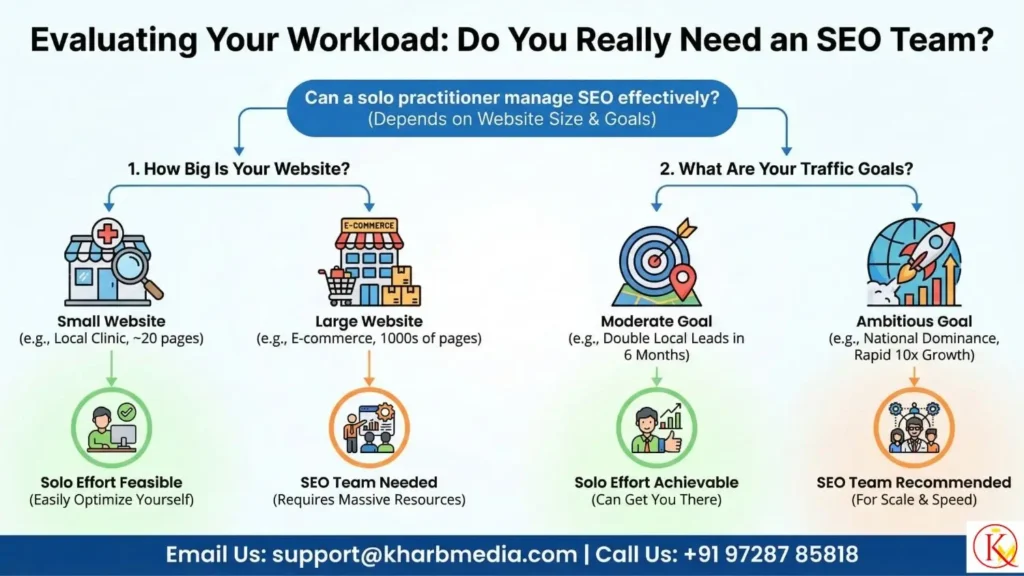
Can a solo practitioner manage SEO effectively? It entirely depends on your website’s size and your ultimate business goals. Here are a few things our senior strategists always tell clients to evaluate:
1. How Big Is Your Website? A local clinic website with 20 pages does not need a full-time SEO team. You can easily optimize those pages yourself.
On the other hand, an e-commerce store with thousands of product pages requires massive resources. One person simply does not have enough hours in the day to manage a site that large.
2. What Are Your Traffic Goals? If you want to double your local leads in six months, a solo effort can get you there.
If you expect one person’s part-time efforts to 10x your national traffic overnight, you are setting yourself up for failure. Growth takes time.
Big Agencies vs. Solo Practitioners: Where is the Advantage?
Many small business owners worry they are at a disadvantage against big companies. This is a myth.
Most clients and search engines do not care how big your team is. They care about the value you bring and the problems you solve.
In fact, working alone or keeping your SEO in-house offers a few unique advantages:
- Specialized Expertise: You know your exact niche better than an agency intern ever will.
- Zero Org Chart Layers: You can make website changes instantly without waiting for a series of approvals.
- Cost-Effective: You have significantly less overhead, allowing you to invest in better software or content.
Pro Tip: Google’s 2026 algorithms heavily favor E-E-A-T (Experience, Expertise, Authoritativeness, and Trustworthiness). As a solo practitioner, your personal brand and real-world experience give you a massive edge in creating trustworthy content.
Key Strategies for Effective Solo SEO Management
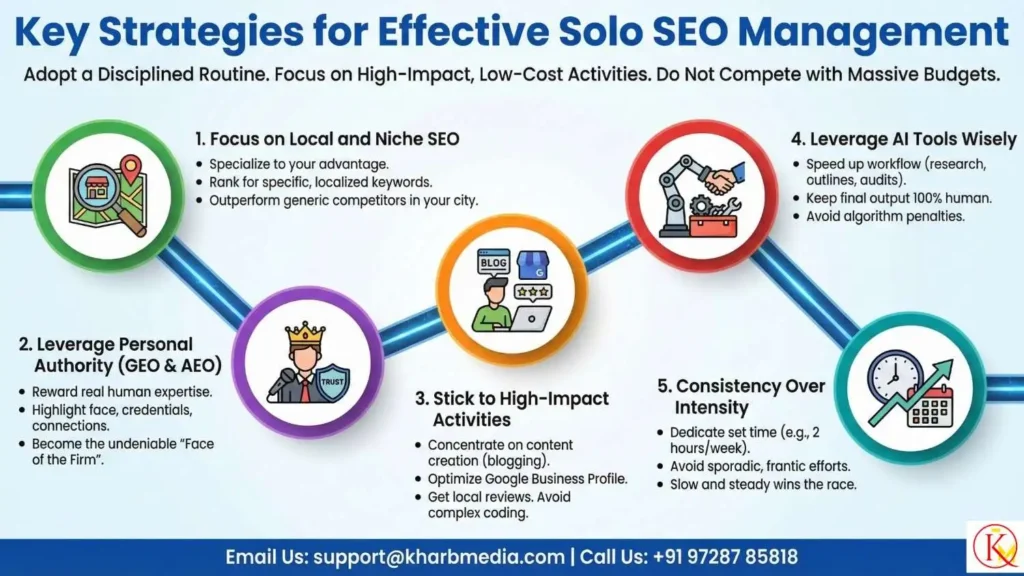
So, can a solo practitioner manage SEO effectively without losing their mind? Yes, by adopting a disciplined and highly focused routine.
Do not try to compete with massive agency budgets. Instead, focus on high-impact, low-cost activities.
1. Focus on Local and Niche SEO
Your greatest advantage is your ability to specialize. It is much easier to rank for specific, localized keywords. Outperforming larger, generic competitors in your local city is a highly realistic goal.
2. Leverage Personal Authority (GEO & AEO)
Google’s AI Overviews (AEO) and Generative Engine Optimization (GEO) reward real human expertise. Highlight your face, your credentials, and your local connections. Become the undeniable “Face of the Firm” in your industry.
3. Stick to High-Impact Activities
Do not try to learn complex coding. Concentrate on content creation (like blogging), optimizing your Google Business Profile, and getting local reviews.
4. Leverage AI Tools Wisely
Use modern AI tools to speed up your workflow. You can use them for keyword research, drafting outlines, and basic technical audits. Just remember to keep the final output 100% human to avoid algorithm penalties.
5. Consistency Over Intensity
Dedicate a set amount of time such as 2 hours a week to your website. Sporadic, frantic efforts rarely work. Slow and steady wins the search ranking race.
What You Need for DIY SEO: Beginner-Friendly Tasks
If you are keeping your marketing in-house, you need to know which battles to fight.
Our team at Kharb Media recommends that solo business owners focus on these beginner-friendly SEO tasks:
- Keyword Research: Use tools like Google Keyword Planner to find phrases with decent search volume and low competition. Target long-tail keywords (e.g., “best emergency plumber in Rohtak” instead of just “plumber”).
- On-Page SEO: Make sure your page titles, meta descriptions, and headers include your target keywords.
- Content Creation: Write helpful blogs, service pages, and FAQs based on your keyword research. Answer the exact questions your customers ask you every day.
- Managing Google Business Profile: Keep your address, hours, and services updated. Add fresh photos and reply to every single review.
- Basic Analytics Tracking: Set up Google Search Console and Google Analytics to track your traffic and see how people find your site.
The Pitfalls: Where Does DIY SEO Fall Short?
While it is empowering to do things yourself, DIY SEO has its limits.
If people ask us, “can a solo practitioner manage SEO effectively forever?”, we usually point out these common hurdles:
The Time Commitment SEO is not fast. It often takes three to six months to see real changes. Search engines need time to crawl your website, evaluate your updates, and adjust your rankings. Maintaining those top spots is a continuous, weekly effort.
Fierce Competition Levels Outranking firms with massive marketing budgets in highly competitive, large cities requires a flawless, targeted approach. Sometimes, passion isn’t enough to beat a million-dollar ad budget.
Dangerous Black-Hat Mistakes Without knowing it, beginners often make mistakes that trigger Google penalties. You must strictly avoid:
- Buying backlinks from shady websites.
- Keyword stuffing (repeating the same word over and over unnaturally).
- Publishing thin, low-quality content just for the sake of posting.
Pro Tip: Never write content just for the search engine bots. Always write for your human readers first. If it sounds robotic, rewrite it.
Which SEO Tasks Are Best Left to Experts?
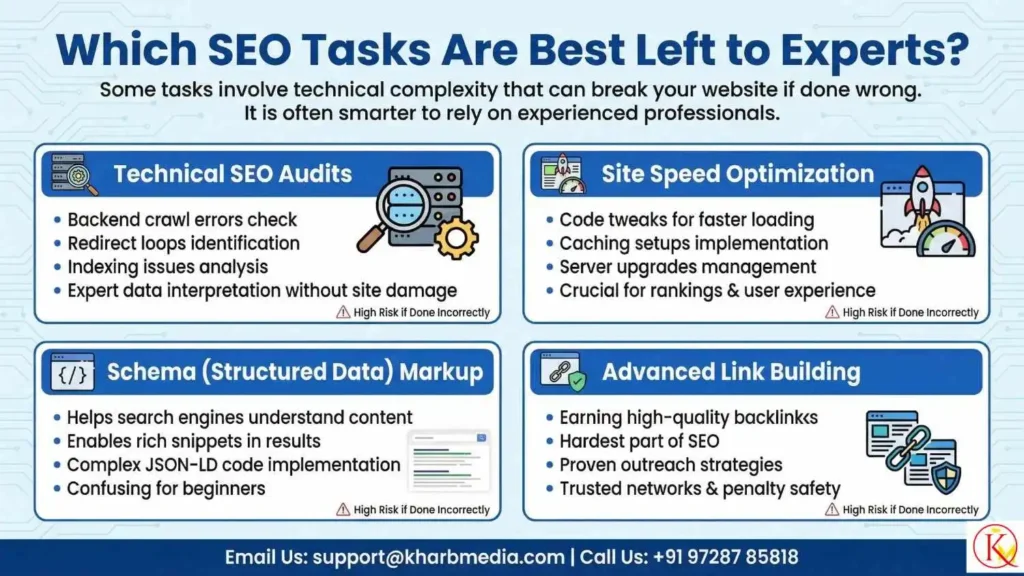
Some tasks involve technical complexity that can break your website if done wrong.
When a solo practitioner reaches this stage, it is often smarter to rely on experienced professionals.
Technical SEO Audits Checking your site’s backend for crawl errors, redirect loops, and indexing issues requires technical skill. An expert knows how to interpret this data without deleting important files.
Site Speed Optimization Page speed affects your rankings and your user experience. Making a site truly fast requires code tweaks, caching setups, and server upgrades.
Schema (Structured Data) Markup Schema helps search engines understand your content better, giving you rich snippets in search results. Implementing JSON-LD code correctly can be highly confusing for beginners.
Advanced Link Building Earning high-quality backlinks is one of the hardest parts of SEO. Professionals bring proven outreach strategies and trusted networks that keep your site safe from Google link penalties.
The Hybrid Approach: Doing What You Can
You do not have to choose between doing it all yourself or handing over full control.
Have you thought about a hybrid approach?
Many of our most successful clients use this method. You can handle the content creation, local networking, and Google Business Profile updates. Then, you hire a trusted agency to handle the complex technical audits, site speed optimization, and overarching strategy.
This allows you to keep costs down while ensuring your technical foundation is rock solid.
If you are looking for an SEO partner to handle the heavy technical lifting, Contact Kharb Media for a custom strategy session.
When Should You Consider Hiring a Pro?
Can a solo practitioner manage SEO effectively? Yes, until they hit a growth wall.
If you are consistently hitting roadblocks, it might be time to get outside help. You should consider hiring an SEO agency if:
- You are not seeing traffic growth after six months of steady effort.
- Your business is growing, and you simply no longer have the time to write blogs.
- You face technical problems like crawl errors or mobile usability warnings that you don’t know how to fix.
- You want to expand out of your local city and target a national audience.
Hiring someone is not a failure. It is a smart business investment when your progress stalls.
Ready to Dominate Your Market in 2026?
So, can a solo practitioner manage SEO effectively? Absolutely. By focusing on your local niche, creating great content, and avoiding technical pitfalls, you can build a highly visible brand.
However, as your business grows, your digital marketing needs will evolve. When you are ready to stop guessing and start scaling, our team is here to help.
With over 15+ years of combined experience, our experts at Kharb Media know exactly what it takes to dominate the 2026 search algorithms.
Get Your Free SEO Audit today and let us build your custom growth roadmap: Chat with an Expert
Call Us: +91 97287 85818
Email Us: support@kharbmedia.com
People Also Ask (FAQs)
What is the first thing I should do when starting DIY SEO?
Begin by understanding the basics. Set up Google Search Console and Google Analytics. Then, focus on learning basic keyword research and writing high-quality content that answers your customers’ problems
Can I rank on Google without hiring an SEO agency?
Yes. If you are consistent, use the right tools, and produce high-quality content targeting relevant, low-competition keywords, it is highly possible to rank without agency support.
How do I know if my SEO efforts are working?
Check your Google Search Console. If you are seeing an upward trend in impressions and clicks over a 3-to-6 month period, your efforts are paying off. Patience is mandatory.
Is blogging necessary for DIY SEO?
Blogging is one of the most effective ways to build topical authority. Regular posts targeting specific search queries help you rank for more keywords and prove your expertise to Google.