
SaaS companies rarely fail at SEO because they forget a meta description or don’t know how to place a keyword.
Instead, they fail because small, compounding SaaS SEO mistakes quietly misalign content with what buyers actually want. These quiet, repeatable errors slowly weaken your discoverability and choke your qualified pipeline.
This is a massive problem today. Buyer-led discovery is happening earlier than ever. In fact, 94% of buyers say they order their shortlist by preference before they even speak with a sales rep.
If your SEO is misaligned, your sales team loses the deal before they even get a chance to pitch.
With over 15+ years of combined experience, our team at Kharb Media has seen how these unforced errors destroy growth. We have also seen how fixing them turns a struggling website into an unstoppable revenue engine.
Table of Contents
Stop writing boring blogs that win the click but lose the buyer: Chat on WhatsApp
Below, our senior strategists break down the most common SaaS SEO mistakes we see in the market today, and exactly how you can fix them.
Mistake #1: Chasing High Search Volume Instead of Buyer Intent
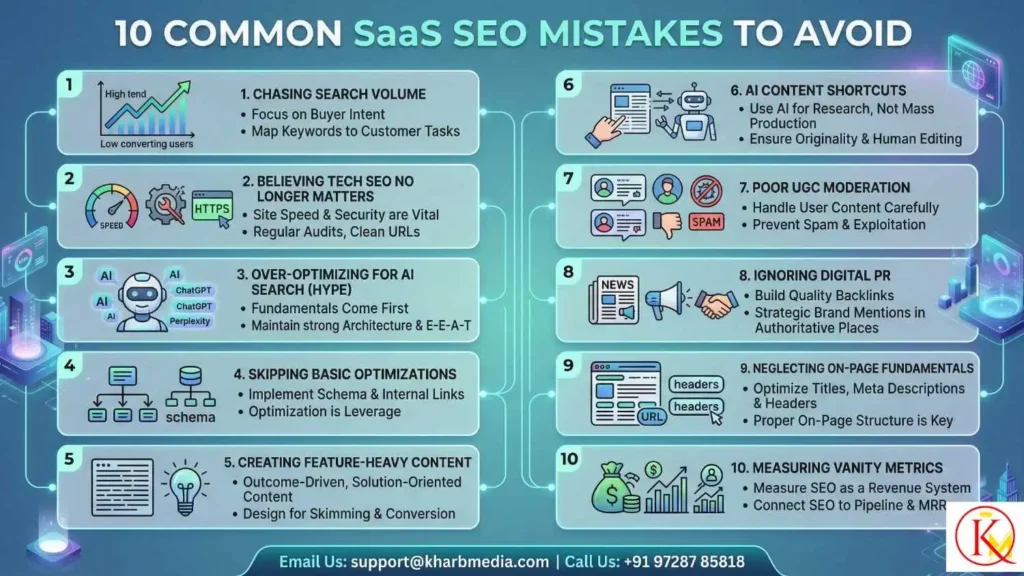
Chasing search volume instead of buyer intent is one of the fastest ways to build traffic that looks great on a graph but converts poorly.
Many teams optimize for high-volume terms simply because they are easy to justify on a content calendar. The traffic goes up, but your trial starts and demo requests barely move.
Treat your blog content like a conversion surface, not just a writing exercise: Chat on WhatsApp
A surprising number of SaaS companies also skip doing keyword research for their own specific product pages. If you ignore the keywords that actually describe your product, you miss potential customers who are ready to buy.
How to Fix It:
- Map keywords to buyer tasks: Focus on evaluation, comparison, implementation, and pricing.
- Use real customer language: Involve your sales and support teams to find out exactly what phrases your users use.
Mistake #2: Believing Technical SEO No Longer Matters
This is one of the most dangerous SaaS SEO mistakes today because it sounds modern to say “content matters more”.
Teams tell themselves that technical clean-up can wait. It cannot. Technical health matters more than ever because search engines and AI crawlers refuse to send users to a slow, broken, or confusing website.
Technical issues pile up quietly rendering problems, crawl waste, orphaned pages, and messy URLs. Each error chips away at your visibility and search engine trust.
How to Fix It:
- Run regular audits: Focus on site speed, secure connections (HTTPS), and clean URL structures.
- Treat it as table stakes: Technical SEO is a standing requirement to rank and convert attention, not a legacy checklist.
Mistake #3: Over-Optimizing for AI Search (AEO/GEO)
Everyone wants to win in ChatGPT, Perplexity, and Gemini. Because of this, enterprise teams often chase unproven tactics and format hacks.
They act like the fundamentals of SEO suddenly stopped working. They did not.
AI search engines still want to surface quality content that is credible, useful, and validated by external sources. Ignoring strong information architecture and E-E-A-T (Experience, Expertise, Authoritativeness, Trustworthiness) to chase flashy tricks is a massive distraction.
How to Fix It:
- Keep fundamentals first: Quality content and external validation are still the core drivers of AI visibility.
- Test carefully: Do not let flashy new experiments replace proven, hard work.
Mistake #4: Skipping “Basic” SEO Optimizations
Not every SEO win requires a six-month strategy deck. Many teams leave real revenue on the table by ignoring high-leverage optimizations.
Things like internal linking, schema markup, and site architecture upgrades are not glamorous. Because publishing feels like progress and optimization feels like maintenance, existing leverage stays untapped.
When you skip these, search engines get weaker structural signals, and buyers have a harder time moving through your site.
How to Fix It:
- Treat optimization as leverage: Small structural updates help search engines understand your site faster.
- Implement structured data: Use schema markup to help your site appear in rich snippets and improve click-through rates.
Mistake #5: Creating Boring, Feature-Heavy Content
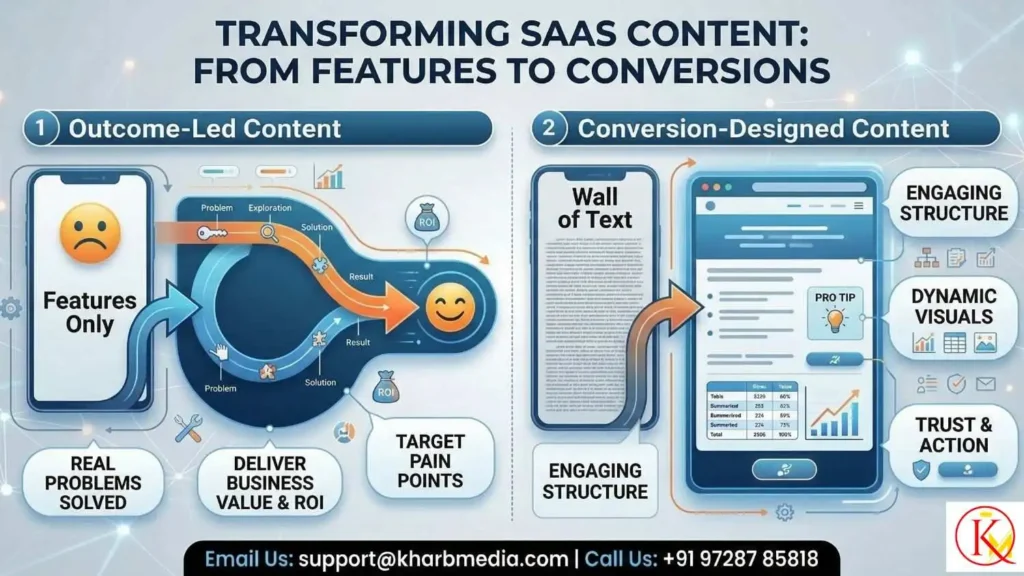
This is where a lot of B2B SaaS content goes to die. You win the click, but greet the reader with a giant wall of text that looks like it was written just to satisfy a brief.
Many SaaS brands make the mistake of highlighting product features instead of showing how they solve real customer problems. Most people are searching for solutions, not a bulleted list of features.
Blog content often becomes over-explained and structurally flat, lacking in-line CTAs, tables, graphs, or examples.
How to Fix It:
- Focus on outcomes: Shift your messaging to focus directly on pain points and customer needs.
- Design for conversion: Treat your blog posts like conversion surfaces. Make them easy to skim, trust, and act upon.
Mistake #6: Automated Content Manipulation
With the rise of generative AI, many companies try to take shortcuts. In one study, a startup lost 99.5% of its organic traffic after receiving a Google manual penalty.
How? They cloned a competitor’s site structure and used AI to mass-produce low-quality content to game the rankings.
Using AI to generate generic, overly simplistic articles is one of the most common SaaS SEO mistakes right now. Google’s spam team will eventually catch you and remove your site from search results.
How to Fix It:
- Use AI for research, not mass production: Have humans edit and fact-check all content to ensure originality.
- Add real value: Include original research, industry stats, and expert insights to build true topical authority.
Mistake #7: Poor User-Generated Content (UGC) Management
User-generated content can be powerful, but it must be managed carefully. One major content platform saw a 97% drop in organic traffic after they deindexed thousands of user-generated portfolio pages.
They did this because users were exploiting free subdomains to rank for spammy keywords. Deindexing key pages in a panic is a catastrophic error.
How to Fix It:
- Moderate effectively: Use automated and manual review systems to catch spam before it takes over.
- Use selective deindexing: Only remove or “noindex” spammy pages, preserving your valuable, legitimate content and rankings.
Mistake #8: Ignoring Digital PR and Quality Backlinks
A lot of SaaS teams talk about authority as if the conversation begins and ends with basic backlinks. This view is way too narrow.
The bigger issue is whether credible external sources are talking about your brand and referencing your expertise. Failing to build quality backlinks means you miss out on referral traffic and domain authority.
If you ignore digital PR, your competitors will shape the category conversation while you are left behind.
How to Fix It:
- Think beyond pure link building: Build a strategy that gets your brand mentioned in places buyers actually trust.
- Publish data-driven studies: Create linkable assets and reports that authoritative websites naturally want to reference.
Mistake #9: Ignoring On-Page SEO Fundamentals
Some SaaS companies focus entirely on social media or acquiring backlinks while completely neglecting basic on-page SEO.
Poor on-page optimization leads to lower rankings, no matter how great your content is. Without properly optimized meta tags, headers, and URLs, search engines struggle to understand your pages.
How to Fix It:
- Optimize Titles & Descriptions: Craft compelling meta tags that include your target keywords to entice users to click.
- Use Header Tags Properly: Structure your content with H1, H2, and H3 tags to help search engines understand your content hierarchy.
Mistake #10: Measuring SEO Like a Channel, Not a Revenue System
When your SEO reporting only focuses on sessions and keyword rankings, your program stays easy for leadership to undervalue.
Teams often default to last-click attribution because it is simple, not because it reflects reality. This leads to budget distortion, where you invest in what looks measurable rather than what actually acquires customers.
SEO gets pressured to prove itself with traffic spikes instead of pipeline influence.
How to Fix It:
- Align with RevOps: Measure SEO as part of a complete revenue system.
- Track pipeline influence: Connect your organic search data to CRM outcomes like SQLs and closed-won revenue.
How to Build a Compounding SaaS SEO Strategy with Kharb Media
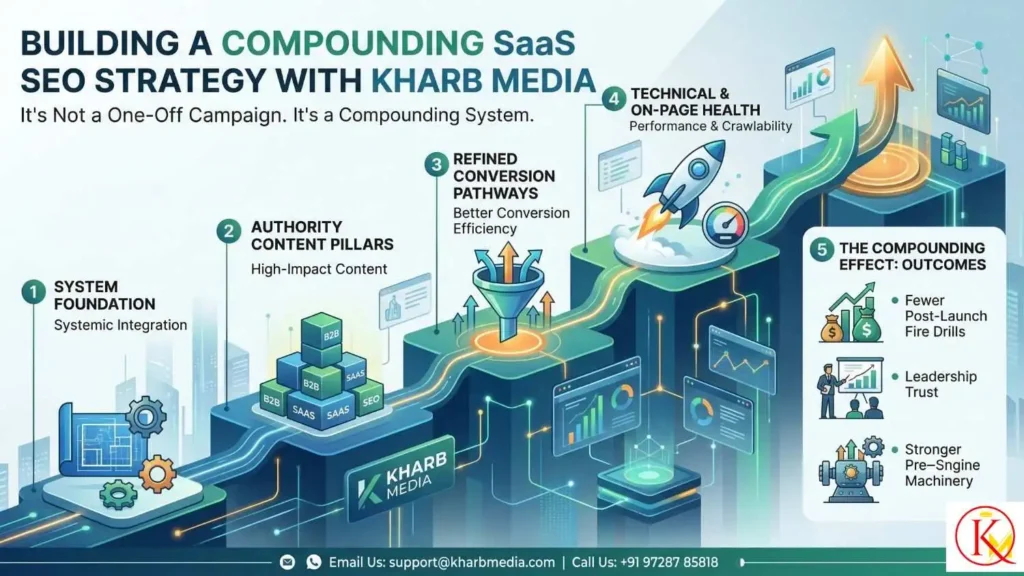
At Kharb Media, our senior strategists know that SaaS SEO is not a one-off campaign; it is a compounding system.
When the system is broken, every new page adds friction. When it works, you get better conversion efficiency, fewer post-launch fire drills, and a stronger pre-sales engine.
We don’t waste time on vanity metrics. Our team focuses on outcome-driven strategies that turn your website into something leadership can actually trust.
Claim Your Free Digital Growth Strategy Today
Stop losing pipeline to easily avoidable errors. If you are tired of stagnant traffic and low-quality leads, it is time to let the experts audit your system.
With over 15+ years of combined experience, our experts will identify exactly where your system is leaking revenue and how to fix it.
Get Your Free SEO Audit from the team at Kharb Media today: Chat on WhatsApp
- Phone: +91 97287 85818
- Email: support@kharbmedia.com
People Also Ask (FAQs)
What are the most common SaaS SEO mistakes?
The most frequent errors include ignoring keywords attached to your specific product, overlooking technical SEO, focusing heavily on product features instead of customer problems, and neglecting content marketing and link building.
Why is technical SEO important for SaaS businesses?
Technical SEO ensures your software’s website is crawlable, indexable, and fast. Without it, search engines won’t rank your site, and visitors will leave due to a poor user experience.
How can SaaS companies avoid penalties for thin content?
Thin content offers zero value to the user. To avoid Google penalties, aim to create well-researched, in-depth guides that solve specific pain points. Updating older pages regularly also prevents them from being flagged.
How does poor site structure affect SaaS SEO performance?
A confusing site structure hurts both user experience and search engine crawling. It leads to higher bounce rates and missed opportunities to rank for crucial, high-intent keywords.