
Did you know that 75% of users do not go beyond the first page of search results?
If your website is not sitting on that first page, your business practically does not exist to your target audience.
This is not an exaggeration. The data shows that a mere 0.78% of users actually click on a result found on the second page of Google.
With over 15+ years of combined experience, our team at Kharb Media has seen every trick, shortcut, and empty promise in the industry.
We know that topping search results is the literal difference between a business thriving and failing.
But in 2026, the old tricks no longer work.
Today, you need digital marketing and SEO done with honesty: Chat On WhatsApp
What does that mean? It means prioritizing actual user experience, building genuine brand trust, and creating content that truly helps people.
Let’s break down exactly how honest SEO fuels your entire digital marketing strategy, and what you actually need to do to win today.
Table of Contents
What is the Relationship Between SEO and Digital Marketing?
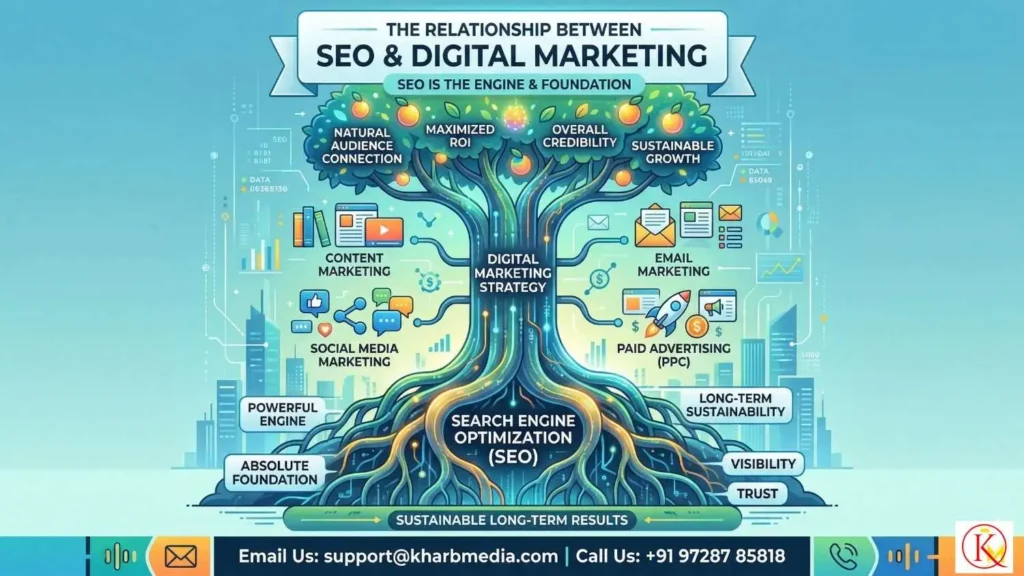
To understand the connection, we need to look at the big picture.
Digital marketing uses online tools and channels like websites, social platforms, and email to promote your services.
The core elements usually include:
- Search Engine Optimization (SEO)
- Content Marketing
- Email Marketing
- Social Media Marketing
- Paid Advertising (PPC)
So, what is the exact relationship?
SEO is not just a small piece of your digital marketing plan; it is the absolute foundation.
Without a strong SEO foundation, your long-term digital strategies simply cannot achieve sustainable results.
SEO acts as the powerful engine that naturally connects your brand with the right audience, enhancing your overall credibility and maximizing your return on investment.
The 4 Pillars of Honest SEO
SEO relies on a specific set of techniques to improve your visibility.
Missing even one of these pillars weakens your entire growth system.
1. On-Page SEO (Content & Intent)
On-page SEO involves optimizing individual pages to help users find answers quickly.
- This includes optimizing your actual content, titles, and descriptions.
- It also requires the effective use of relevant keywords within the site.
2. Off-Page SEO (Earning Trust)
Off-page SEO focuses on actions taken outside of your website to build your reputation.
- The primary goal is to get search engines to view your site as a trustworthy source.
- This involves building high-quality external links and boosting your brand’s overall reliability.
3. Technical SEO (The Prerequisites)
Technical SEO ensures that search engine bots can actually read and understand your site.
- This means dramatically improving site speed and ensuring total mobile compatibility.
- It also requires fixing broken links, resolving crawl errors, and providing a secure HTTPS connection.
4. Local SEO (Dominating Your Area)
Local SEO targets customers who are physically near your business.
- You must optimize your Google Business Profile to rank in local pack results.
- It is critical to use location-specific keywords and actively manage your customer reviews.
What Actually Changed in SEO in 2026? (The Honest Truth)
Our senior strategists have executed hundreds of campaigns. The gap between what Google rewarded three years ago and what it rewards today is massive.
Here is what digital marketing and SEO done with honesty looks like in 2026.
The Shift to AEO and GEO (AI Overviews)
Search is no longer just about ten blue links.
AI Overviews have fundamentally changed what it means to rank on Google.
- When Google places an AI-generated answer at the very top, the organic results below it are effectively pushed down to positions 4, 5, and 6.
- To compete, you must adapt to Answer Engine Optimization (AEO) and Generative Engine Optimization (GEO).
- Your content must directly answer questions in 2-3 short sentences right at the start of a section.
Brand Trust is Now a Major Ranking Signal
Generic keyword chasing is dead.
In a recent case study, two identical businesses received the exact same SEO work, but one jumped to the top 3 spots effortlessly. Why?
Because they ran an offline promotion that caused 400-500 people to actively search for their brand name on Google.
- Google tracks “site authority” through branded searches.
- When real people seek you out by name, Google’s algorithm instantly trusts you more.
The Real “Sandbox” Period for New Domains
In the past, agencies would build backlinks the moment a new website went live. Today, that is toxic.
- Google places brand new domains in a “sandbox” trust evaluation window for roughly the first six to ten months.
- Building generic links immediately looks like manual manipulation and will tank your rankings.
- Honest SEO means spending the first four to six months focusing strictly on content depth and user trust.
User Experience (UX) is the Ultimate Prerequisite
We recently audited a business that paid for SEO for five years with zero growth.
The problem was not their keywords. The problem was their mobile layout was broken and their contact forms did not work.
- Every user who immediately left the broken site sent a massive negative engagement signal to Google.
- A delay in page loading by just one single second can crush your conversion rates by up to 20%.
- If your website frustrates users, no amount of SEO investment will save it.
From Search to Sale: How Honest SEO Fuels Growth
When you practice digital marketing and SEO done with honesty, you stop chasing vanity metrics and start driving actual revenue.
Here is how the growth cycle works:
1. Get Found: By targeting relevant keywords, you show up exactly when buyers are actively searching for a solution.
2. Earn Trust: Users inherently trust organic results far more than paid ads. Holding high rankings consistently builds immense credibility.
Take the Next Step With Us Today: Chat On WhatsApp
3. Attract the Right Visitors: SEO traffic is highly intentional. Because these visitors are in the decision-making stage, the likelihood of a conversion skyrockets.
4. Maximize ROI: Compared to the endless spending of paid ads, honest SEO provides a significantly higher Return on Investment (ROI) over the long run.
Stop Guessing: Track What Actually Matters
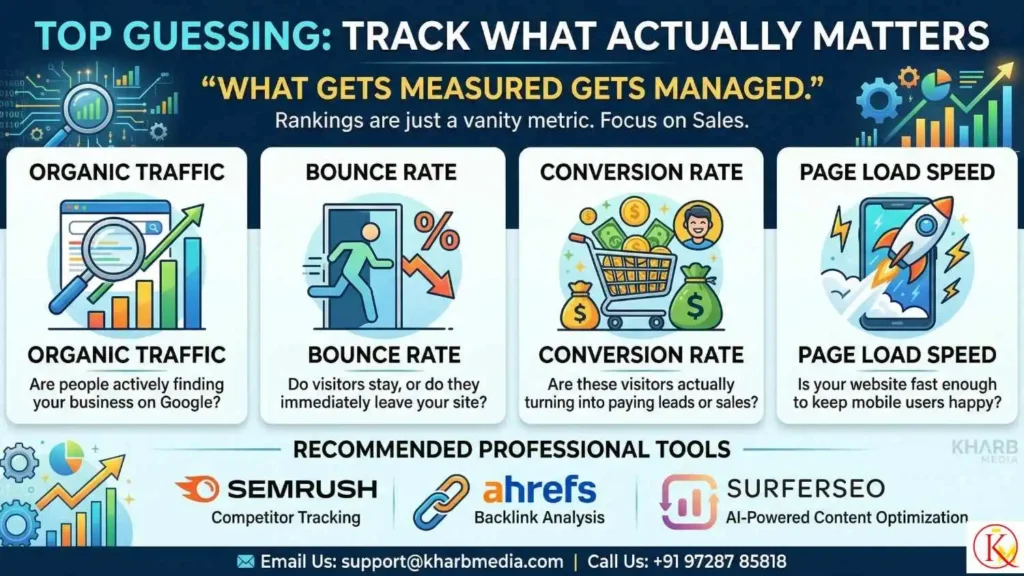
What gets measured gets managed.
If you want to ensure your strategy is working, you must track specific, actionable metrics. Rankings are just a vanity metric if they do not lead to sales.
Our team focuses on tracking:
- Organic Traffic: Are more people actively finding your business on Google?
- Conversion Rate: Are these visitors actually turning into paying leads or sales?
- Bounce Rate: Do visitors stay, or do they immediately leave your site?
- Page Load Speed: Is your website fast enough to keep mobile users happy?
Pro Tip: Never write content just for machines. Google’s E-E-A-T framework highly values actual, first-person human experience. Share your real mistakes, specific case studies, and honest wins to dominate the rankings.
To gather this data, we recommend using professional-grade tools like Semrush for competitor tracking, Ahrefs for backlink analysis, and SurferSEO for AI-powered content optimization.
Get Your Free SEO Audit Today
Digital marketing and SEO done with honesty is not a quick fix. It is a compounding asset that builds permanent value for your brand.
If your current marketing strategy feels broken, or if you are tired of agencies promising overnight results, it is time for a transparent approach.
Ready to start turning search into scale: Chat On WhatsApp
Email: support@kharbmedia.com
Call Us: +91 97287 85818
People Also Ask (FAQs)
What is the main purpose of SEO?
The main purpose is to make your business easily visible to the right people, and to turn that targeted attention into action and revenue
Why does my business need an actual SEO strategy?
Without a strategy, your efforts are just guesswork. A focused plan ties your content directly to business goals and ensures long-term, measurable success.
How does SEO improve the user experience?
SEO requires you to drastically improve page speed, simplify your site navigation, and provide high-quality answers. This keeps users happy and reduces bounce rates.
Can I stop doing SEO once I reach page one?
No. Algorithms constantly evolve, and competitors never sleep. SEO requires relentless consistency to maintain your trust and visibility.