
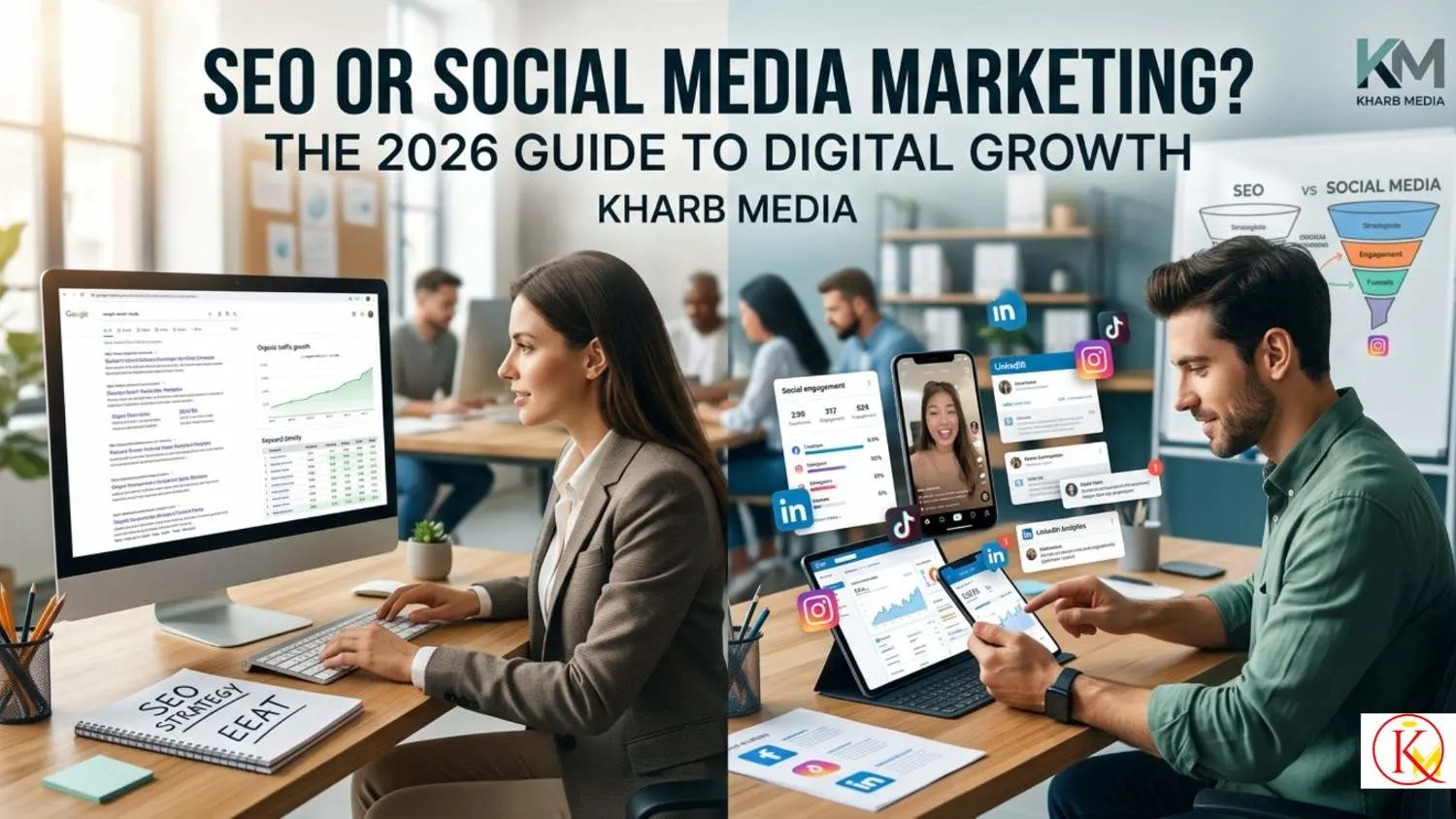
If you spend enough time around business owners, you will eventually hear a familiar debate. Someone declares that Google search is dead. Someone else claims social media is a waste of money.
And somewhere in the middle, a business owner is left wondering where to put their marketing budget before their coffee gets cold.
If you are asking yourself whether you should invest in SEO or social media marketing, you are not alone. Both strategies promise visibility, leads, and revenue. Both require time, effort, and consistency. But they work in entirely different ways.
With over 15+ years of combined experience, our team at Kharb Media has seen how the digital world evolves. We have helped countless businesses navigate this exact decision.
In 2026, the old comparison is outdated. It is like asking whether you should buy shoes or socks. You can technically choose one, but you will not enjoy the results.
Today, people search, and people scroll. They check Google, watch TikToks, and read LinkedIn posts—usually all within the same buying journey.
In this ultimate guide, our senior strategists will break down exactly how each channel works, the differences in ROI, and how to combine them into a winning strategy.
Table of Contents
What is Search Engine Optimization (SEO) in 2026?
Traditionally, SEO meant optimizing your web pages for Google. You targeted keywords, built backlinks, fixed technical errors, and slowly climbed the search engine results pages (SERPs).
It was predictable. It was linear.
But search in 2026 is no longer limited to a single platform. Today, SEO is a method for improving your website’s visibility across multiple search environments, including AI overviews (AEO) and traditional engines.
This visibility drives organic traffic. These are the highly motivated users who find your website without clicking on paid ads.
A strong SEO strategy today includes:
- On-page SEO: Researching high-intent keywords and writing top-tier content that answers user questions perfectly.
- Off-page SEO: Acquiring links from reputable sources to show search engines that your brand is trustworthy (building your E-E-A-T).
- Technical SEO: Ensuring your site is lightning-fast, mobile-optimized, and easy for search engine bots to read.
When implemented correctly, SEO is a long-term growth engine. It delivers steady, sustained, and highly profitable traffic for years.
What is Social Media Marketing in 2026?
Social media marketing is the practice of using platforms like Facebook, Instagram, LinkedIn, X, and TikTok to market your brand.
But it is not just about posting cute graphics and hoping they go viral. Today, social media platforms behave far less like casual networks and far more like discovery engines.
People type questions directly into TikTok or YouTube. They check Instagram comments before buying a product. They judge B2B brands based on how active their leadership team is on LinkedIn.
Social media marketing is built around three pillars:
- Engagement and Relationships: Building two-way communication through comments, direct messages, and authentic community building.
- Brand Awareness: Increasing your visibility by showing up in user feeds with highly relevant, visual content.
- Social Commerce: Driving instant traffic and even closing sales directly inside the social apps.
Social media puts your brand in front of thousands of people instantly. It creates momentum and buzz at a speed that SEO simply cannot match.
SEO vs Social Media Marketing: The 4 Critical Differences
When weighing SEO or social media marketing, you have to understand that they are not competing for the same job. They influence the same customer, but at different moments.
Our team at Kharb Media breaks down the differences into four key areas:
1. Content and User Intent
The content that wins on Google is very different from the content that wins on Instagram.
SEO Content: This content is informative, research-backed, and highly structured. Users want direct answers to specific questions without clicking multiple links. Long-form content (1500+ words) that properly targets keywords performs best here.
Social Media Content: Social content sparks emotion. Whether it is awe, humor, or inspiration, emotional responses drive engagement. Content here is short, visually striking, and easy to consume.
2. Audience Targeting
How you find your audience changes drastically depending on the channel.
SEO Audience: Users are actively seeking information. You do not need to interrupt them; you just need to be the best answer when they search. You create content based on marketing personas and the specific questions your ideal buyers are asking.
Social Media Audience: User behavior is passive. People do not open Instagram with a specific buying plan. Therefore, you rely on precise demographic targeting, interests, and behaviors to put your brand in front of consumers who aren’t actively searching yet.
3. Success Rate and Timeframe
This is where the SEO or social media marketing debate gets heated. The measurement of success happens on completely different clocks.
SEO Timeframe: Success is a slow, rewarding process. It takes months—sometimes over a year—to gain enough authority to rank for highly competitive keywords. But once you rank, the traffic is steady and free.
Social Media Timeframe: You can upload a post today and see engagements in real-time. Paid social ads can generate sales by lunchtime. However, the content is ephemeral. A post from yesterday is already buried at the bottom of the feed.
4. Key Metrics
How do you know if your marketing strategy is working?
SEO Metrics: You track organic search rankings, monthly website traffic, and conversion rates. Social Media Metrics: You focus on shares, comments, likes, follower growth, and immediate click-through rates.
The Battle of ROI: Which Drives Better Conversions?
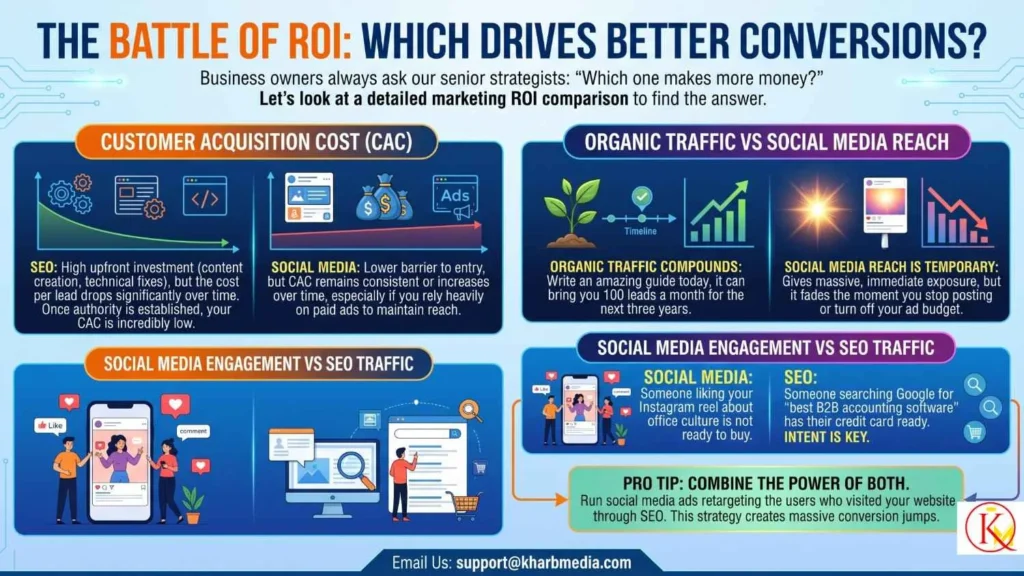
Business owners always ask our senior strategists: “Which one makes more money?”
Let’s look at a detailed marketing ROI comparison to find the answer.
Customer Acquisition Cost (CAC)
SEO: High upfront investment (content creation, technical fixes), but the cost per lead drops significantly over time. Once authority is established, your CAC is incredibly low.
Social Media: Lower barrier to entry, but CAC remains consistent or increases over time, especially if you rely heavily on paid ads to maintain reach.
Organic Traffic vs Social Media Reach
When looking at organic traffic vs social media reach, the main difference is sustainability.
Organic traffic compounds. If you write an amazing guide today, it can bring you 100 leads a month for the next three years.
Social media reach is temporary. It gives you massive, immediate exposure, but it fades the moment you stop posting or turn off your ad budget.
Social Media Engagement vs SEO Traffic
When analyzing social media engagement vs SEO traffic for conversion rates, SEO almost always wins.
Why? Because of intent.
Someone liking your Instagram reel about office culture is not ready to buy. But someone searching Google for “best B2B accounting software” has their credit card ready.
Pro Tip: Combine the power of both. Run social media ads retargeting the users who visited your website through SEO. This strategy creates massive conversion jumps.
When to Choose SEO vs Social Media (The Decision Framework)
Still wondering whether to prioritize SEO or social media marketing? Here is the exact framework our team at Kharb Media uses for our clients.
Choose Social Media When:
- You Need Brand Awareness Fast: If you are a new brand with zero reputation, waiting six months for Google to trust you is painful. Social media gets you instant eyeballs.
- You Are Launching a Product: If you have a flash sale or a time-sensitive event, social media marketing is your fastest path to revenue.
- You Have a Highly Visual Product: Fashion, food, and fitness brands thrive on visual storytelling.
Choose SEO When:
- You Want Predictable Revenue: If your goal is to generate consistent, daily leads without paying for every click, SEO is the undisputed king.
- You Sell High-Ticket Services: B2B companies, legal services, and consultants rely on trust. Decision-makers search for solutions; they don’t buy enterprise software based on a TikTok dance.
- You Want Long-Term Authority: SEO builds digital real estate that competitors cannot easily buy their way into.
Ready to stop guessing and start growing? Whether you need high-intent search traffic or viral social growth, our team has the blueprint.
Claim Your Free Digital Growth Strategy with Kharb Media Today: Emai Us : support@kharbmedia.com
Social SEO: The 2026 Game-Changer
Here is the secret most marketing agencies will not tell you: the line between these two channels has completely blurred.
Welcome to Social SEO.
Social SEO is the practice of optimizing your social media content so it ranks in search engines-both inside the social platforms and on Google.
TikTok, YouTube, and LinkedIn are now massive search engines. Users are typing specific queries into the search bars of these apps. If you optimize your social captions, alt text, and hashtags with high-volume keywords, your videos will rank for those queries.
Furthermore, Google now indexes social media posts. A highly engaging LinkedIn post or YouTube short can easily appear on page one of Google results.
Search Everywhere Optimization™: Kharb Media’s Winning Strategy
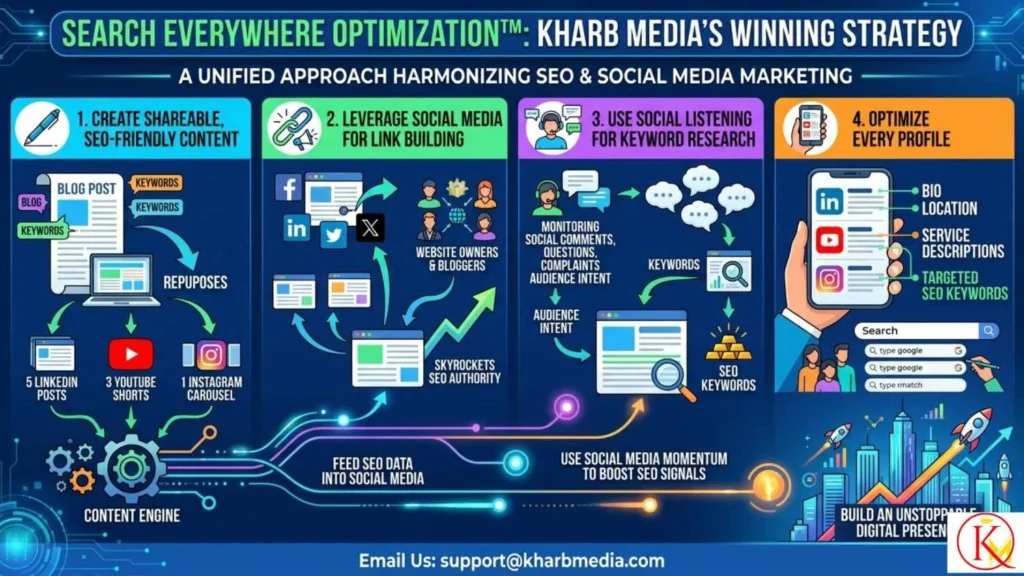
In 2026, the smartest businesses do not choose between SEO or social media marketing. They use a unified approach.
We call this Search Everywhere Optimization. Here is how our experts harmonize these efforts:
1. Create Shareable, SEO-Friendly Content We write in-depth, keyword-optimized blog posts for your website. Then, we chop that 2000-word article into five LinkedIn posts, three YouTube Shorts, and an Instagram Carousel. One piece of content fuels both engines.
2. Leverage Social Media for Link Building Sharing your high-quality content on social platforms puts it in front of other website owners and bloggers. When they see your data and link to it from their own websites, your SEO authority skyrockets.
3. Use Social Listening for Keyword Research Social media is a goldmine for audience intent. We monitor the comments, questions, and complaints your target audience shares on social media. Then, we use those exact phrases as SEO keywords for your website content.
4. Optimize Every Profile We ensure every social media profile you own contains targeted SEO keywords. Your bio, location, and service descriptions must match what people type into Google.
By feeding your SEO data into your social media strategy, and using social media momentum to boost your SEO signals, you build an unstoppable digital presence.
Pros and Cons: The Honest Truth
To summarize, let’s look at the raw pros and cons of each channel.
SEO Pros & Cons
Pros:
- Drives high-intent, purchase-ready traffic.
- Highly cost-effective in the long run.
- Builds massive brand trust and authority.
Cons:
- Requires patience (results take months).
- Highly technical and requires expert execution.
Social Media Marketing Pros & Cons
Pros:
- Instant reach and immediate gratification.
- Incredible for community building and humanizing your brand.
- Fast testing ground for new products or messaging.
Cons:
- Content lifespan is extremely short.
- Lower immediate purchase intent from users.
- Requires relentless, ongoing content creation.
Final Verdict: Which Should You Choose?
Summing it up, the debate over SEO or social media marketing shouldn’t be a matter of choice. It should be a strategy of synergy.
If you choose SEO alone, you get reliable traffic but miss out on cultural relevance and fast brand building. If you choose social media alone, you get instant attention but lose the compounding, passive value of search traffic.
The reality? Brands that leverage both methods together win the modern digital landscape.
SEO captures demand when someone is ready to buy. Social media creates that demand long before the search ever happens.
Ready to Dominate Your Market in 2026?
Stop wasting time trying to guess the algorithms. If you want a clear roadmap that combines the best of SEO or social media marketing, our team at Kharb Media is ready to help.
We will audit your current digital footprint, identify massive growth opportunities, and build a custom strategy that drives real revenue.
Contact Kharb Media Today:
Email: support@kharbmedia.com
Frequently Asked Questions (People Also Ask)
What is the main difference between SEO vs social media marketing?
SEO brings long-term organic traffic from users actively searching for answers. Social media drives instant audience engagement and brand awareness from users casually browsing.
Which platform offers a better marketing ROI comparison?
In a marketing ROI comparison, SEO offers higher returns over time because traffic compounds without ongoing ad spend. Social media requires continuous effort and investment for sustained results.
Which one drives better conversions: social media engagement vs SEO traffic?
SEO traffic generally results in higher-quality, purchase-ready leads because of user intent. However, retargeting those SEO visitors with social media ads creates the highest conversion rates overall.
Can SEO and social media marketing work together?
Absolutely. This is the foundation of digital growth in 2026. Social media amplifies your content reach, which builds backlinks and social signals that ultimately boost your SEO search presence.
How does organic traffic vs social media reach affect my budget?
Organic traffic requires upfront investment (content and technical SEO) but very low maintenance cost. Social media reach requires either constant daily labor or a steady paid advertising budget to keep your brand visible.