
Raise your hand if you spend way too much time scrolling through your phone. Doctors, nurses, and pharmacists do it too. Healthcare providers (HCPs) are on social media for personal relaxation and professional growth.
With over 15+ years of combined experience, our team at Kharb Media has seen how the digital world changes. In 2026, old-school advertising does not work anymore. To reach medical experts, you need a smart, targeted plan.
This comprehensive guide will show you exactly how to execute social media marketing for healthcare professionals/hcps to build trust, stay compliant, and scale your brand.
Table of Contents
Understanding the Unique Digital Behavior of HCPs
Medical professionals are not typical consumers. They are highly informed, very busy, and skeptical of unverified data. They look for evidence-based insights and professional discussions.
Our senior strategists have executed campaigns across both Western and Eastern markets. We know that HCPs log onto social platforms with two distinct mindsets:
- White Coat Moments: When they look for clinical updates, research summaries, and peer networks.
- Blue Jeans Moments: When they unwind at home and scroll through standard feeds.
To win their attention, your content must fit both moments perfectly.
Why Specialized Healthcare Marketing is Required in 2026
Reaching the right doctor at the right time is hard. They have irregular schedules and ignore generic ads. In 2026, successful brands use hyper-targeted, hyperlocal approaches.
Example: If flu cases are high in New York but low in California, you should not waste your ad budget showing flu-treatment ads to California doctors.
Generic social ad managers cannot handle this level of medical targeting. That is why specialized digital strategies are mandatory.
The Power of Social Platforms in the HCP Journey
Recent data shows that 90% of physicians use social media for personal reasons, and 65% use it professionally. Over 71% of healthcare professionals regularly use mainstream social networks.
By adding social media to an omni-channel campaign, you reinforce your brand message where doctors spend their free time. It builds familiarity and trust over the long term.
Platform Breakdown: Where Do Medical Experts Gather?
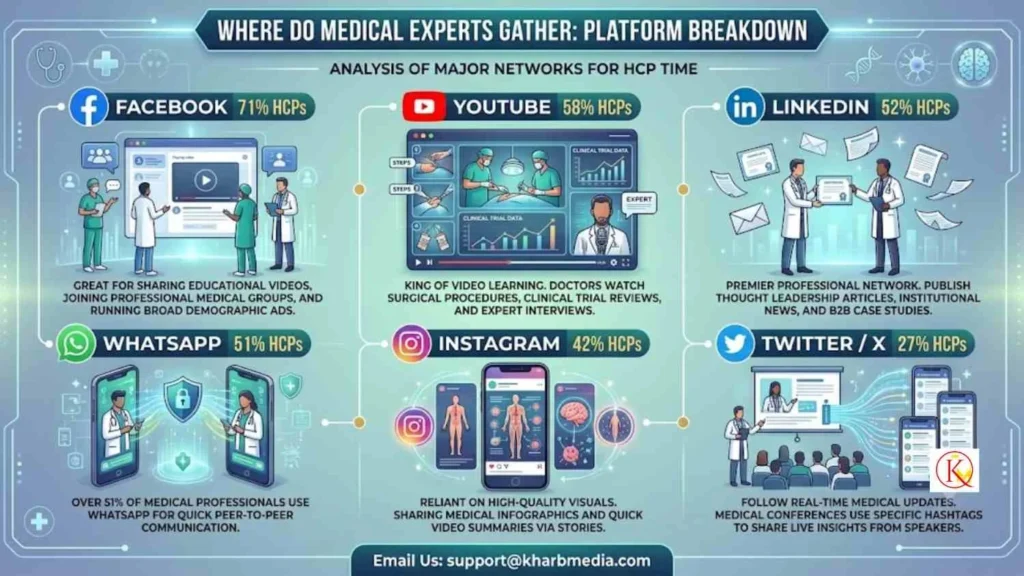
Our team has analyzed the major networks to see where healthcare providers actually spend their time.
Surprisingly, over 71% of surveyed HCPs regularly use Facebook. It is great for sharing educational videos, joining professional medical groups, and running broad demographic ads.
YouTube
Used by 58% of HCPs, YouTube is the king of video learning. Doctors use it to watch surgical procedures, clinical trial reviews, and expert interviews.
With 52% of HCPs active, LinkedIn is the premier professional network. This is the best place to publish thought leadership articles, institutional news, and B2B case studies.
Over 51% of medical professionals use WhatsApp for quick peer-to-peer communication. It must be used carefully since it is a highly personal space.
Used by 42% of HCPs, Instagram relies heavily on high-quality visuals. It is perfect for sharing medical infographics and quick video summaries via Stories.
Twitter / X
Around 27% of HCPs use X to follow real-time medical updates. Medical conferences use specific hashtags to share live insights from speakers.
Clinically Focused Platforms (Doximity, Sermo, Medscape)
About 20% of HCPs prefer private, physician-only networks. Platforms like Sermo and Doximity verify credentials during registration. They allow secure peer-to-peer consulting without the lay public watching.
TikTok & Reddit
TikTok (10%) and Reddit (5%) are smaller but growing spaces. TikTok works well for reaching younger medical students, while Reddit hosts deep, anonymous clinical debates.
Creating High-Value, Educational Content
HCPs are hit with information overload every single day. If your content looks like a basic sales pitch, they will scroll past it.
Our senior content team works closely with medical experts to produce high-value resources:
- Educational Summaries: Turn 50-page clinical trial PDFs into clear, 1-page summaries.
- Industry Breakthroughs: Share instant updates on newly approved treatments or regulatory guidelines.
- Concise Visuals: Use sharp infographics to let busy doctors absorb key takeaways in under 5 seconds.
Benefits of Social Media for Healthcare Brands
When done correctly, digital marketing brings huge advantages to medical institutions and individual providers:
Professional Networking & Crowdsourcing
Social networks let doctors connect globally. A specialist in a Western country can share real-time surgical tips via a live stream with a doctor in a developing nation.
Organizational Promotion
Over 70% of US healthcare organizations use social media. A strong online presence proves to patients that an institution uses modern, cutting-edge technologies.
Public Health Tracking
Organizations like the CDC track keyword patterns on social media to spot flu outbreaks early. Real-time updates help disaster response teams move quickly during emergencies.
The Hidden Dangers of Healthcare Social Media
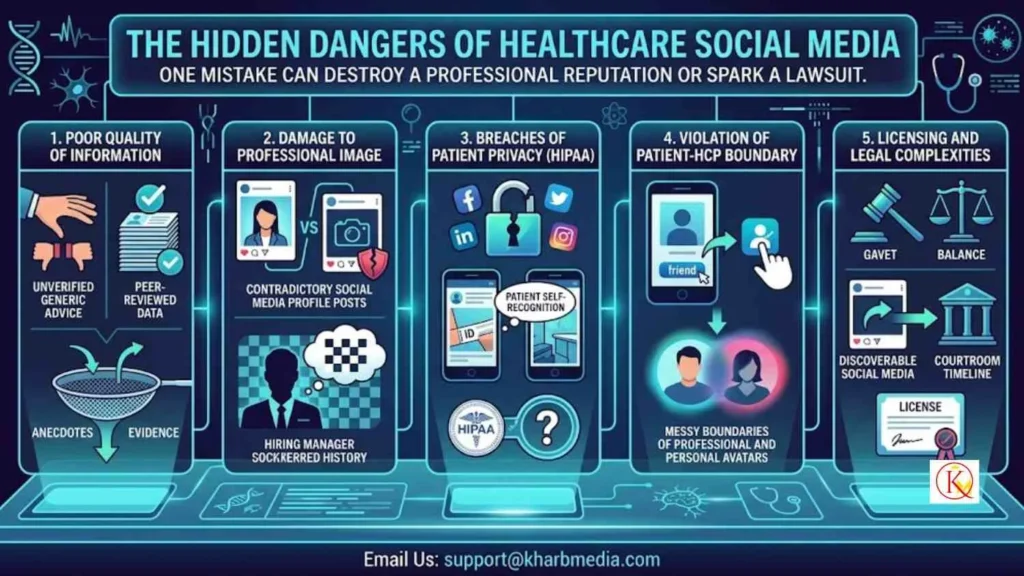
While the opportunities are massive, the risks are equally high. One mistake can destroy a professional reputation or spark a lawsuit.
1. Poor Quality of Information
The internet is full of unverified, informal health advice. Social media often highlights single patient anecdotes over evidence-based medicine. Brands must always cite peer-reviewed data to stand out as trustworthy sources.
2. Damage to Professional Image
Venting about difficult patients or posting inappropriate photos can ruin a medical career. Residency programs and hospital employers routinely search social media profiles before hiring.
3. Breaches of Patient Privacy (HIPAA)
Sharing patient details, photos, or specific case locations without consent violates federal privacy laws. Even if you do not mention a name, a patient might still recognize themselves.
4. Violation of the Patient-HCP Boundary
Accepting personal “friend” requests from active patients blurs professional boundaries. It can lead to ethical issues and biased clinical judgments.
5. Licensing and Legal Complexities
State medical boards frequently discipline providers for online misconduct or for giving specific medical advice to non-patients online. Anything you write on a public platform is legally discoverable in a court of law.
Compliance and Professional Guidelines
To stay safe, our team strictly adheres to the frameworks established by top medical authorities.
Institutional Policies
Hospitals and clinics must create clear social media handbooks for their staff.
| Policy Focus Area | Mandatory Requirement |
| Brand Representation | Employees must state that their views do not represent the hospital. |
| Patient Privacy | No patient-specific data or photos can be posted without a signed HIPAA form. |
| Conflict of Interest | Full disclosure of any financial ties or sponsored content is mandatory. |
Professional Association Standards
- American Medical Association (AMA): Advises separate personal and professional profiles, strict privacy settings, and maintaining patient boundaries.
- American Society of Health-System Pharmacists (ASHP): Requires pharmacists to provide clinical advice online only when a complete medical history is known.
- Federation of State Medical Boards (FSMB): Warns that once data is posted online, it can spread forever and impact your medical license.
Why Meta’s Ad Manager Alone Is Not Enough
Many marketers make the mistake of using standard Meta (Facebook/Instagram) targeting for their campaigns. It rarely works for B2B medical marketing.
Standard social media platforms are built for lifestyle targeting, not clinical targeting. They cannot tell you if a user is a cardiologist who prescribes a specific drug.
What to Look For in a Real HCP Activation Solution
To successfully execute social media marketing for healthcare professionals/hcps, you need a system that integrates health-focused data:
- NPI Verification: The tool must match National Provider Identifier (NPI) numbers directly to active social media profiles.
- Real-Time Behavioral Tracking: The ability to target doctors based on real clinical actions, like recent brand website visits or specific prescriptions written.
- Granular Analytics: Dashboards that report exact NPI-level engagement, showing you which specialties and facilities are clicking your ads.
Our senior strategists partner with advanced programmatic data providers to build verified NPI target lists. This data-driven precision ensures your ad dollars are only spent on genuine, qualified medical professionals.
Strategic Tactics to Boost Your Digital Engagement
Here are three proven methods our team uses to make healthcare campaigns highly interactive.
Promote Patient-Powered Networks
Guide your audience toward platforms like PatientsLikeMe. These forums allow patients to swap real-world stories while connecting with reputable health systems in a safe space.
Live-Tweeting/Streaming for Education
Have your leading physicians live-tweet during medical conferences or stream educational Q&A sessions. It establishes your institution as a leading voice in medicine.
Leverage Medical Hashtags
Use tracked medical hashtags like #HCSM (Healthcare Social Media) or #MDChat. This helps your content appear instantly when researchers and doctors search for industry trends.
Measuring Success: Metrics That Actually Matter
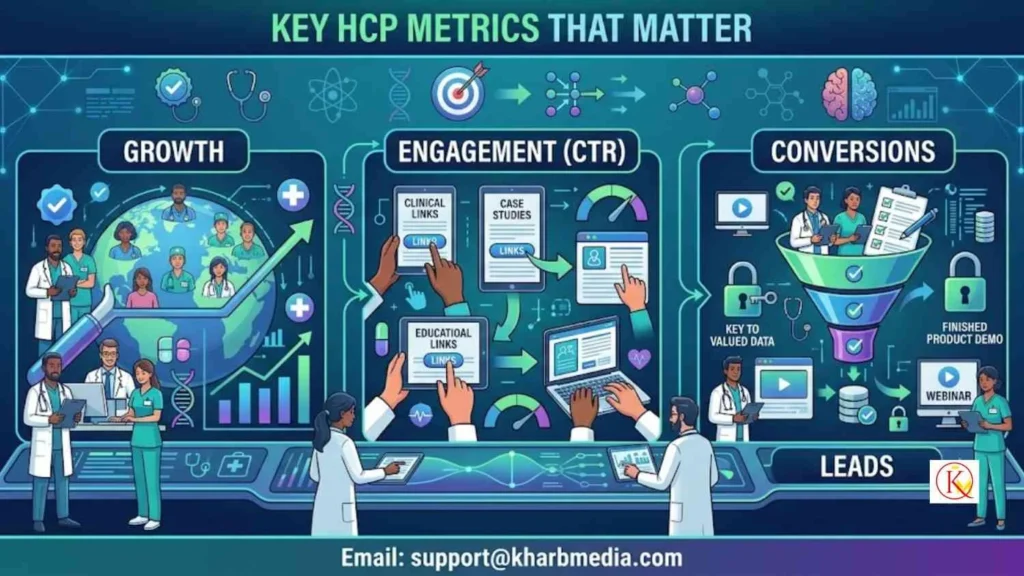
We do not care about vanity metrics like random “likes” from the general public. Our team tracks data that directly connects to your business goals:
- Segmented Follower Growth: Tracking how many verified doctors and nurses join your community over time.
- Click-Through Rate (CTR): Measuring how many HCPs click your educational links to access deeper clinical resources.
- Lead Generation & Conversion: Tracking how many providers sign up for your webinars, medical downloads, or product demonstrations.
Build Your Custom Growth Strategy Today
Mastering social media marketing for healthcare professionals/hcps requires a perfect balance of deep medical data, strict regulatory compliance, and highly engaging human writing. You cannot leave your digital reputation to chance or generic agencies.
With over 15+ years of combined experience, our team at Kharb Media knows exactly how to navigate the complex world of medical marketing. We build highly targeted, fully compliant campaigns that respect the time of busy professionals while driving measurable clinical ROI for your brand.
Stop guessing with your digital marketing budget. Let our senior strategists build a custom roadmap for your healthcare business.
Claim Your Free Digital Growth Strategy Email Us: support@kharbmedia.com
People Also Ask
Why should HCPs use social media?
For professional networking, patient education, and improving clinical care.
Which platforms are most popular for HCPs?
Facebook is the most used (71%), followed by YouTube (58%) and LinkedIn (52%).
How do you stay HIPAA compliant online?
Always “de-identify” patient data by removing names, photos, and specific locations, and get written consent before posting.
Why are standard Facebook ads not enough?
Standard ads lack clinical targeting. To reach the right doctors, you need to match National Provider Identifiers (NPIs) directly to social accounts.