
If you are a professional photographer, you already know that snapping the perfect photo is only half the job.
Today, getting your work in front of paying clients is the real challenge. Social media marketing for photographers involves leveraging platforms like Instagram, Facebook, Pinterest, TikTok, and others to showcase your work, connect with potential clients, and build a strong online presence. But if you’ve been searching for a solution, let us be clear: the answer is not posting more, chasing trends, or relying on the algorithm alone.
With over 15+ years of combined experience, our team at Kharb Media has seen firsthand how creative professionals exhaust themselves trying to go viral. Strategic social media marketing for photographers requires positioning, content systems, SEO integration, automation, and clear conversion pathways working together.
Table of Contents
If you are ready to stop guessing and start treating your social profiles like a predictable growth engine, this guide is for you.
Bonus: Ready to skip the guesswork? Claim Your Free Digital Growth Strategy with our expert team today email us : support@kharbmedia.com
Why Most Photographers Struggle With Social Media Marketing
Many photographers assume that their social media activity is failing because they lack creativity, but they are actually struggling because they lack structure. Posting frequently is not a strategy; visibility without direction rarely leads to conversion.
Here is why you might be hitting a plateau:
1. Posting Without Positioning
A feed filled with beautiful work does not automatically communicate value. When your messaging remains broad, potential clients admire the work without feeling compelled to inquire.
Social media marketing for photographers becomes powerful when content reinforces a clear identity. A luxury photographer communicates differently than a budget-focused provider. Without clear positioning, your content simply blends into the noise.
2. Chasing Algorithms Instead of Building Assets
Algorithms reward trends, speed, and engagement spikes, but those elements rarely create stability. When your strategy revolves around staying visible inside one platform, growth depends on factors you cannot control.
Social media marketing for photographers should support long-term authority, not constant reaction. Relying entirely on platform performance creates emotional volatility, where engagement rises one week and drops the next.
3. Burnout From Inconsistent Strategy
Creative energy fluctuates, and posting without a framework magnifies that inconsistency. Content feels urgent one week and overwhelming the next.
A defined social media strategy reduces pressure. When planning supports a core purpose, consistency becomes sustainable.
What Strategic Social Media Marketing for Photographers Actually Looks Like
Effective social media marketing for photographers does not begin with trends; it begins with clarity. Strategic social media connects brand positioning, audience intent, and conversion goals into one cohesive structure.
The Four Pillars of Content
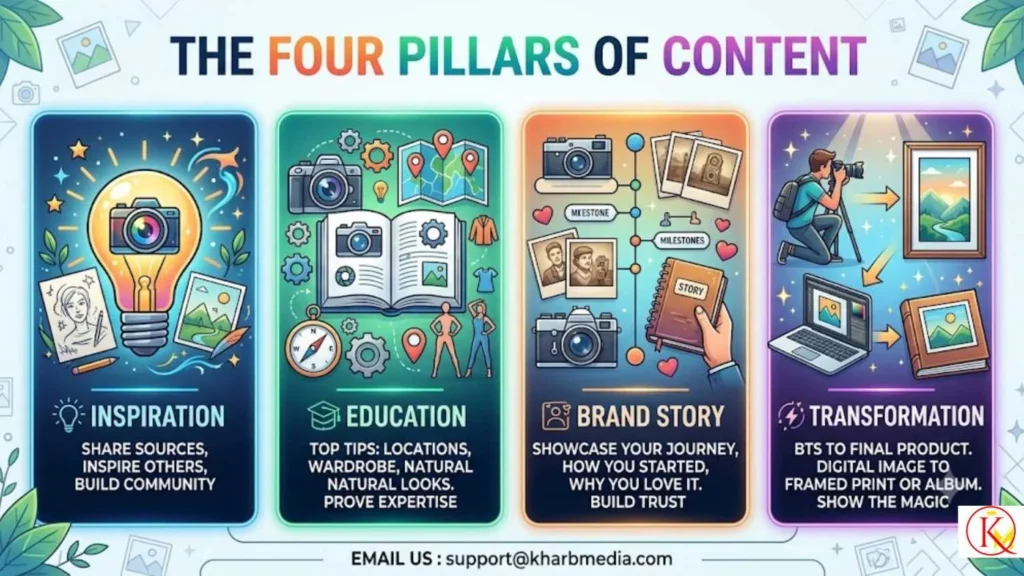
To create an engaging and meaningful online presence, your social media posts should be built around four main pillars:
- Inspiration: Share your sources of inspiration and how your work inspires others. This builds a sense of community around mutual passions.
- Education: Provide top tips on scouting locations, wardrobe choices, or looking natural in front of the camera. Educational content proves your expertise and helps potential clients understand the effort behind your images.
- Brand Story: Showcase your journey by sharing how you got started and why you love what you do. A relatable brand story forms an emotional connection and establishes trust.
- Transformation: Take your audience on a journey from behind-the-scenes action to the final product. Show them the magic of turning a digital image into a stunning framed print or keepsake album.
Consistent Messaging and Brand Voice
Visual consistency attracts attention, but verbal consistency builds trust. Captions, story sequences, and profile descriptions should reflect the same tone across all platforms.
Whether your tone is professional, friendly, humorous, or inspirational, it should reflect your personality and resonate with your target audience. Clear messaging eliminates ambiguity and guides users toward inquiries.
The Best Social Media Platforms for Photographers in 2026
You don’t need to be on every platform. You need to be on the ones where your dream clients hang out and where your content actually performs.
1. Instagram: Visual Portfolio & Social Proof
Instagram remains one of the most visible platforms for creative work. It’s where people go to check your vibe before they book.
- Reels: Aim for 6-30 seconds with a punchy hook and on-screen text.
- Carousels: Use 5-10 frames, starting with a strong headline and ending with a CTA.
- Stories: Use question polls and client FAQs to drive direct interactions.
2. Pinterest: Evergreen SEO Traffic
Pinterest is a visual search engine, meaning one good post can drive traffic for months or even years.
- Best for: Wedding, portrait, and branding photographers.
- Strategy: Create vertical pins (e.g., 1000×1500) and add keyword-rich titles and descriptions that a client would search for.
3. TikTok & YouTube: Video Authority
TikTok is a storytelling platform that rewards authenticity. Hook your viewers in the first 3 seconds with a compelling moment.
YouTube is a long-game move, but it is incredibly powerful for building trust and SEO visibility. Google indexes YouTube content, making it excellent for video SEO. Try posting gear reviews, BTS walkthroughs, or client FAQs.
4. Facebook: Local Bookings & Community
Facebook is still highly useful for local networking.
- Join 3-5 local groups (venues, parent communities) and post helpful answers weekly.
- Create Events for mini-sessions or holiday promos.
- Upload vertical video, as Facebook distributes most video as Reels.
5. Niche Platforms for Photographers
Don’t ignore specialized networks to build peer authority and gain backlinks:
- Behance: Connect with a global community of creatives and get discovered by commercial clients.
- 500px: Reach a community that appreciates high-quality photography and monetize your work through licensing.
- Flickr: Organize your portfolio, use keyword tags, and participate in photo challenges.
- Foto: A newer, ad-free app specifically made for artists and photographers.
How to Build a Conversion-Focused Social Media Strategy
Attention does not equal bookings. Followers do not guarantee revenue. Effective social media marketing for photographers must connect visibility to action.
1. Integrating Social Media With SEO
Social platforms should direct traffic toward assets you control, like your website and email list. Search visibility and social visibility should support one another .
Blog posts can be broken into caption series, and educational resources can become carousels. This circular structure creates momentum, where effort multiplies rather than dissipates.
2. Automating Your Workflows (CRM + AI)
Consistency builds authority, and systems protect consistency. Using AI tools can accelerate execution for caption drafting and content organization. However, the strategic direction and brand voice must remain human-led.
Connect your social platforms to a Customer Relationship Management (CRM) system. Your profile links should guide users to landing pages that collect inquiries, while automated workflows handle follow-ups and reminder emails .
Pro Tip: Your DM strategy is crucial. Use direct messages to follow up on inquiries, reach out to local venues, and re-engage past clients for holiday mini-sessions .
3. Clear Calls to Action (CTAs)
When offers remain vague, bookings stall. A conversion strategy connects content to action.
Your profile links should guide users to strategic landing pages, and your captions should encourage specific steps. Include strong CTAs like “Visit the shop,” “Download our guide,” or “Sign up today” to move followers off the app and onto your client roster .
Creating Your Social Media Content Calendar
Content becomes manageable when planning replaces improvisation. A defined calendar clarifies what will be published and why.
Step 1: Set SMART Goals & KPIs
Before you post, determine the goals behind your social presence. Turn broad objectives into SMART goals (specific, measurable, achievable, relevant, and time-bound). For example, aim to “generate five new client leads via Facebook ads in the next month”.
Focus only on KPIs that matter. Metrics like likes or followers can be shallow predictors. Instead, track profile visits, website clicks, saves, and shares, as these indicate high intent and actual value.
Step 2: Batch Creation and Scheduling
Batch creation increases efficiency. Writing captions in focused sessions reduces decision fatigue, and scheduling tools prevent last-minute scrambling.
Use tools like Hootsuite, Buffer, Later, or Sprout Social to plan content in advance. Research your analytics to determine the optimal times your audience is active online, and schedule posts to go live automatically.
Advanced Tactics: Hashtags, Paid Ads, and Contests
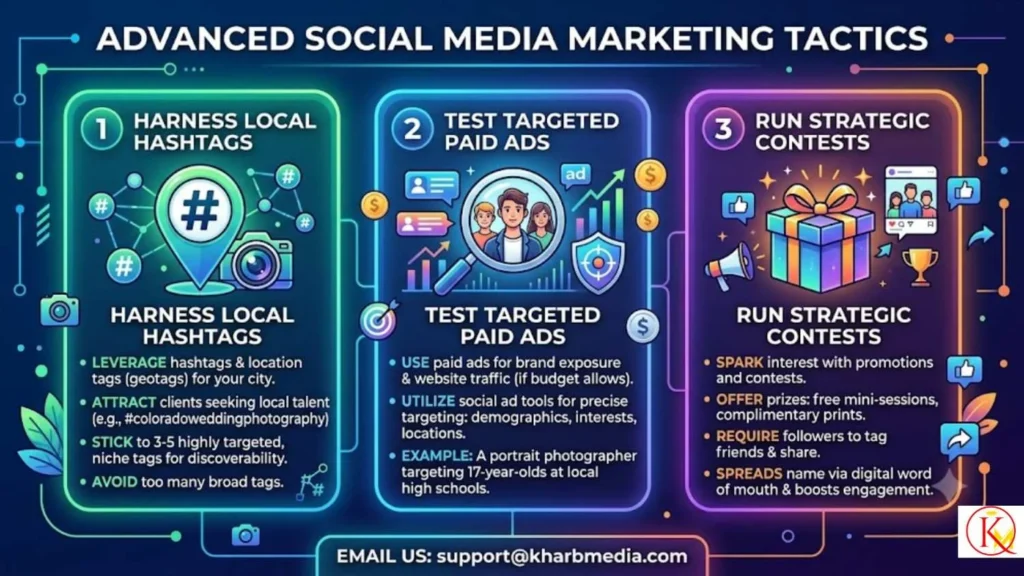
Once your foundation is secure, you can amplify your reach using advanced marketing tactics.
Harness Local Hashtags
Leverage hashtags and location tags (geotags) that relate to your specific city to attract clients looking for local talents, such as #coloradoweddingphotography. Avoid using too many broad tags; stick to 3-5 highly targeted, niche tags to improve discoverability .
Test Targeted Paid Ads
If your budget allows, paid ads can increase brand exposure and website traffic. Social media ad tools allow you to use demographics, interests, and locations to target a highly specific group. For example, if you are a senior portrait photographer, you can show ads exclusively to 17-year-olds attending your local high schools.
Run Strategic Contests
Promotions and contests are tried-and-true methods for sparking interest. Offer a free mini-session or complimentary print in exchange for followers tagging friends and sharing your post . This spreads your name through digital word of mouth and boosts engagement.
Conclusion: Transform Your Photography Business Today
Growing your photography business on social media won’t happen overnight. There is no magic formula consistency, dedication, and authentic engagement are your best allies.
By treating social media as an authority amplifier inside a larger marketing ecosystem, you can turn followers into website traffic, and passive viewers into paying clients.
If you are tired of guessing what works, let the experts handle the heavy lifting.
Ready to dominate your local market? Claim Your Free Digital Growth Strategy Email Us : support@kharbmedia.com
Also Read : Social Media Marketing for Filmmakers
Frequently Asked Questions (People Also Ask)
How often should photographers post on social media?
Frequency matters less than consistency and clarity. Posting daily without structure creates noise. Two to four intentional posts per week, supported by daily stories and engagement, often outperform sporadic bursts of content.
Should photographers hire a social media manager?
Hiring can be helpful once your positioning and messaging are clear. A social media manager executes, but the strategy must come first. Without brand clarity, outsourcing only amplifies confusion.
Is Instagram enough to grow a photography business?
No. Instagram can generate awareness, but it should not be your only growth engine. Integrating social media with SEO, email marketing, and website optimization creates balance and protects you against algorithm changes.
Can AI replace social media strategy?
AI accelerates production, but it does not replace human judgment. Social media marketing for photographers benefits from AI when it enhances clarity, speeds up caption drafting, and helps organize ideas, but strategic direction and voice must remain human-led .