
Before most travelers ever visit your official website, they have already been somewhere else: your Instagram feed.
They might have taken a TikTok tour of your resort or read a thread about your customer service on X. In today’s digital world, social media is where travel decisions start. Inspiration, research, and booking decisions now all happen in one place.
With over 15+ years of combined experience, our team at Kharb Media has seen how the right digital strategy can transform an empty hotel into a fully booked destination.
But succeeding in social media marketing for travel businesses requires more than just posting nice photos. The most effective travel brands combine storytelling, short-form video, and user-generated content to turn emotional moments into real, measurable bookings.
In this massive guide, we will break down exactly how to build a winning social media strategy for your travel business.
Table of Contents
The Role of Social Media in Tourism Marketing
Social media has fundamentally changed how people research and make decisions before going on a trip.
The days of relying solely on brochures and billboards are over. Today, people build their trust in a tourism agency based on the reviews and real experiences shared by others.
Because travel products cannot be physically examined before they are bought, social media is crucial for showing destination authenticity and building trust. It acts as the ultimate digital storefront.Pro Tip: Your response time, tone, and transparency during high-stress travel moments shape your brand perception far more than your latest advertising campaign. Social media is now your most visible customer service platform.
Step-by-Step: Building Your Travel Social Media Strategy
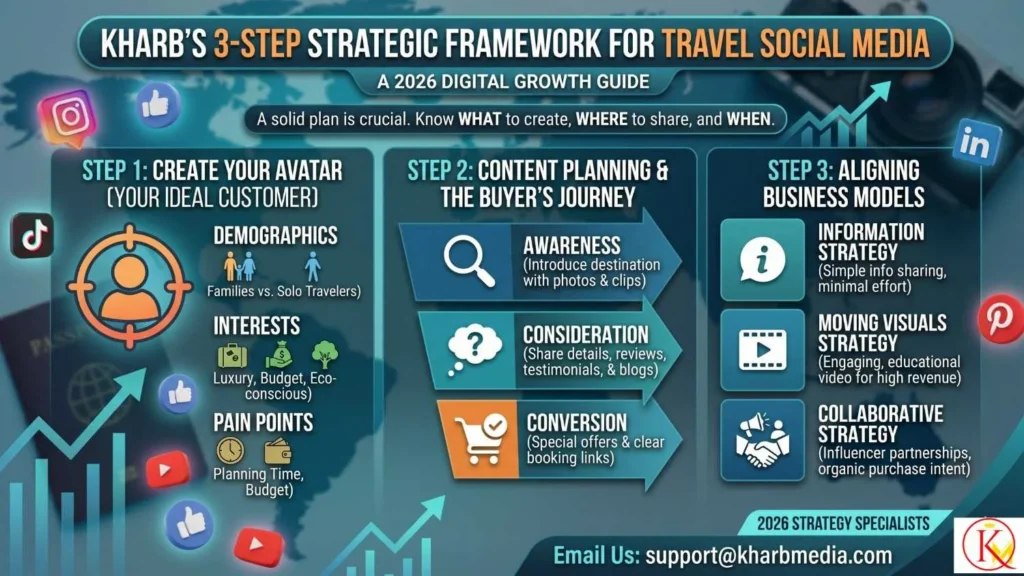
A solid plan is crucial before you start posting content. You need to know what information to create, where to share it, and when.
Our senior strategists at Kharb Media always start with a structured framework.
Step 1: Create Your Avatar (Your Ideal Customer)
You cannot market to the entire world, and you should not try to. The first step is defining your ideal customer.
- Demographics: Are they families looking for all-inclusive deals or solo travelers seeking adventure?
- Interests: Are they looking for luxury, budget trips, or eco-conscious travel?
- Pain Points: Do they struggle with finding the time to plan or staying within a budget?
Step 2: Content Planning & The Buyer’s Journey
Do not post randomly. Map your posts according to the buyer’s journey.
- Awareness Content: Introduce your destination using visually engaging content like travel photos and short clips.
- Consideration Content: Give them more details. Use reviews, testimonials, and blog posts to answer common questions.
- Conversion Content: Share special offers and clear booking links when they are ready to decide.
Step 3: Aligning Business Models
We look at three main business models for social media travel marketing:
- Information Strategy: Simple information sharing on your profiles with minimal effort and low costs.
- Moving Visuals Strategy: Publishing engaging, educational video content to generate strong engagement and revenue.
- Collaborative Strategy: Working with influencers and vloggers to spark discussions and organically drive purchase intent.
Key Strategies for Travel Marketing That Drive Bookings
How do you turn a casual scroller into a confirmed guest? Here are the top strategies you need to implement.
1. Visual Storytelling & Short-Form Video
The most effective travel content makes people imagine themselves right there in the moment.
A stunning photo of a sunset is good, but a 15-second Reel showing a couple checking in and popping champagne on the balcony is ten times better.
Short-form videos like TikToks, Reels, and YouTube Shorts are perfect for sharing POV tours, quick tips, and behind-the-scenes authentic moments.
2. User-Generated Content (UGC)
Modern travelers trust real people more than they trust promotional ads.
User-generated content is one of the best ways to get people to engage with your business. When you encourage guests to share their experiences, it builds massive trust.
Case Study: Kimpton Hotels successfully used UGC tools to share authentic moments from guests across their properties. This allowed them to scale their content creation without hiring more staff, while deeply connecting with followers.
3. Influencer Partnerships
Partnering with niche creators who align with your ideal traveler brings unmatched authenticity.
Working with travel influencers helps your business become more visible and reaches a broader audience quickly. Go beyond simple one-off posts and try to co-create content series or destination takeovers.
4. Seamless Social Commerce & Selling
Inspiration without action is just window shopping. You must make it easy for people to take the next step.
Add clear booking links to your bios, pinned posts, and Instagram Stories. Use action-driven calls to action like “Reserve your spot” or “Book your escape” instead of a basic “Learn more”.
5. Promote Sustainable Tourism
Highlighting eco-friendly and responsible travel options is becoming increasingly important to modern travelers. Building communities around niche interests, like eco-conscious travel experiences, is a great way to nurture your audience.
Best Social Media Platforms for Travel Marketing (2026 Guide)
Different platforms attract different audiences. You must tailor your content for each specific channel.
Instagram & TikTok (The Trendsetters)
- Audience: Millennials, Gen Z explorers, and trend-followers (Ages 16-35).
- How to Use: Ideal for visual storytelling, reaching younger audiences, and sharing aspirational imagery. TikTok is great for quick, punchy videos that rely on viral trends.
- Engagement Tip: Use Instagram to show off beautiful visuals, and use TikTok to spark massive top-of-funnel engagement.
Facebook (The Community Builder)
- Audience: Families, older demographics, and mid-tier professionals (Ages 35-65+).
- How to Use: Highly effective for community building, running targeted ads, and sharing detailed posts or links.
- Engagement Tip: Start conversations using polls and open-ended questions. Facebook’s Recommendations feature is also excellent for letting users share real experiences.
Pinterest (The Planning Engine)
- Audience: Dreamers, planners, and those actively in the research phase (Ages 25-45).
- How to Use: It acts as a search engine for visuals. It is perfect for driving traffic through travel guides, itineraries, and checklists.
- Engagement Tip: Pinterest users tend to convert later in the buying process, making it ideal for long-term lead nurturing.
YouTube (The Deep Dive)
- Audience: Everyone from young travelers to professionals (Ages 18-60+).
- How to Use: Suitable for long-form content, in-depth travel guides, destination overviews, and influencer reviews.
- Engagement Tip: YouTube excels at helping potential travelers clearly visualize the entire trip experience.
LinkedIn (The B2B Powerhouse)
- Audience: Corporate travelers, business executives, and travel agents (Ages 30-55).
- How to Use: This is the place for B2B marketing. Use it for corporate travel packages, conference venues, and networking.
- Engagement Tip: Reach business travelers directly based on the specific locations where you provide your services.
Real-World Data: Social Media in the Cruise Industry
To show exactly how this works, let’s look at recent research conducted within the cruise industry regarding platform usage and engagement.
- Most Used Platform: Facebook was the most popularly used channel, bringing in the highest percentage of social traffic for most cruise brands.
- Posting Frequency: The standard posting frequency was about 35 posts per month.
- Highest Engagement: Instagram generated the highest overall engagement, averaging 1,447 likes and 119 comments per month.
- Top Performer: Carnival Cruises had the best Facebook engagement metrics, securing an average of 661 likes and over 1,000 comments per post.
- Worst Performer: Twitter (X) scored poorly for engagement across almost every brand analyzed.
The takeaway? Not every social media channel is created equal. You must focus your energy on the platforms that sync up with your specific goals and target audience.
Elevate Customer Care & Protect Your Brand
In the travel industry, every single experience—whether good or bad—can play out publicly.
It is one thing for a customer to complain privately; it is another for them to tag your brand, mention news outlets, and go viral before your team even notices.
When travelers face delays or issues, they expect a real answer from a real human, and they expect it fast.
Case Study: When Aeromexico implemented unified social care tools, they could view, prioritize, and respond to DMs, tags, and comments from one dashboard. This led to faster response times and a much stronger brand reputation during critical moments.
Responding quickly to comments and direct messages is crucial because they are often real-time pre-booking inquiries. Solving customer problems kindly directly leads to a better company reputation.
Key Metrics to Monitor & Measuring ROI
If you are just tracking likes and comments, you are flying blind. You must connect your social media efforts directly to actual bookings.
Our team at Kharb Media focuses on these critical metrics:
- Engagement Rate: Track your likes, comments, shares, and saves to see what content resonates.
- Website Traffic: Monitor the number of visitors moving from your social platforms to your actual booking site.
- Conversion Rate: This is the number of real bookings resulting from social media, usually tracked using tools like Google Analytics.
- Return on Ad Spend (ROAS): A critical metric for paid campaigns to measure your exact return on investment.
Case Study: TUI, one of the largest global travel companies, used advanced analytics to lower their cost per engagement by 81%. They stopped relying on surface-level metrics and dug into content performance and audience insights to drive real business outcomes.
Claim Your Free Digital Growth Strategy
Social media is no longer just for selfies and viral dances; it is a powerful tool to reach the right audience and grow your business.
Whether you need to boost your organic reach, launch high-converting paid ads, or build a bulletproof brand reputation, you need an expert team in your corner.
With over 15+ years of combined experience, our senior strategists at Kharb Media know exactly how to turn your social media followers into loyal, paying guests. Stop guessing and start scaling.
Ready to dominate your market? Claim Your Free Digital Growth Strategy today email us : support@kharbmedia.com
People Also Ask (FAQs)
Why is social media marketing so important for travel businesses?
Most travelers discover destinations on social platforms long before they visit a website. A strong strategy captures attention early, builds trust, and guides followers from dreaming about a trip to finally reserving it.
Can social media really drive bookings, not just awareness?
Yes. By using strategic retargeting ads, seamless social commerce (like booking links in bios), and clear calls to action, social media acts as a highly effective direct response channel.
How do travel businesses build engaged communities?
You build a community by showing up like a human, not a billboard. This means nurturing niche audiences, responding quickly to questions, and joining conversations that travelers are already having online.
What type of content works best for travel social media?
Content that tells a story, showcases real authentic moments, and evokes emotion performs best. Short-form video and user-generated content are the top drivers for engagement.